Budgeting methods often fail because they treat income and expenses as fixed, static numbers.
Real-world finances are messy: insurance premiums jump unexpectedly, car tires wear down, income fluctuates month to month, and inflation shifts baseline grocery and utility costs.
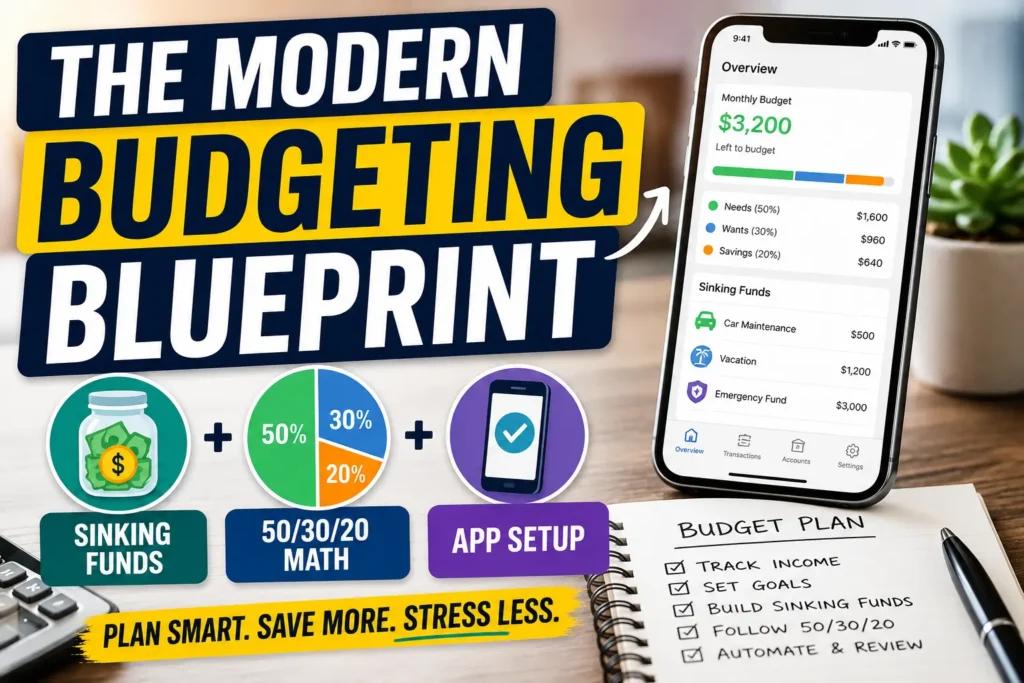
To build a financial plan that survives real life, you need three core elements:
- A realistic baseline budget adjusted for current post-inflation living expenses.
- A sinking fund framework that eliminates surprise bills before they happen.
- The right tool (YNAB vs. Monarch Money) to handle your income type.
Here is a practical, guide to setting up your personal finance ecosystem.
1. Post-Inflation 50/30/20 Budget Examples ($50k, $70k, $100k)
The 50/30/20 rule divides your net post-tax income into three buckets:
- 50% Needs: Non-negotiable survival expenses (housing, utilities, transportation, minimum debt payments, groceries).
- 30% Wants: Discretionary lifestyle spending (dining out, entertainment, travel, subscriptions).
- 20% Savings & Debt Payoff: Emergency funds, investments, and principal debt payments beyond the minimum.
Below are realistic breakdowns based on typical US federal, state, and payroll tax rates (~18%–22% effective tax burden) and current post-inflation living costs.
Post-Tax Monthly Budget Breakdown
| Gross Annual Salary | Net Monthly Take-Home Pay | 50% Needs Limit | 30% Wants Limit | 20% Savings & Debt Limit |
| $50,000 / year | ~$3,300 / month | $1,650 / mo | $990 / mo | $660 / mo |
| $70,000 / year | ~$4,500 / month | $2,250 / mo | $1,350 / mo | $900 / mo |
| $100,000 / year | ~$6,300 / month | $3,150 / mo | $1,890 / mo | $1,260 / mo |
In-Depth Example: The 50/30/20 Rule on a $70,000 Salary
On a $70,000 gross salary, your net take-home pay is approximately $4,500 per month (assuming single filer status with average state tax and standard 401(k) deductions). Here is how a realistic monthly budget allocates that money:
NET MONTHLY TAKE-HOME: $4,500
50% NEEDS ($2,250)
- Rent / Mortgage + Insurance: $1,450
- Electric, Water, Internet: $250
- Groceries & Hygiene: $350
- Transportation (Gas/Insurance):$200
30% WANTS ($1,350)
- Dining Out & Social: $450
- Gym & Hobbies: $150
- Weekend Travel / Shopping: $450
- Streaming & Subscriptions: $300
20% SAVINGS & SINKING FUNDS ($900)
- Emergency Reserve / HYSA: $400
- Roth IRA / Index Funds: $300
- Sinking Funds Allocation: $200
Adjustment Note: In high-cost-of-living (HCOL) cities like New York or San Francisco, housing costs often push “Needs” to 60%. If your Needs eat 60%, compensate by flexing “Wants” down to 20% while protecting your 20% Savings floor.
2. Complete Sinking Fund Categories List for Couples
A sinking fund is an intentional savings bucket where you set aside a small amount of cash each month to pay for a known, future expense. Unlike an emergency fund (which covers unexpected events like job loss), sinking funds cover expected expenses with predictable timing.
Setting up joint sinking funds prevents arguments and eliminates month-to-month budget shocks.
Master Sinking Fund Category & Calculation List
| Sinking Fund Category | Typical Target Goal | Monthly Contribution Formula | Example Monthly Transfer |
| Car Maintenance & Tires | $1,200 / year | $\text{Target} \div 12$ | $100 / month |
| Auto & Home Insurance | $1,800 / year | $\text{Target} \div 12$ | $150 / month |
| Annual Pet Care & Vet | $600 / year | $\text{Target} \div 12$ | $50 / month |
| Holiday & Birthday Gifts | $1,200 / year | $\text{Target} \div 12$ | $100 / month |
| Vacations & Travel | $3,000 / year | $\text{Target} \div 12$ | $250 / month |
| Home Repair / Appliances | $2,400 / year | $\text{Target} \div 12$ | $200 / month |
| Medical / Dental OOP | $1,500 / year | $\text{Target} \div 12$ | $125 / month |
| Couples Date Night Fund | $300 / month | Direct Monthly Fill | $300 / month |
How Couples Should Organize Sinking Funds
- Open a High-Yield Savings Account (HYSA) with Sub-Accounts: Choose a bank that allows virtual “sub-accounts” or “buckets” (e.g., Ally Bank, SoFi) under one joint account.
- Automate Transfers on Payday: Set up an automatic transfer on the 1st of every month from your checking account into your HYSA sinking fund buckets.
- Agreed-Upon Withdrawal Rules: Establish a clear threshold (e.g., any sinking fund expense over $200 requires a quick text confirmation from both partners).
3. YNAB vs. Monarch Money for Variable Income & Couples
Choosing the right budgeting tool comes down to how your household earns income and how much active management you want.
Feature & Philosophy Comparison
| Feature | YNAB (You Need A Budget) | Monarch Money |
| Core Philosophy | Zero-Based Budgeting (Give every dollar a job) | Automated Dashboard & Net Worth Tracking |
| Pricing | $109 / year ($14.99 / month) | $99.99 / year ($14.99 / month) |
| Income Type Best Suited For | Variable / Freelance / Commission Income | Stable / Salaried W-2 Income |
| Couples Features | YNAB Together (Share 1 subscription up to 6 people) | Household Collaboration (Multi-login & permissions) |
| Investment Tracking | ❌ Basic tracking (Focuses on cash flow) | ✅ Robust (Portfolio holdings & net worth graph) |
| Learning Curve | High (Requires active daily/weekly management) | Low (Set-and-forget automation) |
Why YNAB Wins for Variable Income
If you are a freelancer, contractor, or commission-based earner, your income fluctuates every month.
YNAB’s Rule 1: Give Every Dollar a Job works best for variable income because:
- You only budget money you currently have in your bank account today – never projected future income.
- When a big commission check arrives, you “buffer” it by funding the next 1–2 months of expenses in advance.
- During low-income months, you draw down from the buffer without creating artificial debt.
Why Monarch Money Wins for Busy Salaried Couples
If both partners earn a steady salary, Monarch Money offers a superior collaborative experience:
- Custom Views: Partners can view combined household cash flow or filter by individual accounts.
- Automated Categorization: Rules automatically tag recurring transactions (e.g., Netflix, groceries) with minimal manual effort.
- All-in-One Net Worth: Tracks 401(k)s, IRAs, mortgage balances, and cash in a single unified dashboard.
4. Downloadable Sinking Fund Budget Template
Paste this template into Google Sheets or Excel to quickly build your personal budget:
| Category | Annual Target | Monthly Fill | Current Balance |
| Car Maintenance | $1,200.00 | $100.00 | $450.00 |
| Auto Insurance | $1,800.00 | $150.00 | $600.00 |
| Vacation Fund | $3,000.00 | $250.00 | $1,200.00 |
| Holiday Gifts | $1,200.00 | $100.00 | $300.00 |
| Home Repairs | $2,400.00 | $200.00 | $800.00 |
| Pet Medical Care | $600.00 | $50.00 | $200.00 |
| Total Monthly Sinking Fund Transfer | — | $850.00 | $3,550.00 |
5. Summary & Key Takeaways
A successful personal budget does not require strict sacrifice or overly complex math. Instead, it relies on building a system that accommodates both predictable living expenses and irregular costs without throwing your cash flow into chaos.
Core Takeaways:
- The 50/30/20 Rule Is a Baseline, Not a Rulebook: Use 50% Needs / 30% Wants / 20% Savings as a starting guide. If high inflation or local housing costs push your Needs to 60%, flex your discretionary Wants down to 20% to keep your 20% savings floor intact.
- Sinking Funds Eliminate Financial Surprises: Converting irregular yearly bills (car insurance, vet visits, holiday gifts, home repairs) into predictable monthly transfers protects your core emergency fund from routine life events.
- Tool Selection Follows Income Structure: Choose YNAB if you earn variable, commission, or freelance income and need zero-based control. Choose Monarch Money if you are a salaried couple seeking automated multi-account dashboarding and net worth tracking.
Conclusion: Building a Budget That Lasts
The primary reason most budgets fail within 90 days is friction. When a budget feels like a restriction rather than an automated roadmap, tracking fatigue sets in.
To implement this blueprint successfully, take action in three sequential steps:
- Calculate your true net take-home pay and map out your baseline 50/30/20 targets.
- Open a high-yield savings account (HYSA) that supports sub-accounts, pick 3 to 5 core sinking fund categories, and schedule an automatic transfer on payday.
- Connect your accounts to a dedicated app (or a simple monthly spreadsheet tracker) to monitor your progress effortlessly.