If you have cash sitting in a Fidelity brokerage account, SPAXX is convenient—but it may not be the best fit for every investor.
You may want higher after-tax income, more Treasury exposure, lower expenses, or a different way to keep cash available.
The good news is that you have several choices.
The best SPAXX alternative depends on how quickly you need the money, your state income tax rate, your account type, and whether you want automatic cash management.
Below, we compare the most practical options for U.S. investors in 2026.
What Is the Best Alternative to SPAXX?
For most investors, there is no single winner.
| SPAXX Alternative | Approx. Current Yield* | Best For | Main Advantage |
|---|---|---|---|
| FDLXX | 3.38% | Fidelity taxable accounts | Treasury exposure and state-tax advantage |
| VUSXX | 3.69% | Treasury-focused cash | Very low expense ratio |
| SGOV | 3.70% | ETF investors | Short-term Treasury exposure |
| USFR | 3.68% | Floating-rate Treasury exposure | Very short interest-rate sensitivity |
| U.S. Treasury bills | Market-dependent | Tax-efficient cash | Federal government obligation + state/local tax exemption |
| HYSA | Varies | Banking/emergency cash | FDIC insurance and simple access |
| Muni money market funds | Varies | High-tax-bracket investors | Potential federal tax-exempt income |
*Yields change frequently and are not guaranteed. The figures above are recent official figures from late September/early October 2026, not forecasts.
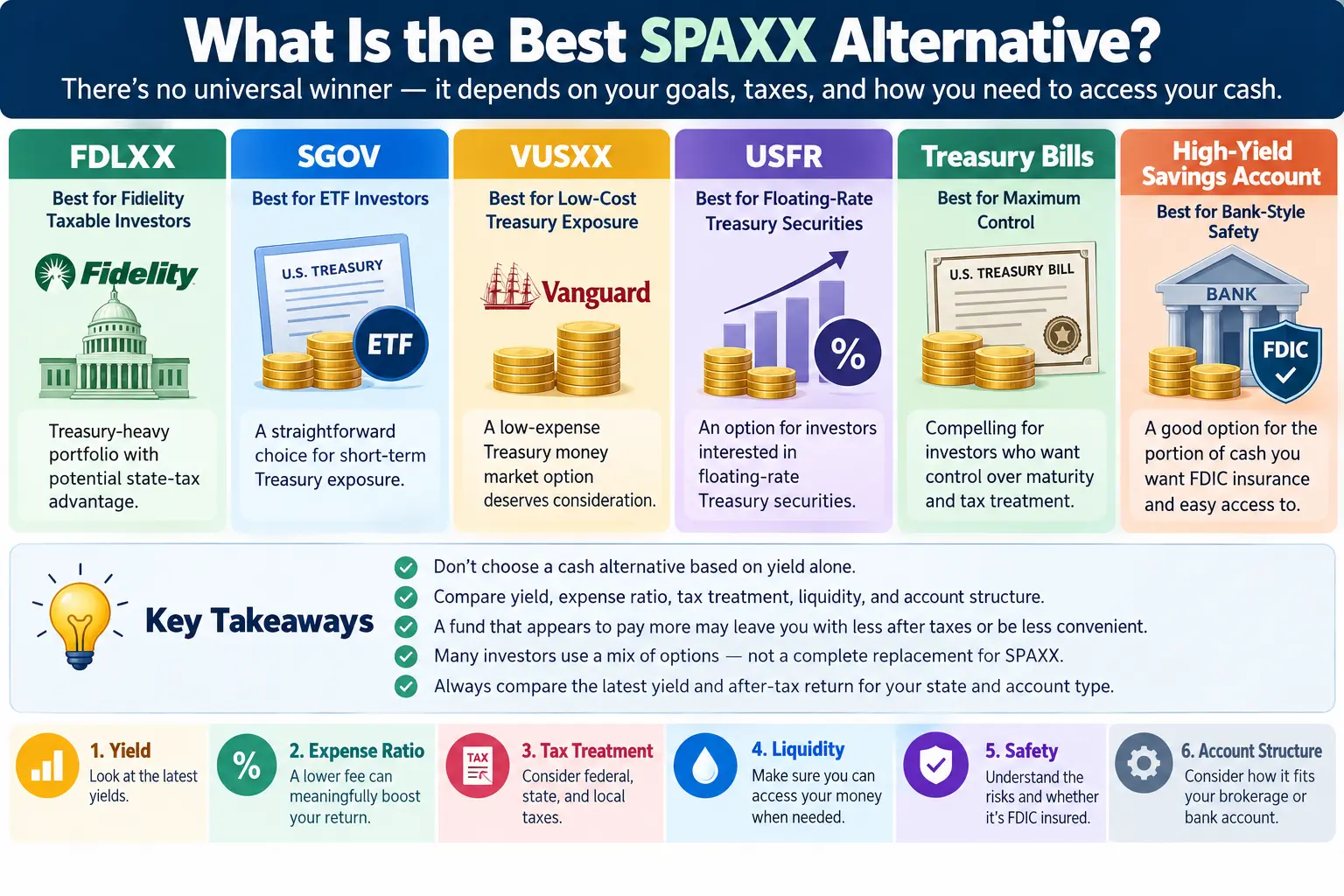
Our overall takeaway: If you already use Fidelity and live in a state with income tax, FDLXX deserves a close look. If you want an ETF, SGOV is one of the simplest Treasury choices. If you want the lowest-cost Treasury money market structure, VUSXX is worth comparing.
Why Look Beyond SPAXX in 2026?
SPAXX remains a popular place for uninvested Fidelity cash.
Fidelity’s Government Money Market Fund had a 7-day yield of approximately 3.34% as of September 10, 2026.
That is competitive for a cash-like investment.
But your personal return is not determined by yield alone.
You also need to consider:
- Federal income taxes
- State and local income taxes
- Expense ratios
- Liquidity
- Account type
- Whether you need automatic cash management
- Whether you are comfortable buying an ETF or individual Treasury bills
This matters because Treasury income receives favorable tax treatment.
The IRS says interest from U.S. Treasury bills, notes, and bonds is subject to federal income tax but exempt from state and local income taxes.
That can make a Treasury-heavy fund more attractive than a slightly higher-yielding taxable alternative.
The economic environment also matters.
The latest available August 2026 CPI report showed consumer prices rising 3.4% over the previous 12 months, while the September CPI report was scheduled for October 14, 2026.
In other words, cash still needs to earn a meaningful return if you want to limit the loss of purchasing power.
1. FDLXX: Best SPAXX Alternative at Fidelity for Many Taxable Investors
Fidelity Treasury Only Money Market Fund (FDLXX) is one of the most obvious alternatives to SPAXX.
FDLXX normally invests at least 99.5% of its assets in cash and U.S. Treasury securities. Fidelity also states that it normally invests at least 80% in U.S. Treasury securities.
As of September 9, 2026, FDLXX’s 7-day yield was approximately 3.38%, compared with about 3.34% for SPAXX around the same period.
The bigger attraction may be taxes.
Because FDLXX invests heavily in Treasury securities, a substantial portion of its income can qualify for state and local tax treatment associated with U.S. government obligations.
However, do not assume that 100% of a money market fund’s distribution is state-tax exempt. The actual percentage can vary by year and fund distribution.
Why choose FDLXX?
FDLXX may make sense if you:
- Already have a Fidelity account
- Live in a state with income tax
- Want Treasury exposure
- Want a money market fund rather than an ETF
- Prefer keeping your cash inside Fidelity
Important limitation
FDLXX is not necessarily a direct replacement for SPAXX as your automatic core position.
You may need to purchase it separately rather than simply having every incoming dollar automatically sweep into FDLXX.
That difference matters if you use your Fidelity account for frequent withdrawals or bill payments.
Best for: Fidelity investors who want Treasury exposure and potential state-tax benefits.
2. VUSXX: A Low-Cost Treasury Money Market Alternative
Vanguard Treasury Money Market Fund (VUSXX) is another popular option.
VUSXX invests in U.S. Treasury obligations and fully collateralized repurchase agreements. Vanguard lists an expense ratio of just 0.07%. Its 7-day SEC yield was approximately 3.69% in late August 2026, according to Vanguard’s published fund data.
That low expense ratio is one of the biggest differences compared with some Fidelity Treasury money market funds.
For example, FDLXX’s gross expense ratio was approximately 0.42% as of June 29, 2026.
Why VUSXX can be attractive
You get:
- Treasury-focused exposure
- A $1 NAV money market structure
- Very low expenses
- Potential state-tax advantages
- High liquidity relative to many other fixed-income investments
Recent Bogleheads discussions also frequently mention VUSXX and other Treasury funds when investors compare alternatives to SPAXX.
The catch
VUSXX is a Vanguard mutual fund.
If you use Fidelity, buying an outside mutual fund can be less convenient than using a Fidelity fund or ETF.
Best for: Investors who are comfortable using Vanguard and want a low-cost Treasury money market fund.
3. SGOV: One of the Best ETF Alternatives to SPAXX
If you prefer an ETF, SGOV deserves serious consideration.
The iShares 0-3 Month Treasury Bond ETF holds U.S. Treasury bills with very short maturities.
As of October 2, 2026, SGOV had:
- 3.70% 30-day SEC yield
- 0.09% expense ratio
- Approximately 0.10 years effective duration
- A portfolio focused on 0–3 month Treasury securities
That makes SGOV relatively close to the cash end of the bond market.
Why investors choose SGOV
It offers:
- Short-term Treasury exposure
- Low expenses
- ETF liquidity
- Easy trading through most brokerages
- Potential state-tax benefits associated with Treasury income
But there is an important distinction.
SGOV is an ETF, not a money market fund.
Its price can fluctuate during the trading day.
That fluctuation has historically been small because the underlying securities are very short-term, but it is still different from treating a money market fund as a $1-per-share cash position.
SGOV vs. SPAXX
Choose SGOV when:
“I want my cash invested in short-term Treasury securities and I am comfortable placing ETF trades.”
Choose SPAXX when:
“I want simple Fidelity cash management and automatic access to my uninvested cash.”
Best for: Investors who want a simple Treasury ETF instead of a money market mutual fund.
4. USFR: A Floating-Rate Treasury Alternative
WisdomTree Floating Rate Treasury Fund (USFR) takes a different approach.
Rather than focusing on traditional Treasury bills, USFR invests in U.S. Treasury floating-rate notes.
WisdomTree reported a 3.68% 30-day SEC yield and a 0.15% net expense ratio as of September 10–11, 2026. Its effective duration was only about 0.02 years.
The fund is designed to track floating-rate Treasury securities whose rates reset based on short-term Treasury bill rates.
Why consider USFR?
It can be useful if you want:
- U.S. government Treasury exposure
- Very low interest-rate sensitivity
- ETF liquidity
- Exposure that adjusts with short-term rates
SGOV vs. USFR
The two funds are similar in their cash-management role, but they are not identical.
SGOV owns very short Treasury bills.
USFR owns floating-rate Treasury notes.
If your goal is straightforward short-term Treasury exposure, SGOV is easier to explain.
If you specifically want floating-rate Treasury exposure, USFR deserves consideration.
Best for: Investors who want Treasury exposure with extremely low duration sensitivity.
5. Buy U.S. Treasury Bills Directly
For investors who are willing to manage maturities, individual Treasury bills can be another excellent alternative.
Treasury bills generally mature in:
- 4 weeks
- 8 weeks
- 13 weeks
- 26 weeks
- 52 weeks
The IRS confirms that Treasury bill interest is subject to federal income tax but exempt from state and local income taxes.
That tax treatment can be particularly valuable for investors living in high-tax states.
Example
Suppose two investments both generate a 4% yield.
A taxable investment may have its income reduced by both federal and state taxes.
Treasury bill income remains subject to federal tax but receives the state and local tax exemption.
Therefore, a Treasury yielding slightly less before taxes can sometimes produce a higher after-tax return.
The downside
Treasury bills require more management.
You need to consider:
- Maturity dates
- Reinvestment
- Settlement
- Cash-flow timing
- Whether you need access to the money before maturity
You can purchase Treasury bills through TreasuryDirect or through a brokerage.
Best for: Investors who want direct Treasury exposure and are willing to manage maturities.
6. High-Yield Savings Account: Best for Bank-Style Cash
A high-yield savings account, or HYSA, is not an investment fund.
It is a bank deposit account.
That distinction matters.
A qualifying bank deposit is generally covered by FDIC insurance within applicable limits, while money market mutual funds such as SPAXX, FDLXX and VUSXX are not FDIC-insured.
A HYSA may therefore be appropriate for money that needs to function like traditional bank cash.
Consider a HYSA if:
- You want FDIC insurance
- You need simple bank access
- You use the money for emergency expenses
- You do not want to trade funds or ETFs
- You want a separate savings bucket
The tradeoff is that the highest advertised APY may change over time.
And you may have to move money between your bank and brokerage account.
Best for: Emergency funds and cash that you want to keep completely separate from investments.
7. Municipal Money Market Funds for High Tax Brackets
For some high-income investors, a municipal money market fund may deserve consideration.
These funds invest primarily in short-term municipal securities.
The attraction is potential federal tax-exempt income.
But this does not automatically mean a municipal fund is better than SPAXX.
The yield may be lower.
You need to compare the tax-equivalent yield.
Tax-equivalent yield formula
For federally tax-exempt income:
Tax-equivalent yield = Tax-exempt yield ÷ (1 − marginal federal tax rate)
For example, a 3% tax-exempt yield for someone in a 37% federal marginal tax bracket has a tax-equivalent yield of approximately:
3% ÷ 0.63 = 4.76%
This is why the highest-yielding fund is not always the best fund after taxes.
Best for: Higher-income investors who face substantial federal taxes and can accept the specific risks and lower yields of municipal funds.
Which SPAXX Alternative Is Best for You?
The answer depends on what you value most.
If you want to stay at Fidelity
Start by comparing:
SPAXX vs. FDLXX
FDLXX is particularly interesting for investors who live in states with income taxes.
If you want an ETF
Consider:
SGOV
It offers a straightforward way to hold very short-term Treasury securities.
If you want a low-cost Treasury money market fund
Consider:
VUSXX
Its expense ratio is substantially lower than FDLXX’s current expense ratio, although you need to consider platform convenience and tax treatment.
If you want floating-rate Treasury exposure
Consider:
USFR
It provides exposure to Treasury floating-rate notes with extremely low effective duration.
If you want maximum control
Consider:
Individual Treasury bills
They provide direct Treasury exposure and state/local tax advantages.
If you want bank-style safety
Consider:
An FDIC-insured HYSA
This is particularly appropriate for emergency cash that you do not want exposed to market-price fluctuations.
SPAXX vs. Alternatives: What Actually Matters?

Don’t compare funds using yield alone.
Use these six questions.
1. What is the current yield?
Look at the latest 7-day yield for money market funds or 30-day SEC yield for ETFs.
Do not rely on an old article quoting a yield from six months ago.
Rates can change quickly.
2. What is the expense ratio?
A 0.30% difference sounds small.
But on $100,000, it represents approximately $300 per year before considering compounding and changes in yield.
3. What is the tax treatment?
This can be more important than a small difference in headline yield.
Treasury interest is federally taxable but exempt from state and local income taxes.
4. How quickly can you access the money?
This is one of the biggest differences between SPAXX and alternatives.
A money market fund may fit an investor who needs highly liquid cash.
An individual Treasury bill has a maturity date.
An ETF must be sold.
A HYSA functions through the banking system.
5. Is the investment FDIC insured?
Do not confuse:
Money market fund
with
money market deposit account
They are different products.
6. Can the investment lose value?
Even investments designed for capital preservation are not identical.
Money market funds seek to maintain a stable $1 NAV, but they are not bank deposits and are not FDIC-insured. Fidelity explicitly notes this for FDLXX.
Is FDLXX Better Than SPAXX?
It can be, especially for taxable Fidelity investors in states with income taxes.
FDLXX is much more Treasury-focused than SPAXX and may provide a better state-tax profile.
However, the best choice depends on the actual yield and tax characteristics for the year.
Do not switch simply because FDLXX has a slightly higher current yield.
Is SGOV Safer Than SPAXX?
They have different structures.
SGOV owns short-term U.S. Treasury securities.
SPAXX is a government money market mutual fund.
Both are designed for relatively conservative cash management, but they should not be treated as identical products.
SGOV can trade above or below its NAV during the day, while money market funds are designed to maintain a stable $1 share price under normal circumstances.
Is Treasury Bill Interest Tax-Free?
Not completely.
Treasury bill interest is subject to federal income tax.
However, the IRS states that Treasury bill, note and bond interest is exempt from state and local income taxes.
That distinction is extremely important.
Should I Move My Emergency Fund Out of SPAXX?
Not necessarily.
If SPAXX is convenient, liquid and appropriate for your financial situation, there may be no compelling reason to move it.
The question should be:
What problem am I trying to solve?
If the problem is state taxes, investigate Treasury-heavy alternatives.
If the problem is expenses, compare lower-cost options.
If the problem is banking access, consider an HYSA.
If the problem is yield, compare current after-tax yields rather than simply chasing the highest advertised number.
💡 Pro Tip: Don’t optimize your entire cash position around a 0.10% yield difference. First separate money by purpose: immediate emergency cash, near-term spending, and longer-term reserves. Then choose the appropriate vehicle for each bucket.
A Simple Cash Strategy for 2026
You do not necessarily need one fund for every dollar.
A three-bucket strategy can be easier.
Bucket 1: Immediate cash
Keep money you may need immediately in an appropriate bank or brokerage cash solution.
Examples:
- Emergency expenses
- Rent or mortgage
- Upcoming bills
- Medical expenses
Bucket 2: Short-term reserves
For money you may need within several months, consider:
- SPAXX
- FDLXX
- VUSXX
- SGOV
- USFR
- Treasury bills
Bucket 3: Longer-term money
If you will not need the money for years, consider whether holding it entirely in cash is appropriate.
Cash alternatives are designed primarily for preservation and liquidity.
They are not substitutes for a diversified long-term investment portfolio.
This creates a useful cash-management topic cluster instead of treating each article as an isolated page.
Sources
- IRS — Treasury interest tax treatment
- U.S. Bureau of Labor Statistics — CPI and inflation
- Fidelity — SPAXX and FDLXX fund data
- Vanguard — VUSXX fund data
- WisdomTree — USFR fund data
Avoid relying on third-party yield aggregators when the fund sponsor provides current data.
Bottom Line: What Is the Best SPAXX Alternative?
There is no universal winner.
For a Fidelity taxable investor in a state with income tax, FDLXX is one of the first alternatives worth researching because of its Treasury-heavy portfolio and potential state-tax advantage.
For an investor who wants an ETF, SGOV is a straightforward choice for short-term Treasury exposure.
For someone prioritizing low expenses and Treasury money-market exposure, VUSXX deserves consideration.
For investors interested in floating-rate Treasury securities, USFR is another option.
And for investors who want maximum control over maturity and tax treatment, individual Treasury bills can be compelling.
The most important point is this:
Don’t choose a cash alternative based on yield alone.
Compare the yield, expense ratio, tax treatment, liquidity and account structure together.
A fund that appears to pay more may leave you with less after taxes or may be less convenient when you actually need the money.
For many U.S. investors, the smartest approach is not to replace SPAXX completely—but to decide which portion of your cash belongs in a money market fund, Treasury ETF, Treasury bills or an FDIC-insured savings account.
Before moving your money, compare the latest yield and after-tax return for your state and account type.
Disclaimer
This article is for informational and educational purposes only. It is not investment, financial, tax or legal advice. Money market funds, ETFs and Treasury securities have different risks, liquidity characteristics and tax treatments. Past performance does not guarantee future results. Yields change over time and may be lower or higher when you invest. Consult a qualified financial or tax professional about your individual circumstances before making investment or tax decisions.
Related Posts:
- What Is FDLXX? Yield, Tax Perks & Who Should Use It
- ACA Open Enrollment 2027: Key Dates, Premium Increases, and What Lost Subsidies Mean for You
- Tax Brackets Married Filing Jointly: Rates & Calculator Guide
- How to Avoid State Taxes on Treasury Interest: A Guide for U.S. Investors
- Treasury Bills vs. CDs: Which Is Right for Short-Term Savings?