Fund data is as of September 30, 2026 (Vanguard) and April 28, 2026 (Schwab). Yields carry their own dates below. We built this comparison from each fund’s own fact sheet, prospectus, and tax documents, listed at the end.
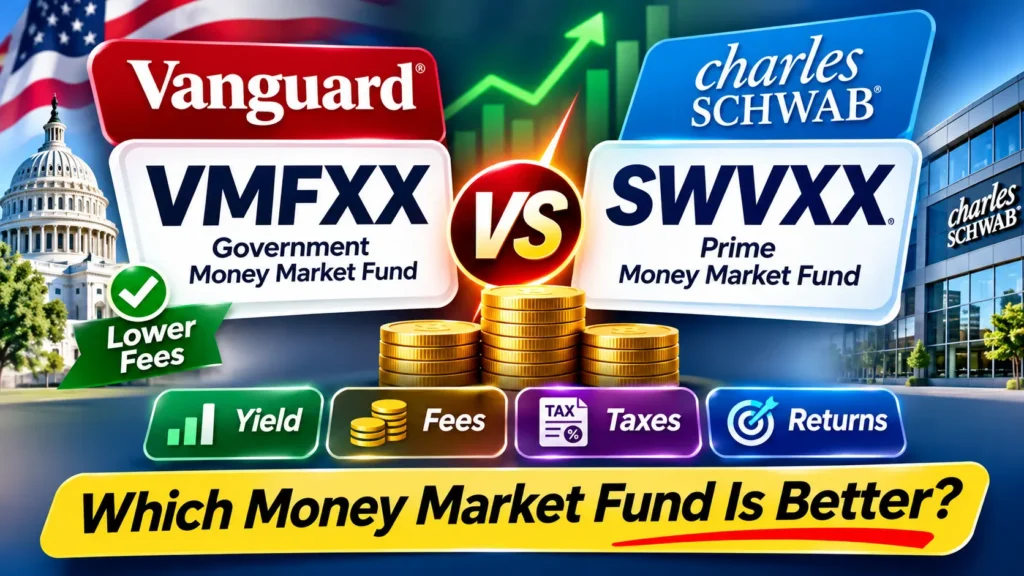
If you keep cash at both Vanguard and Schwab, you have probably seen two tickers that look almost the same: VMFXX and SWVXX.
Both are money market funds.
Both aim to hold a $1.00 share price.
Both currently pay a yield in the high 3% range.
But they are different kinds of funds.
The difference shows up in what they own, what they cost, how much risk they carry, and, in some states, how much tax you pay on the income.
VMFXX vs. SWVXX: Which Is Better?
For most investors, VMFXX is the stronger choice. It is a government money market fund with a lower annual expense ratio than SWVXX, a prime fund that also invests in commercial paper and bank debt.
Government money market fund
Prime money market fund
If your cash already sits at Schwab, SWVXX may be convenient. However, compare Schwab’s government and Treasury money market funds before choosing it.
A note on the name: SWVXX is the Schwab Prime Advantage Money Fund. Many websites still call it the Schwab Value Advantage Money Fund, which is its older name. The ticker has not changed.
VMFXX vs. SWVXX at a glance
VMFXX vs. SWVXX: Side-by-Side Comparison
Compare fund types, expense ratios, yields, investment minimums, holdings, and tax considerations.
| Key Feature | VMFXX Vanguard Federal Money Market Fund | SWVXX Schwab Prime Advantage Money Fund |
|---|---|---|
| Fund name | Vanguard Federal Money Market Fund | Schwab Prime Advantage Money Fund (Investor Shares) |
| Fund type | Government money market | Prime money market Operated as a retail money market fund |
| What it holds | U.S. government and agency securities, Treasury bills, and repurchase agreements backed by government securities. | Commercial paper, promissory notes, bank certificates of deposit, repurchase agreements, and U.S. government securities from U.S. and foreign issuers. |
| Expense ratio | 0.11% Annual expense ratio | 0.34% 0.35% before contractual fee reduction |
| 7-day yield | 3.79% SEC yield · September 30, 2026 | About 3.70% October 9, 2026 |
| 2025 total return | 4.22% | 4.14% |
| Minimum to invest | $3,000 $0 when used as your Vanguard brokerage settlement fund | No minimum Investor Shares |
| Who can own it | Available through Vanguard accounts | Individuals only (natural persons), through a Schwab or other intermediary account. |
| 2025 dividends from U.S. government obligations | 66.61% | Published by Schwab each year. Typically small or zero for a prime fund |
| FDIC-insured? | No | No |
Data reflects the dates shown above and may change. The 7-day yields are from different reporting dates and are not a same-day comparison. Money market mutual funds are not FDIC-insured, and investment returns are not guaranteed.
Yields change daily. The 7-day yield shown for VMFXX is the SEC yield from Vanguard’s September 30, 2026 fact sheet. The SWVXX figure is Schwab’s 7-day yield as of October 9, 2026, which Schwab quotes with fee waivers. For today’s numbers, check Vanguard’s VMFXX page and Schwab’s money fund yields page.
Government Fund vs. Prime Fund: The Difference that Matters
What VMFXX owns
VMFXX is a government money market fund. Under SEC rules, a government fund must keep at least 99.5% of its assets in cash, U.S. government securities, and repurchase agreements backed only by government securities or cash.
Vanguard says VMFXX generally invests 100% of its assets in government securities.
It keeps a dollar-weighted average maturity of 60 days or less, so its holdings turn over quickly.
On September 30, 2026, Vanguard’s fact sheet showed about 39% of the fund in U.S. government obligations, about 37% in Treasury bills, and about 25% in repurchase agreements.
Vanguard also notes that some of the securities the fund holds are neither guaranteed by the U.S. Treasury nor backed by the full faith and credit of the U.S. government. That applies to certain agency securities.
What SWVXX owns
SWVXX is a prime fund.
Schwab’s prospectus says it invests in “high-quality short-term money market investments issued by U.S. and foreign issuers,” including commercial paper, promissory notes, certificates of deposit, repurchase agreements, and U.S. government securities.
Commercial paper and bank CDs usually pay a little more than government securities because the issuers carry more credit risk.
The prospectus lists the extra risks that come with that: credit risk, foreign investment risk, and sector risk from heavy exposure to the financial sector.
It also says the fund’s repurchase agreements may be backed by collateral other than government securities, including equities and below-investment-grade securities.
What “retail money market fund” means
SWVXX is operated as a retail money market fund.
That label means the fund is intended for natural persons, meaning individuals.
Schwab can involuntarily redeem accounts that are not beneficially owned by individuals.
Retail status allows the fund to keep a stable $1.00 share price.
Liquidity fees
The SEC removed redemption gates from money market funds in 2023.
Mandatory liquidity fees now apply to institutional prime funds, not retail funds. Non-government funds, including retail prime funds, may charge a discretionary fee of up to 2% on redemptions if their board decides it is in the fund’s best interests.
SWVXX’s prospectus says the fund “may impose a fee upon the sale of your shares.”
This is a possibility to know about, not a prediction. Vanguard’s fact sheet for VMFXX does not mention one. (See Davis Polk’s summary of the 2023 SEC rules.)
Yield, fees, and returns
Fees
The expense ratio is the yearly fee, taken out of the fund’s earnings before they reach you. VMFXX charges 0.11%. SWVXX charges 0.34% after a contractual fee reduction, and Schwab’s prospectus shows 0.35% before it.
VMFXX vs. SWVXX: Annual Fee Comparison
See how the two expense ratios affect your cash balance and annual fund costs.
| Cash Balance | VMFXX Fee 0.11% |
SWVXX Fee 0.34% |
Annual Difference |
|---|---|---|---|
| $10,000 | $11 | $34 | $23 |
| $50,000 | $55 | $170 | $115 |
| $100,000 | $110 | $340 | $230 |
Estimated annual expenses based on the stated expense ratios and constant cash balances. Actual fund expenses may vary with your average daily balance and applicable fee waivers.
The quoted 7-day yields already reflect these fees, so do not subtract them again. The table shows what each fund charges for its structure.
Which fund earned more?
A prime fund should earn a premium for its extra credit risk. Over the past decade, that premium has been hard to find after fees.
VMFXX vs. SWVXX: Average Annual Returns
Returns for periods ending December 31, 2025
| Period | VMFXX | SWVXX |
|---|---|---|
| 2025 calendar year | 4.22% | 4.14% |
| 5-year average annual return | 3.20% | 3.15% |
| 10-year average annual return | 2.14% | 2.11% |
How to read this: VMFXX recorded a slightly higher return than SWVXX across all three periods shown. Past performance does not guarantee future results.
SWVXX’s figures come from Schwab’s April 2026 summary prospectus.
VMFXX’s 2025 figure is from Vanguard’s fact sheet, and its 5- and 10-year averages are our calculation from the calendar-year returns on that fact sheet.
Past performance does not predict future results, and the gap is small, but the government fund did not trail the prime fund in any of these periods.
The 7-day yields tell a similar story. In early October 2026, the two funds’ yields were about 0.1 percentage point apart.
That gap is small and moves with market conditions, so it is not by itself a reason to choose one fund over the other.
Taxes: where VMFXX has an edge
Federal tax
Dividends from both funds are taxed as ordinary income on your federal return. Neither fund gets the lower tax rates that apply to qualified dividends.
State tax
This is where the funds can differ. Federal law generally keeps states from taxing interest on U.S. government obligations.
In many states, a fund can pass that benefit through to you for the share of its income that came from those obligations.
Interest on repurchase agreements, and on some agency securities, is generally subject to state tax, so even a government fund is rarely 100% exempt.
Each year, Vanguard publishes the percentage of VMFXX’s dividends that came from U.S. government obligations:
VMFXX: U.S. Government Obligations by Tax Year
Percentage of dividends derived from U.S. government obligations
| Tax year | Share of dividends from U.S. government obligations | Met the 50% test for CA, CT, and NY? |
|---|---|---|
| 2023 | 49.37% | Not flagged by Vanguard |
| 2024 | 59.87% | Yes |
| 2025 | 66.61% | Yes |
Important: The 50% threshold is relevant to the state-tax treatment of qualifying mutual fund distributions. Check your state’s rules and the fund’s official tax supplement before claiming an exemption.
California, Connecticut, and New York only let you exempt fund dividends if at least 50% of the fund’s assets are U.S. government obligations at the end of each quarter.
A fund close to that line can lose the exemption for a year.
In 2023, VMFXX’s government share was just under 50%, and Vanguard did not list it as meeting the test.
Vanguard’s footnote on these figures says they “apply to the Vanguard Federal Money Market Settlement Fund.”
Here is what the exemption can be worth. Say you hold $100,000 in VMFXX and earn about $3,790 in dividends over a year, which is 3.79%.
Using the 2025 share of 66.61%, about $2,524 of that income could be subtracted on a state return in a state that allows it.
At a hypothetical 6% state income tax rate, that saves roughly $151.
The number is illustrative, and it is zero in states with no income tax.
To claim the exemption, take the ordinary dividends in Box 1a of your Form 1099-DIV and multiply by the percentage Vanguard publishes for the year.
Then check your state’s rules. Our guide on how to avoid state taxes on Treasury interest covers the basics.
SWVXX holds mostly commercial paper, bank CDs, and repurchase agreements, which do not count as U.S. government obligations.
Its exempt share is therefore typically small or zero.
Schwab publishes the exact percentage each year in its supplementary tax information, so look up the figure for the year you are filing.
How safe is each fund?
Neither fund is FDIC-insured, and neither one guarantees a $1.00 share price.
Vanguard states plainly that you could lose money in VMFXX, and that the fund’s sponsor is not required to reimburse the fund for losses.
Schwab’s prospectus likewise says it cannot guarantee SWVXX will keep its $1.00 price.
That said, the two funds do not carry the same risk.
VMFXX’s holdings are government securities and repurchase agreements backed by government collateral, so credit risk is low.
SWVXX also lends to companies and banks, so it takes on credit, sector, and liquidity risk that VMFXX does not.
History shows why that matters.
In 2008, the Reserve Primary Fund, a prime fund, “broke the buck” and fell below $1.00 per share after a large issuer defaulted.
In March 2020, investors pulled billions out of prime funds, and the Federal Reserve set up an emergency backstop for money market funds.
The SEC has tightened the rules since then, but prime funds still carry more risk than government funds.
If you need FDIC insurance, a bank account is the right tool. See our comparison of the best high-yield savings accounts.
Which fund should you choose?
The most important factor is usually where your cash already sits.
Both funds are easy to hold in the right account: VMFXX serves as the settlement fund in Vanguard brokerage accounts, and SWVXX is sold through Schwab accounts and some other intermediaries.
Moving cash between brokers to chase a small yield gap rarely makes sense.
VMFXX may fit you if:
- Your cash is at Vanguard.
- You want government-only holdings and lower credit risk.
- You live in a state with an income tax that allows the exemption, especially California, Connecticut, or New York.
- You care about costs. VMFXX charges less than a third of what SWVXX does.
SWVXX may fit you if:
- Your cash is at Schwab and you are an individual investor.
- You live in a state with no income tax, so the state exemption does not matter.
- You accept the credit risk of a prime fund and its possible redemption fee.
If you hold cash at Schwab, look at the alternatives.
Schwab also offers government and Treasury money funds, including the Schwab Government Money Fund (SNVXX), the Schwab U.S. Treasury Money Fund (SNSXX), and the Schwab Treasury Obligations Money Fund (SNOXX).
A Treasury-only fund usually has a higher share of state-exempt income, but it can pay slightly less.
Compare each fund’s current yield and its published government-obligations percentage before you decide.
At Vanguard, the Vanguard Treasury Money Market Fund (VUSXX) is the Treasury-only option.
To compare funds with your own numbers, try our money market fund comparison calculator. If you are weighing other cash options, see Treasury bills vs. CDs and SGOV vs. USFR. Fidelity investors can read FDLXX vs. SPAXX and our guide to alternatives to SPAXX.
Frequently asked questions
Which is better, VMFXX or SWVXX?
For most people, VMFXX. It costs less, holds lower-risk assets, has matched or beaten SWVXX’s returns over 1, 5, and 10 years through 2025, and part of its income can be state-tax-exempt. SWVXX is a reasonable choice if your cash is at Schwab and you are comfortable with a prime fund.
Is SWVXX a government money market fund?
No. SWVXX is a prime money market fund. It invests in commercial paper, bank certificates of deposit, repurchase agreements, and U.S. government securities. Schwab’s government options are different funds, such as SNVXX.
Is SWVXX the same as the Schwab Value Advantage Money Fund?
The ticker, SWVXX, is the same. Schwab’s current prospectus calls the fund the Schwab Prime Advantage Money Fund, while many websites still use its older name, the Schwab Value Advantage Money Fund.
Is VMFXX exempt from state taxes?
Partly. A portion of VMFXX’s dividends comes from U.S. government obligations, and many states allow you to exempt that portion. For 2025 it was 66.61%. California, Connecticut, and New York also require that at least 50% of the fund’s assets be government obligations at each quarter-end, which VMFXX met in 2024 and 2025 but not in 2023, according to Vanguard’s tax documents.
Are VMFXX and SWVXX safe?
Both aim to keep a $1.00 share price, but neither is FDIC-insured and neither guarantees it. VMFXX holds government securities and government-backed repurchase agreements, so it carries less credit risk. SWVXX takes on more risk because it also holds commercial paper and bank debt.
Can I buy SWVXX at Vanguard?
SWVXX is sold through Schwab accounts and some other financial intermediaries, and it is limited to individual investors. Check with your broker to see whether it offers the fund.
The bottom line
VMFXX and SWVXX look similar on a statement, but one is a government fund with a low fee and the other is a prime fund that costs three times as much and takes more credit risk for a return that has not been higher.
If your cash is at Vanguard, VMFXX is an easy choice. If it is at Schwab, compare SWVXX with Schwab’s government and Treasury funds, and check your state’s tax rules before you decide.
Sources
- Vanguard Federal Money Market Fund fact sheet, September 30, 2026
- Vanguard U.S. government obligations income information: tax year 2023, tax year 2024, and tax year 2025
- Vanguard money market funds
- Schwab Prime Advantage Money Fund summary prospectus (Form 497K), April 28, 2026
- Schwab Asset Management money fund yields
- Davis Polk: SEC adopts money market fund reforms (July 2023)
This article is for general education and is not personalized financial, tax, or legal advice. Fund yields, fees, and tax percentages change, so confirm current figures in each fund’s documents before you invest. See our Financial Disclaimer.