Last updated: November 12, 2026
Having $50,000 in savings is a big milestone, but if it sits in a typical bank account, it may be earning less than $200 a year.
Move it to one of the best high-yield savings accounts (HYSAs) and the same money can earn more than $2,000 a year, still FDIC-insured and available whenever you need it.
The catch: at a $50,000 balance, rate tiers, balance caps, and promo deadlines matter.
Here are the best options for $50K and how to pick the right one.
Best HYSAs for $50,000 Right Now
Compare savings rates, estimated annual earnings, and account requirements before choosing where to keep your cash.
Our Top 4 High-Yield Savings Accounts
Compare your optionsPIBANK
Earn the listed rate on any balance, making it a straightforward option for someone depositing $50,000.
Western Alliance Bank
Through RaisinOffers a competitive rate across balances, without the monthly direct-deposit condition described for the Axos offer.
Axos ONE
The promotional rate is available for six months when you meet the qualifying requirements, including $1,500+ in monthly direct deposits.
Marcus by Goldman Sachs
A recognizable financial institution option for savers who prefer a familiar banking brand.
Compare Your $50,000 Earnings
| Bank | APY | Annual Interest |
|---|---|---|
| PIBANK | 4.40% | $2,200 |
| Western Alliance | 4.30% | $2,150 |
| Axos ONE | Up to 5.00% | Up to $2,500* |
| Marcus | 3.50% | $1,750 |
*Axos figure is an annualized illustration at 5.00%, not a guaranteed six-month payout. Actual earnings depend on eligibility, the promotional period, and the rate after the promotion.
Is Your $50,000 FDIC-Insured?
Generally, yes. The standard FDIC insurance limit is $250,000 per depositor, per insured bank, per ownership category.
Remember that eligible deposits held in the same ownership category at the same bank are aggregated. Check the underlying bank and applicable coverage when using a deposit marketplace.
The national average savings rate is just 0.38% in the figures used here.
Important: APYs are variable and can change at any time. Promotional rates may have eligibility requirements and expiration dates. Verify current rates, fees, minimums, account availability, and FDIC coverage directly before opening an account. Interest estimates assume a constant APY and a $50,000 balance for one year, before taxes.
Why Your $50,000 Savings Choice Matters
Rates on savings accounts drifted down after the Federal Reserve’s 2025 rate cuts, but they haven’t collapsed.
On October 28, 2026, the Fed held its benchmark rate at 3.75%–4.00%, and two officials voted to raise rates because inflation is still above the Fed’s 2% target.
For savers, that means:
- High yields are still available. The best online banks pay 4.25%–4.40% APY.
- The gap between banks is huge. Many big banks pay 3.0%–3.5%, and traditional savings accounts average 0.38% (FDIC).
- At $50,000, small rate differences add up. Every 0.50% in APY equals $250 a year.
Best High-Yield Savings Accounts for $50,000 (Comparison)
Compare the Best HYSAs for $50,000
Compare interest rates, potential earnings, opening deposits, and requirements before moving your $50,000 into a high-yield savings account.
Pibank Savings
4.40% APY · No direct deposit required
All 10 Savings Options Compared
Based on the supplied November 2026 rate figures| Account | APY* | Annual Earnings | Minimum to Open | Conditions at $50K |
|---|---|---|---|---|
| Pibank Savings Best overall | 4.40% | $2,200 | $0 | Any balance. No direct deposit required. |
| Elevault High-Yield Savings | 4.34% | $2,170 | Check site | Rate applies up to $500,000. |
| Western Alliance BankVia Raisin | 4.30% | $2,150 | Check site | All balances; no rate tiers. |
| Peak Bank | 4.27% | $2,135 | Check site | Rate applies up to $499,999.99. |
| E*TRADE Premium SavingsPromotional rate | 4.25%6 months | ~$1,0636 months | Check site | Guaranteed for 6 months only, then variable. |
| Axos ONE Savings Conditional offer | Up to 5.00% 6 months, then 4.21% | ~$1,2506 months at 5% | $0 | $1,500+ monthly direct deposits and $1,500 average daily balance in Axos ONE Checking. Otherwise, savings rate falls to about 1.00%. |
| Marcus by Goldman Sachs | ~3.50% | $1,750 | $0 | No fees; established banking brand. |
| Capital One 360 Performance Savings | 3.20% | $1,600 | $0 | Branch and café access; strong banking app. |
| Ally Bank Savings | ~3.10–3.20% | $1,550–$1,600 | $0 | Savings buckets and a strong mobile app. |
| Traditional SavingsNational average | 0.38% | $190 | Varies | Used as a comparison benchmark. |
Axos advertises a higher promotional rate, but its direct-deposit and checking-balance requirements matter. Pibank’s listed 4.40% rate is more straightforward if you want a competitive rate without those conditions.
*Annual earnings are estimates based on a constant $50,000 balance and the stated APY for one year, before taxes. Promotional six-month figures represent approximate interest during the promotional period, not a full-year return. Actual earnings depend on compounding, balance changes, and rate changes.
Our Top Picks Explained
1. Pibank — Best Overall for $50,000
APY: 4.40% on any balance · Minimum: $0 · Fees: none
Pibank’s biggest advantage at $50K is simplicity: no balance tiers, no caps, and no direct deposit requirement. Your whole $50,000 earns the top rate.
- ✅ High flat rate on the full balance
- ✅ No minimum deposit or monthly fees
- ❌ Lesser-known online bank with no branches
- ❌ Fewer extras (budgeting tools, savings buckets) than big-name online banks
Best for: savers who want the highest no-strings rate on the full $50K.
2. Western Alliance Bank (via Raisin) — Best No-Strings Runner-Up
APY: 4.30% · Balance tiers: none
Raisin is a marketplace. Your money is held at Western Alliance Bank, an FDIC-insured bank, and you manage it through Raisin’s platform.
- ✅ Competitive rate on all balances
- ✅ Easy to also open CDs from other banks on the same platform
- ❌ You deal with Raisin, not the bank, for customer service
Best for: people who may want to move part of their $50K into CDs later.
3. Axos ONE — Best Promo Rate (If You Qualify)
APY: up to 5.00% for 6 months, then up to 4.21% · Requirements: $1,500+ monthly direct deposit and $1,500 average daily checking balance
At 5.00%, $50,000 earns about $1,250 in six months, the most on this list. But it only works if you move your paycheck to Axos and meet the balance rule. Miss them and the rate can drop to about 1.00%.
- ✅ Highest rate available
- ✅ Checking and savings in one place
- ❌ Requirements every month; the promo ends after 6 months
Best for: people willing to switch their direct deposit.
4. Marcus by Goldman Sachs — Best Big-Name Bank
APY: ~3.50% · Minimum: $0
If you’d rather keep $50K with a household-name bank, Marcus pays one of the best rates among large online banks, with no fees and no minimum.
- ✅ Well-known, backed by Goldman Sachs Bank USA
- ❌ About $450 less per year than Pibank on $50K
5. Capital One 360 / Ally — Best for Banking Everything in One Place
APY: ~3.10%–3.20%
Neither pays the top rate, but both offer excellent checking accounts, apps, and savings “buckets”. That’s useful if you want your emergency fund next to your everyday account.
- ❌ About $600 less per year than the top rates on $50K
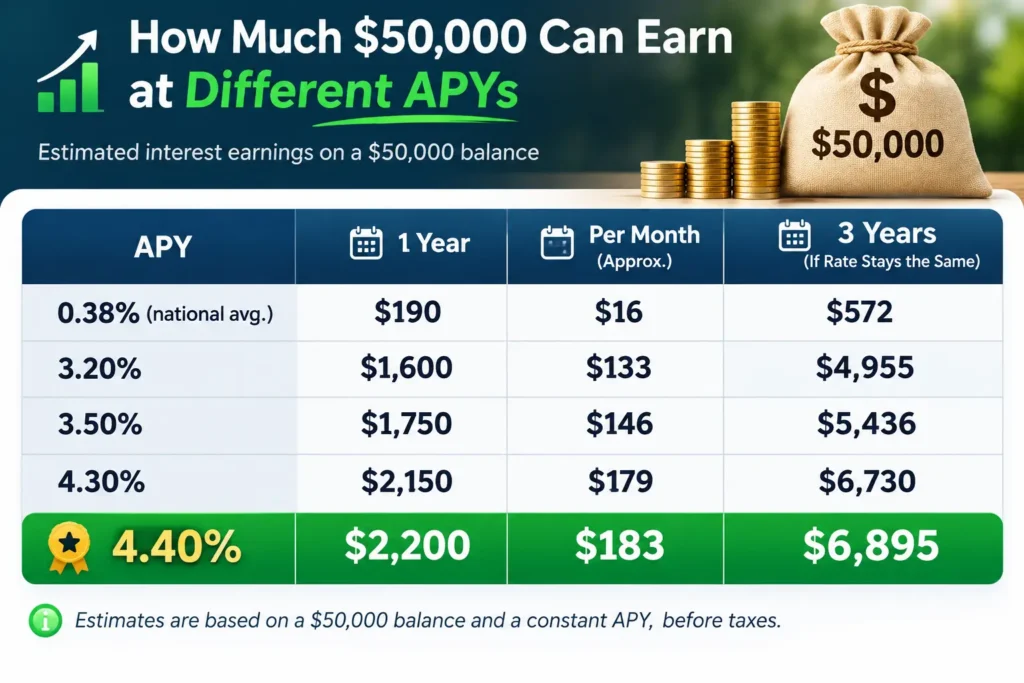
How Much Interest Will $50,000 Earn?
Because APY already includes compounding, the math is simple:
Annual interest = $50,000 × APY
How Much Can $50,000 Earn?
Compare potential interest earnings at different high-yield savings rates.
| APY | 1 Year | Per Month | 3 Years |
|---|---|---|---|
| 0.38% National average | $190 | $16 | $572 |
| 3.20% | $1,600 | $133 | $4,955 |
| 3.50% | $1,750 | $146 | $5,436 |
| 4.30% | $2,150 | $179 | $6,730 |
| 4.40% Highest rate | $2,200 | $183 | $6,895 |
At 4.40% instead of the 0.38% national average, a $50,000 deposit could earn approximately $2,010 more in the first year.
Calculation note: Estimates assume a $50,000 starting balance, constant APY, and no withdrawals. Three-year figures assume interest is compounded annually at the stated effective APY. Monthly figures are approximate averages, not guaranteed monthly interest payments. Figures are before taxes. Actual returns will vary as savings rates change.
Rates are variable. Your real earnings will change if the APY changes.
What about taxes?
HYSA interest is taxed as ordinary income at the federal and state level. Your bank sends Form 1099-INT if you earn $10 or more (IRS Topic No. 403). In the 22% federal bracket, $2,200 of interest costs about $484 in federal tax, plus any state tax.

Is $50,000 Safe in a High-Yield Savings Account?
Yes, as long as the bank is FDIC-insured (or the credit union is NCUA-insured). Deposit insurance covers up to $250,000 per depositor, per insured bank, per ownership category. A $50,000 balance is fully protected, even if the bank fails.
Want more than $250,000 covered? You can raise coverage by using joint accounts (each co-owner is insured separately) or multiple banks.
Pro Tip: Before opening any account, look up the bank on the FDIC’s BankFind tool. Some apps (fintechs) are not banks; they hold your money at a partner bank. Make sure your deposits are covered by “pass-through” FDIC insurance at that partner bank.
HYSA vs. Money Market Fund vs. T-Bills for $50,000
HYSA vs. Money Market Funds vs. Treasury Bills
Compare yields, insurance protection, state taxes, and access to your cash before deciding where to keep your $50,000.
| Feature | HYSA | Money Market Fund | Treasury Bills |
|---|---|---|---|
| Typical yield November 2026 |
Up to ~4.40% APY | ~3.5%–3.6% 7-day yield | Variable Check current Treasury rates |
| FDIC insured? | ✓ Yes At an FDIC-insured bank, within limits | ✕ No SIPC protection may apply at a brokerage | ✓ Government-backed Not FDIC-insured |
| State income tax | Taxable Generally subject to state and local income tax | Partly or mostly exempt FDLXX: approximately 98% qualifying income in the example | Exempt U.S. Treasury interest is exempt from state and local income taxes |
| Access to cash | 1–2 business days Typical transfer to checking | Same or next day Depends on brokerage settlement and withdrawal rules | At maturity Can be sold earlier in the secondary market |
A HYSA is a bank deposit, a money market fund is an investment, and a Treasury bill is a short-term U.S. government security. Their insurance protections, tax treatment, and liquidity are different.
Expert insight: Even after state tax, a 4.40% HYSA currently beats FDLXX’s ~3.6% yield for most people. A California saver in the 9.3% bracket keeps about 3.99% from the HYSA vs. about 3.60% from FDLXX. That can change quickly, so compare every few months. See our guides on SPAXX vs HYSA, FDLXX, and Treasury bills vs CDst.
Should You Keep All $50,000 in a High-Yield Savings Account?
Not necessarily. A HYSA is ideal for money you might need within 1–2 years. Here’s a common way to split $50K:
- Emergency fund (3–6 months of expenses) → HYSA. For many households that’s $15,000–$30,000. See how much emergency fund you need.
- Short-term goals (house, car, tuition within 1–3 years) → HYSA, CDs, or T-bills. CDs and T-bills can lock in today’s rates in case savings rates fall. Learn how to buy T-bills at Fidelity.
- Long-term money (5+ years) → invest. Retirement accounts like a 401(k) or IRA historically grow faster than savings over long periods.
- High-interest debt? Paying off a 22% credit card beats earning 4.40%. Read pay off debt or save first.
How We Chose the Best HYSAs for $50,000
We compared accounts from November 2026 rate surveys and bank websites using criteria that matter at a $50K balance:
- APY on a $50,000 balance, not just the headline rate
- Balance caps and tiers. We left out accounts that drop the rate below $50K
- Requirements and promo length (direct deposit, minimum balances, expiration)
- FDIC or NCUA insurance
- Fees and minimums
- Ease of access (transfer speed, app quality, customer service)
How to Open a High-Yield Savings Account (5 Steps)
- Compare the current APY on the bank’s own site.
- Confirm FDIC insurance using FDIC BankFind.
- Apply online (about 10 minutes): you’ll need your SSN, ID, and address.
- Link your current bank and transfer the $50,000. Some banks limit the size of the first transfer, so you may need to split it over a few days.
- Set a calendar reminder every 3 months to check that your rate is still competitive.
Frequently Asked Questions
What is the best high-yield savings account for $50,000?
As of November 2026, Pibank pays one of the highest rates with no conditions: 4.40% APY on any balance, or about $2,200 a year on $50,000. Western Alliance Bank (via Raisin) at 4.30% is a close runner-up.
How much interest will $50,000 earn in a high-yield savings account?
At 4.40% APY, $50,000 earns about $2,200 per year (around $183 a month). At the national average of 0.38%, it would earn only about $190.
Is it safe to keep $50,000 in a high-yield savings account?
Yes. FDIC insurance covers up to $250,000 per depositor, per bank, per ownership category, so $50,000 at an FDIC-insured bank is fully protected.
Is a high-yield savings account better than a money market fund for $50,000?
Right now, top HYSAs (about 4.40%) pay more than most money market funds (about 3.5%–3.6%) and are FDIC-insured. Money market funds can still win for investors in high-tax states if yields get closer.
The Bottom Line
With $50,000 in savings, where you keep it can be worth $2,000+ a year. For most people, a no-strings online bank like Pibank or Western Alliance (via Raisin) offers the best balance of high yield and simplicity. If you’ll switch your paycheck, Axos ONE’s promo pays more, but only for six months.
Your next step: Check the current APYs in the table above, confirm FDIC coverage, and move your money. Then decide how much of your $50K is emergency fund and how much could go into CDs, T-bills, or long-term investments.
Disclaimer: This article is for informational and educational purposes only and is not financial, tax, or legal advice. APYs are variable and can change at any time; rates shown were reported in November 2026 and may differ when you apply. Verify current rates, fees, and FDIC/NCUA coverage directly with each institution. Consider consulting a qualified financial professional about your situation.