Last reviewed November 2026. The fund percentages below are for tax year 2025, taken from each fund company’s own tax documents. Fund companies publish new figures each January or February, so check for 2026 numbers before you file next year.
Is state tax on money market funds a bill you can avoid?
Partly.
Federal law generally keeps states from taxing interest on U.S. Treasury securities that you own directly.
But when you hold a money market fund or a Treasury ETF, your state’s fund rules decide how much of the dividend you can exempt, and some funds that sound safe from a tax standpoint fail those rules.
Quick answer:
Are Treasury Investments Exempt From State Income Tax?
The answer depends on whether you own Treasury bills directly or hold them through a fund or ETF.
Yes, in most cases. Interest from directly owned U.S. Treasury securities is generally exempt from state and local income taxes, but federal income tax still applies. For funds and ETFs, the exemption generally applies only to the qualifying portion of their distributions.
Directly Owned T-Bills
Interest from Treasury bills you own directly is generally exempt from state income tax. You must still report it for federal income tax purposes.
Money Market Funds & ETFs
You can generally exclude the qualifying portion of fund dividends attributable to U.S. government obligations when calculating state taxable income. The rules and documentation vary by state.
The 50% Asset Test
50% MinimumCalifornia, Connecticut, and New York generally require a fund to hold at least 50% of its assets in qualifying U.S. government obligations at the end of each quarter to qualify for the state tax exemption.
Which Funds Passed in 2025?
Based on the 2025 fund results, Treasury-focused funds cleared the 50% test, while these two Fidelity funds did not.
VUSXX Vanguard Treasury Money Market Fund
FZFXX Fidelity Treasury Money Market Fund
Check your fund’s annual tax supplement for its qualifying U.S. government obligations percentage. Use the eligible percentage to calculate the portion of dividends that may be excluded on your state tax return. Don’t automatically exclude the entire dividend.
Start here: Does your State Tax This income?
Some states do not tax interest or dividends at all, so there is nothing to exempt.
They are Alaska, Florida, Nevada, New Hampshire, South Dakota, Tennessee, Texas, Washington, and Wyoming.
Tennessee ended its tax on interest and dividends in 2021, and New Hampshire ended its tax on interest and dividends at the start of 2025.
Washington does not tax interest income. Rules can change, so confirm with your state if you have not checked recently.
If you live in one of those states, you can skip the rest of this guide. Everyone else, read on.
Treasuries you own directly are exempt
Under federal law (31 U.S.C. § 3124), interest on obligations of the United States is generally exempt from state and local income tax. That covers Treasury bills, notes, bonds, and TIPS, as well as savings bonds.
You still report the interest on your federal return.
When you buy T-bills at a brokerage or through TreasuryDirect, you own the securities directly, so the exemption does not depend on any state fund rule.
The interest appears in Box 3 of Form 1099-INT, which is labeled interest on U.S. savings bonds and Treasury obligations.
That is the amount you subtract on your state return.
Our guide to how to avoid state taxes on Treasury interest covers the basics, and Treasury bills vs. CDs compares them with bank CDs.
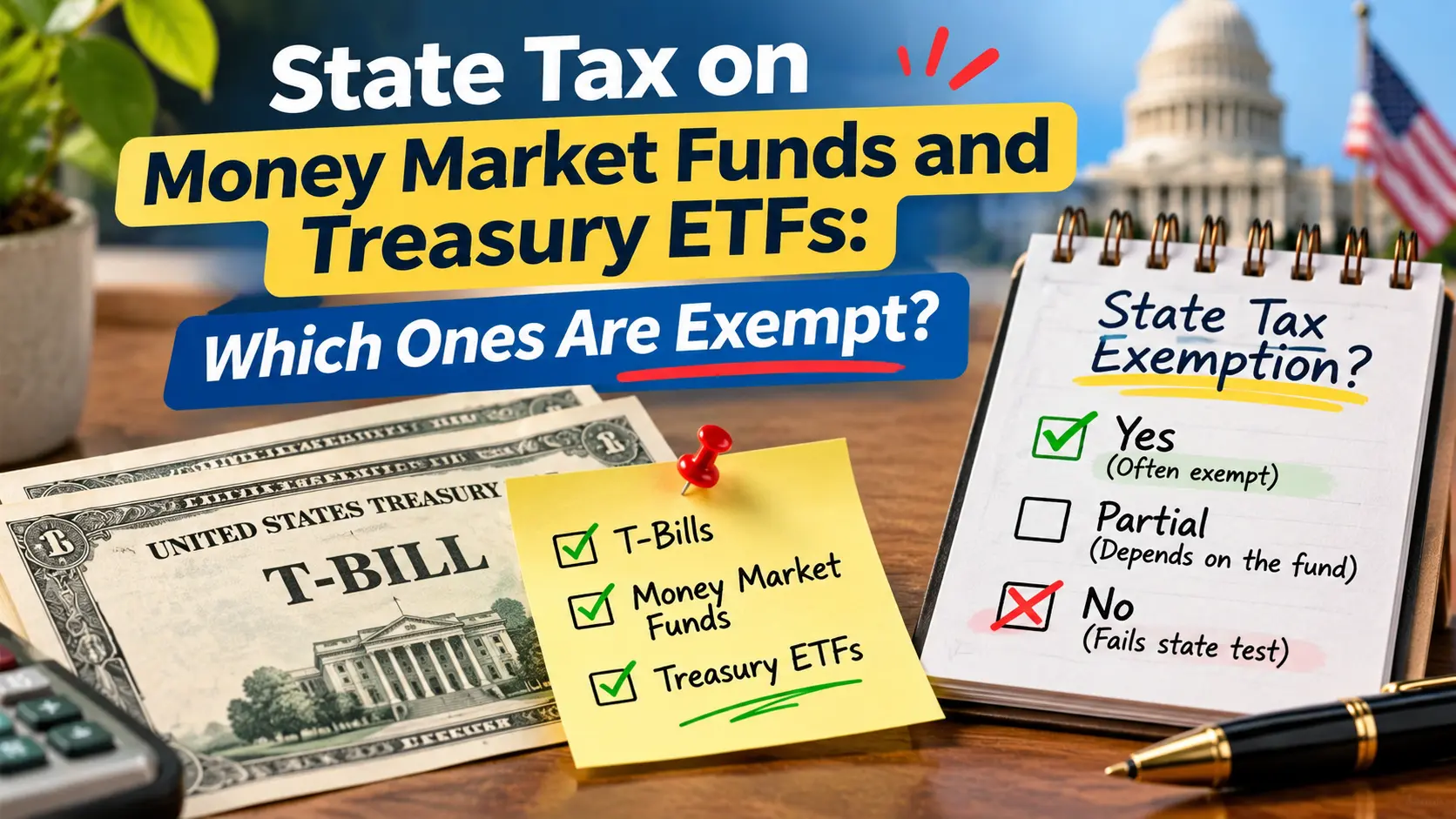
How states treat money market fund and ETF dividends
A fund is different from a T-bill. You own shares in the fund, and the fund owns the securities.
Your fund reports the percentage of its dividends that came from U.S. government obligations, and your state decides whether you can use it.
Most states let you subtract that share.
Fidelity’s 2025 tax letter says as much: “Most states exempt the dividend income derived from a fund’s investments in U.S. government securities.” A few states add a gate.
Here is how the main ones work:
State-by-State Rules for Treasury Fund Tax Exemptions
How States Tax Treasury Fund Dividends
State-by-state rules for excluding U.S. government obligation income from mutual fund and ETF distributions.
Not every state follows the same rules. Some require funds to meet a minimum government-obligation threshold, while others apply their own qualification standards.
California
50% TESTAt least 50% of the fund’s assets must be invested in exempt U.S. obligations at the end of each quarter. If the fund passes, you can generally exempt the qualifying share of its dividends. If it fails, no exemption is allowed under this rule.
Connecticut
50% TESTUses the same 50% quarter-end asset test. The fund must meet the threshold at the end of each quarter for its qualifying U.S. government obligation income to receive the state tax exemption.
New York
50% + REPORTINGThe fund must hold at least 50% of its total assets in qualifying U.S. obligations at each quarter-end. It must also notify shareholders in writing of the amount of dividends that qualifies for the exemption. See New York Tax Law § 612(c)(1).
New Jersey
80% TESTNew Jersey applies a separate Qualified Investment Fund (QIF) standard, generally involving an 80% investment test. The rules differ from the 50% states. Check the current NJ-1040 instructions before claiming an exclusion.
Most Other Income-Tax States
VARIESGenerally allow an exclusion for the portion of fund dividends attributable to qualifying U.S. government obligations. However, minimum investment thresholds, documentation, and reporting requirements vary by state.
What Should You Check Before Filing?
Find your fund’s annual tax supplement, confirm the percentage of income from qualifying U.S. government obligations, and review your state’s current tax instructions. A fund qualifying under one state’s rules does not automatically qualify under another state’s rules.
The fund companies describe the same rule in their own tax documents.
Vanguard puts a footnote on funds that clear it: “This fund meets the threshold requirements for California, Connecticut, and New York, which require that 50% of the fund’s assets at each quarter-end within the tax year consist of U.S. government obligations.”
Fidelity marks funds that fall short with an asterisk.
iShares says some states have investment threshold requirements, and its footnote for SGOV says at least 50% of the fund’s assets were in federal obligations at the end of each quarter of the fiscal year.
One more detail: many states exempt only Treasury obligations and certain agency debt.
Vanguard notes that repurchase agreements and some mortgage-backed agency securities are generally subject to state and local tax. That is why even a government money market fund is rarely 100% exempt.
Which funds qualify? The 2025 results
Here is what the fund companies reported for 2025.
Each fund’s percentage is the share of its dividend income that came from U.S. government securities.
The last column shows whether the fund cleared the 50% asset test used in California, Connecticut, and New York.
Which Treasury Funds Qualify for State Tax Exemption?
Compare the share of 2025 dividends from U.S. government securities and the reported 50% eligibility test results.
| Fund & Ticker | Fund Type | 2025 Dividend Share | 50% Test |
|---|---|---|---|
| Vanguard Treasury Money Market Fund VUSXX | Treasury money market | 100.00% | ✓ Yes |
| Fidelity Treasury Only Money Market Fund FDLXX | Treasury-only money market | 98.67% | ✓ Yes |
| iShares 0-3 Month Treasury Bond ETF SGOV | Treasury bill ETF | 95.14% | ✓ Yes |
| Vanguard Federal Money Market Fund VMFXX | Government money market | 66.61% | ✓ Yes |
| Fidelity Treasury Money Market Fund FZFXX | Treasury money market | 61.52% | ✕ No |
| Fidelity Government Cash Reserves FDRXX | Government money market | 52.17% | ✕ No |
| Fidelity Government Money Market Fund SPAXX | Government money market | 50.90% | ✕ No |
These are two different measurements. The dividend percentage represents the share of distributions attributable to U.S. government securities. The 50% test looks at fund assets at each quarter-end. A fund can have more than 50% of its dividends from government securities and still fail the quarterly asset test.
Three lessons stand out.
- Treasury-only funds were the safest bet. VUSXX, FDLXX, and SGOV all cleared the test, with 95% or more of their dividends coming from government securities.
- A fund’s name does not tell you enough. Fidelity’s “Treasury Money Market Fund” (FZFXX) failed the test in 2025, while its “Treasury Only Money Market Fund” (FDLXX) passed. Read the exact fund name and check the number.
- The percentage and the test are different measures. FZFXX and SPAXX both reported more than 50% of their dividends from government securities, yet both failed the asset test. The percentage looks at income for the year, while the test looks at the fund’s assets at the end of each quarter. A fund with a large share of repurchase agreements, which are generally not exempt, can miss the test. Fidelity does not explain why each fund fell short, so that is our reading, not Fidelity’s statement.
The numbers also move from year to year. Vanguard’s Federal Money Market Fund reported 49.37% in 2023, 59.87% in 2024, and 66.61% in 2025. In 2023, Vanguard did not flag it as meeting the 50% test. See how it compares with a Schwab fund in VMFXX vs. SWVXX.
For Fidelity funds specifically, see our guides to FDLXX, FDLXX vs. SPAXX, and alternatives to SPAXX for uninvested cash. For Treasury ETFs, see SGOV vs. USFR.
How to claim the exemption, step by step
- Find your dividends. Look at your Form 1099-DIV. For brokerage accounts, the fund-by-fund detail is in the supplemental pages of your 1099 tax statement. Vanguard points you to “Details for Dividends and Distributions,” and Fidelity points you to the “Details of 1099-DIV Transactions” section.
- Use the right number. Take the ordinary dividends (Box 1a), not capital gains distributions. Vanguard says to subtract long-term capital gains and nondividend distributions first when you work from the brokerage detail.
- Get the fund’s percentage for that tax year. Use Vanguard’s “U.S. government obligations income information,” Fidelity’s “Percentage of Income from U.S. Government Securities” letter, or iShares’ “U.S. Government Source Income Information” for the year you are filing.
- Check the 50% flag if you live in California, Connecticut, or New York. If your fund did not meet the test, the exemption is zero in those states, whatever the percentage says.
- Multiply. Ordinary dividends from the fund times the percentage equals the amount you can generally subtract.
- Enter it on your state return. Every state’s form names this subtraction differently, and tax software often will not apply it unless you enter the amount. Keep the fund’s tax letter with your records. New York, for one, requires the fund to notify you of the qualifying portion.
Your state’s own instructions are the final word. The fund companies say the same in their letters: they are not tax advice, and you should check with your state or a tax professional.
What the exemption is worth
These examples use round numbers and a hypothetical 6% state tax rate to show the effect. They are illustrations, not predictions.
Example 1: a Treasury-only fund. You earn $5,000 in dividends from a fund with a 98.67% government share. The exempt amount is $4,933.50 ($5,000 × 98.67%). At a 6% state rate, that avoids about $296 in state tax.
Example 2: a fund that fails the test. You earn the same $5,000 from SPAXX, which reported 50.90% in 2025. In a state with no minimum, the exempt amount would be $2,545 ($5,000 × 50.90%), which avoids about $153 of state tax at 6%. In California, Connecticut, or New York, SPAXX failed the 50% asset test, so the exemption would be $0.
Example 3: yield after state tax. A higher yield is not always better after tax. Use this formula to compare funds:
After-state-tax yield = yield × (1 − state tax rate × (1 − exempt share))
Does a Treasury-Only Fund Really Pay More After Taxes?
See how state income taxes can affect the actual yield you keep from two hypothetical money market funds.
Compare the yield you actually keep
Despite starting with a lower yield, Fund A leaves you with a higher return after state taxes.
In this example, the fund that yields 0.15 percentage point less ends up ahead after state tax. The yields here are made up to show the math, not current rates. You can plug in real numbers with our money market fund comparison calculator. Federal tax applies to both funds in the same way, so it does not change the comparison.
Which option fits you?
- You live in California, Connecticut, or New York. Favor T-bills you own directly or a fund that cleared the 50% test. Do not assume a government fund qualifies.
- You live in another income-tax state. A fund’s government share is usually what counts. A Treasury-only fund will give you the most exempt income, but compare after-tax yield, not just the exempt share.
- You live in a state with no income tax. Pick on yield, fees, and convenience.
- You hold the money in an IRA or 401(k). The state exemption does not matter inside these accounts. Interest earned there is not taxed each year.
- You want certainty. Holding T-bills directly removes the fund test altogether. You trade that for a little more work buying and rolling them.
Common mistakes
- Assuming every fund with “Treasury” or “government” in its name is fully exempt.
- Reusing last year’s percentage. Look up the figure for the year you are filing.
- Applying the percentage to total distributions instead of ordinary dividends.
- Forgetting that California, Connecticut, and New York can disqualify a fund entirely.
- Skipping the subtraction because the software did not prompt for it.
- Counting the exemption on money held in a retirement account.
Frequently asked questions
Is SGOV exempt from state tax?
Mostly. For 2025, iShares reported that 95.14% of SGOV’s income came from U.S. government obligations, and its tax document says at least 50% of the fund’s assets were in federal obligations at the end of each quarter. That is the test California, Connecticut, and New York use. So most of the dividend was eligible, but check your state’s rules and the figure for the year you file.
Is FDLXX exempt from state tax?
FDLXX reported 98.67% from U.S. government securities for 2025, and Fidelity did not flag it as missing the minimum for California, Connecticut, and New York. That makes it one of the stronger choices. Read our full FDLXX guide.
Is SPAXX exempt from state tax?
Partly, in some states. SPAXX reported 50.90% for 2025. Fidelity flagged it as not meeting the minimum for California, Connecticut, and New York, so residents of those states could not exempt any of it. Elsewhere, you may be able to exempt about half, depending on your state’s rules.
Do I pay state tax on T-bill interest?
Generally no. Interest on Treasury securities you own directly is exempt from state income tax under federal law. You still pay federal income tax on it.
Why did my “government” money market fund get no exemption?
A fund can report a share above 50% and still fail the asset test that California, Connecticut, and New York apply at each quarter-end. Funds that hold a lot of repurchase agreements are at risk, because those are generally not exempt. Check the fund company’s flag for your state.
Does the state exemption apply to money market funds in an IRA?
No. Income earned inside an IRA is not taxed each year, so there is nothing to exempt. The state rules matter for taxable brokerage accounts.
When will the 2026 percentages be available?
Fund companies published the 2025 figures in early 2026, so expect the 2026 numbers in January or February 2027. File with the percentage for the tax year you are reporting.
Do I need a tax professional?
If your dividends are large, or you live in California, Connecticut, New York, or New Jersey, it can be worth a quick check. State rules are detailed, and a mistake can cost you either way.
The bottom line
State tax on money market funds depends on three things: your state, your fund, and the year. Treasury-only funds and T-bills held directly give you the best chance of a large exemption. Government funds can fall short, especially in California, Connecticut, and New York. Look up your fund’s percentage each year, check your state’s rules, and do the math before you chase the highest yield.
Sources
- 31 U.S.C. § 3124, Exemption from taxation (Cornell Legal Information Institute)
- New York Tax Law § 612, modifications reducing federal adjusted gross income
- Vanguard: U.S. government obligations income information, tax year 2025; also tax year 2024 and tax year 2023
- Fidelity: 2025 Percentage of Income from U.S. Government Securities and Fidelity mutual fund tax information
- iShares: 2025 U.S. Government Source Income Information
- California Revenue and Taxation Code § 17145 (fund dividends from exempt obligations)
This article is for general education and is not personalized financial, tax, or legal advice. State tax rules change and depend on your situation, so confirm them with your state tax agency or a tax professional before you file. See our Financial Disclaimer.
Related Posts:
- Year End Tax Planning 2026: Moves to Make Before December 31
- State Tax on Money Market Funds and Treasury ETFs: Which Ones Are Exempt?
- 2027 401(k) and IRA Contribution Limits: What the IRS Announced
- VMFXX vs. SWVXX: Vanguard vs. Schwab Money Market Fund Compared
- Best High-Yield Savings Accounts for $50000: Earn Up to $2,200 a Year (November 2026)