If you have debt and money sitting in your savings account, you may feel stuck.
Should you use the savings to eliminate the debt? Should you keep building your emergency fund? Should you invest instead?
There is no single answer that works for everyone.
The right approach depends on the type of debt you have, your interest rate, your emergency savings, your income stability, and whether your employer offers a retirement match.
For many people, the answer is not actually “debt or savings.” It is a sequence:
Protect yourself from financial emergencies first, then aggressively attack expensive debt while continuing important long-term savings.
This guide walks through that decision step by step.
Related guide: If you’re trying to figure out your overall money priorities Read Money Guide:
The Short Answer
For most households, a reasonable order is:
- Pay all required minimum debt payments.
- Keep enough cash for immediate emergencies.
- Contribute enough to a workplace retirement plan to capture an available employer match, if appropriate for your situation.
- Prioritize high-interest debt.
- Build your emergency fund further as your debt situation improves.
- Then increase investing and other long-term savings.
This is not a rigid rule.
Someone with a very stable job, $30,000 in savings, and 25% credit card debt has a very different situation from someone with $1,500 in savings, an unstable income, and a low-rate student loan.
The key is to avoid solving one problem by creating another.
Why Saving Money Before Paying Off Debt Can Make Sense
It can be tempting to send every available dollar toward debt.
But having zero cash savings can create another problem.
Imagine you have:
- $5,000 of credit card debt
- $5,000 in savings
- $0 remaining after paying the credit card
- An unexpected $2,000 car repair
You may have to put the repair back on a credit card.
You paid off debt, only to create new debt.
That is why an emergency reserve can be valuable even when you still owe money.
Your emergency fund is a financial shock absorber
An emergency fund can help cover unexpected expenses such as:
- Car repairs
- Home repairs
- Insurance deductibles
- Medical or dental bills
- Temporary income loss
- Essential travel
- Unexpected family expenses
The exact amount you need depends on your household.
A person with a stable government job and low monthly expenses may need less cash than someone who is self-employed or has variable income.
Keep emergency savings accessible
Emergency money generally belongs somewhere safe and accessible rather than in investments that can fluctuate in value.
Savings accounts and other qualifying deposit accounts at FDIC-insured banks are covered by FDIC insurance within applicable limits. The standard coverage is $250,000 per depositor, per insured bank, per ownership category.
That does not mean you need anywhere near $250,000 in your emergency fund. It simply explains the insurance framework for eligible bank deposits.
Why Paying Off Debt Can Make More Sense
Debt has a cost.
When you pay down debt, you generally reduce the amount of interest you will owe in the future.
This is particularly important with expensive revolving debt.
For example, suppose you have:
- $10,000 credit card balance
- 25% APR
- $10,000 in savings
Keeping all $10,000 in cash while carrying the credit card balance can be expensive because the credit card interest rate may greatly exceed the interest you earn on ordinary savings.
The exact math depends on your account terms and whether the card balance changes, but the principle is straightforward:
The higher the debt’s interest rate, the stronger the financial case for paying it down.
However, don’t automatically drain your savings to zero.
The decision should consider both interest savings and emergency protection.
The Most Important Factor: Your Interest Rate
One of the easiest ways to decide what to do with extra money is to look at the interest rate on your debt.
Consider these broad categories:
High-interest debt
Examples include:
- Credit cards
- Some personal loans
- Certain high-cost financing
This debt often deserves aggressive repayment.
Moderate-interest debt
Examples may include:
- Some private student loans
- Some auto loans
- Certain personal loans
The answer becomes more dependent on your emergency savings, income stability, and other goals.
Low-interest debt
Examples can include certain mortgages or other loans with relatively low rates.
You may have more flexibility to save or invest while making required payments.
But the tax treatment, loan terms, and your individual circumstances matter.
Do not compare debt rates and savings rates without considering taxes, fees, and whether the rates are fixed or variable.
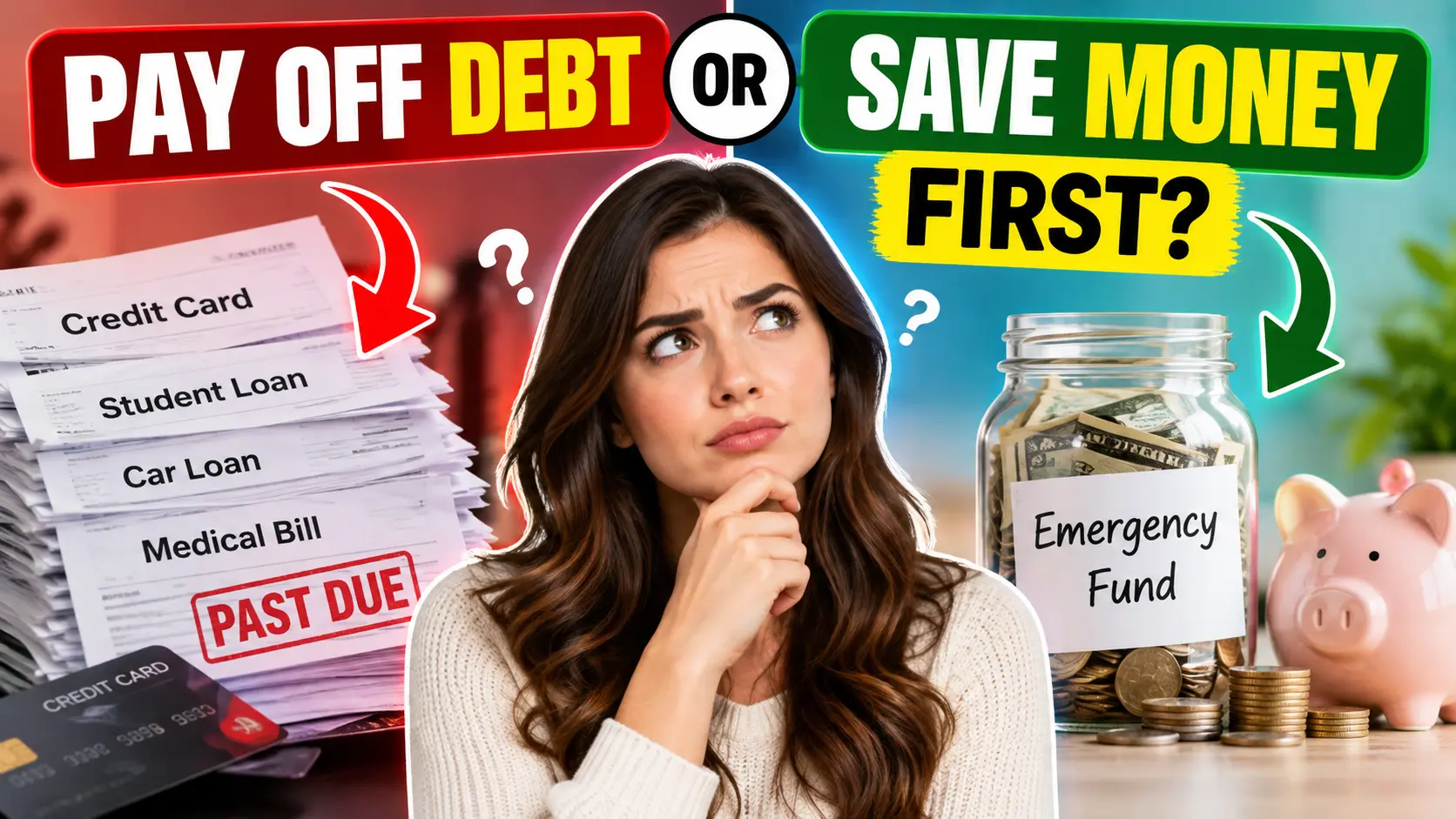
A Simple Debt vs. Savings Decision Framework
Instead of asking:
“Should I pay off debt or save money?”
Ask these seven questions.
1. Can I cover my minimum payments?
If you cannot make your required payments, your first priority is stabilizing your cash flow.
The CFPB recommends contacting your credit card company promptly if you cannot make your payment. Card issuers may have options for people experiencing financial difficulty.
Do not ignore the problem.
2. Do I have any emergency savings?
If your savings balance is essentially zero, consider building a starter emergency reserve before sending every extra dollar toward debt.
The appropriate amount depends on your expenses and circumstances.
A starter reserve might be enough to handle a common unexpected expense.
3. What is my debt’s interest rate?
Write down every debt.
For example:
| Debt | Balance | Interest Rate |
|---|---|---|
| Credit card | $8,000 | 25% |
| Auto loan | $15,000 | 6.5% |
| Student loan | $20,000 | 5% |
| Mortgage | $280,000 | 6% |
The credit card stands out immediately.
4. How stable is my income?
Ask:
- Is my job secure?
- Is my income predictable?
- Am I self-employed?
- Does my household depend on one income?
- Could I replace my income quickly if I lost my job?
The less predictable your income, the more important liquid savings may become.
5. Do I have an employer retirement match?
If your employer offers a retirement plan with matching contributions, understand the plan’s rules.
Employer matching contributions can add money to your retirement account when you contribute. The IRS notes that the plan documents specify the matching formula and requirements.
For example, suppose your employer matches part of your contributions up to a certain percentage of pay.
Contributing enough to receive the available match may be worth considering even while you are paying down debt.
The exact decision depends on your debt, cash reserves, and plan terms.
6. Will paying off the debt leave me cash-poor?
This is one of the most important questions.
If using your savings to eliminate debt would leave you with $0, slow down.
You may be better off keeping a reasonable cash reserve and using the remainder toward debt.
7. What happens if an emergency occurs next month?
This is the stress test.
Imagine:
“I pay off the debt today. Then my car needs a $2,500 repair next month.”
How would you pay for it?
If the only answer is another credit card, your plan may be too aggressive.
Debt vs. Savings Comparison Table
| Situation | What Usually Deserves More Attention | Why |
|---|---|---|
| No emergency savings | Build a starter cash reserve | Prevents every emergency from becoming new debt |
| High-interest credit card debt | Debt repayment | Interest can compound quickly |
| Stable income + high-interest debt | Reserve + aggressive debt payoff | Balances liquidity with interest savings |
| Unstable income + debt | Larger cash reserve may be appropriate | Income disruption can be harder to absorb |
| Low-interest debt + strong savings | Saving/investing may become more competitive | Debt cost may be relatively low |
| Employer 401(k) match available | Consider contributing enough to receive the match | Employer contributions can add to retirement savings |
| Large cash balance + expensive debt | Consider using excess cash toward debt | Keeping excess cash while paying high interest can be inefficient |
| Debt-free | Increase savings and investing | More cash flow becomes available for future goals |
This table is a framework, not a personalized financial recommendation.
How Much Emergency Savings Should You Keep?
There is no universal emergency fund number.
The popular “three to six months” guideline can be useful as a starting point, but your target should reflect your actual circumstances.
Consider:
Monthly essential expenses
Calculate expenses such as:
- Housing
- Utilities
- Groceries
- Transportation
- Insurance
- Minimum debt payments
- Essential healthcare
- Childcare
Then consider how many months you could realistically need to cover.
Job stability
A household with highly predictable employment may approach emergency savings differently from someone with:
- Commission-based income
- Seasonal work
- Self-employment
- Contract work
- One primary income earner
Dependents
Families with children or other dependents may need a larger financial buffer.
Insurance deductibles
Your emergency fund should also account for potentially large out-of-pocket costs.
A useful three-stage emergency fund approach
Instead of thinking:
“I need six months of expenses immediately.”
Use stages.
Stage 1: Starter emergency fund
Build enough cash to handle a common financial surprise.
Stage 2: Debt-protection fund
While paying down expensive debt, continue building savings toward a more meaningful reserve.
Stage 3: Full emergency fund
Once expensive debt is under control, build the reserve to a level appropriate for your household.
What About Credit Card Debt?
Credit card debt deserves special attention because interest can accumulate quickly.
Suppose you have:
- $7,000 credit card balance
- High APR
- $10,000 savings
- Stable employment
You might not want to keep the entire $10,000 untouched while carrying the credit card balance.
A possible approach is:
- Keep a reasonable emergency reserve.
- Use excess savings toward the credit card.
- Stop adding new balances.
- Redirect the monthly payment toward savings once the debt is gone.
This can create a powerful transition.
Before paying a large lump sum
Check:
- Current balance
- APR
- Promotional rate expiration
- Minimum payment
- Any fees
- Whether the card has deferred-interest terms
- Your remaining emergency savings
And remember that paying off a credit card only works if you avoid immediately rebuilding the balance.
If you are already struggling to make payments
Do not wait until the situation becomes severe.
The CFPB recommends contacting your credit card issuer if you cannot make your payments and notes that credit counseling may also be an option.
What About Student Loans, Auto Loans, and Mortgages?
Not all debt should be treated the same way.
Student loans
Look at:
- Federal vs. private status
- Interest rate
- Fixed vs. variable rate
- Repayment plan
- Potential forgiveness eligibility
- Your emergency savings
- Other financial goals
Avoid making large extra payments without first understanding the terms of the loan.
Auto loans
An auto loan can have a relatively moderate interest rate.
If your rate is low and you have little emergency savings, building cash may deserve more attention than making aggressive extra principal payments.
If the rate is high, the calculation changes.
Mortgage debt
A mortgage is different from revolving credit card debt.
You may choose to make extra mortgage payments, invest, or increase other savings depending on:
- Mortgage rate
- Tax considerations
- Retirement savings
- Emergency fund
- Investment goals
- Risk tolerance
- Other debt
There is no universal rule that says every homeowner should pay off the mortgage as quickly as possible.
Should You Contribute to a 401(k) While Paying Debt?
Potentially, yes.
A common mistake is to stop all retirement contributions until every dollar of debt disappears.
That can be problematic when you are giving up an employer match.
Many workplace retirement plans offer employer matching contributions. The IRS explains that the amount and conditions depend on the specific plan.
Example
Suppose:
- Salary: $70,000
- Employer offers a 401(k) match
- You have $10,000 of credit card debt
- You have a small emergency fund
You might consider contributing enough to qualify for the available employer match while directing additional cash toward the high-interest debt.
But this isn’t a universal rule.
If your debt is extremely expensive and your financial situation is unstable, the balance may need to shift toward debt repayment.
Three Practical Examples
Example 1: High-interest credit card debt and little savings
Situation:
- Savings: $1,000
- Credit card debt: $8,000
- Credit card APR: 25%
- Stable job
- Monthly expenses: $3,500
Possible approach
Keep the $1,000 as a starter emergency reserve.
Then focus most available extra cash on the credit card.
Why?
Because the debt has a very high interest cost, while having no cash at all creates the risk of needing to borrow again.
Example 2: Large savings and expensive debt
Situation:
- Savings: $30,000
- Credit card debt: $10,000
- Credit card APR: 24%
- Stable income
- Essential monthly expenses: $4,000
Here, keeping all $30,000 in savings while carrying $10,000 of high-interest credit card debt deserves careful consideration.
A household might decide to:
- Keep a substantial emergency reserve.
- Use some excess cash to eliminate the credit card debt.
- Redirect the former credit card payment into savings.
The exact amount to keep in cash depends on the household’s income stability and risk factors.
Example 3: Low-rate debt and strong savings
Situation:
- Savings: $20,000
- Auto loan: $12,000
- Auto loan rate: 4%
- Stable job
- No credit card debt
- Employer 401(k) match available
The decision is less obvious.
You could potentially:
- Maintain your emergency fund.
- Capture the available retirement match.
- Continue making the required auto payment.
- Direct additional money toward investing or extra loan payments based on your goals.
The lower debt rate makes the opportunity cost of aggressively paying the loan more relevant.
A Step-by-Step Plan You Can Use Today
Here’s a simple process you can complete in about 30 minutes.
Step 1: List every debt
Create a table:
| Debt | Balance | APR | Minimum Payment |
|---|---|---|---|
| Credit card 1 | $ | % | $ |
| Credit card 2 | $ | % | $ |
| Auto loan | $ | % | $ |
| Student loan | $ | % | $ |
| Mortgage | $ | % | $ |
Don’t guess.
Check your current statements.
Step 2: Calculate essential monthly expenses
Add:
- Housing
- Utilities
- Food
- Transportation
- Insurance
- Healthcare
- Minimum debt payments
- Other essential expenses
This gives you a more realistic emergency-fund target.
Step 3: Check your current savings
Separate your money mentally into:
Emergency money
Cash you may need unexpectedly.
Short-term goal money
Money for expenses you expect within the next few years.
Long-term investments
Money intended for retirement or long-term growth.
Don’t treat all three categories as interchangeable.
Step 4: Identify your most expensive debt
Sort debts from highest interest rate to lowest.
This is the foundation of the debt avalanche approach.
For many people, paying the highest-rate debt first can reduce interest costs.
Step 5: Protect your minimum cash reserve
Don’t automatically send every dollar of savings toward debt.
Decide how much cash you need to avoid being forced back into borrowing after a financial surprise.
Step 6: Check your employer retirement match
Review your 401(k) or other workplace retirement plan.
Find out:
- Match percentage
- Match limit
- Vesting requirements
- Contribution requirements
The IRS notes that plan documents contain the relevant matching information.
Step 7: Attack high-interest debt
Once your basic cash buffer is established, direct additional money toward expensive debt.
When one debt disappears, don’t automatically increase spending.
Redirect the payment toward:
- Emergency savings
- Retirement
- Investments
- Another debt
- A specific financial goal
What If You Have $10,000 Saved?
This is a common situation.
There is no universal answer.
Suppose you have:
$10,000 savings + $8,000 credit card debt
The question isn’t simply:
“Should I use $8,000 to pay the debt?”
Instead ask:
“How much of the $10,000 do I genuinely need to keep available?”
If $6,000 is an appropriate emergency reserve for your household, you might consider using the remaining $4,000 toward the credit card and then aggressively paying the remaining balance from future income.
Should You Pay Off Debt or Start Investing?
This is related but slightly different from the savings question.
If you have:
- Emergency savings
- High-interest debt
- No retirement contributions
you may need to balance all three priorities.
High-interest debt can be difficult to justify carrying while making aggressive taxable investments.
But workplace retirement matching can change the calculation.
Common Mistakes to Avoid
Mistake 1: Keeping zero savings
Paying off debt feels great until a $2,000 emergency appears.
A cash buffer can prevent a new borrowing cycle.
Mistake 2: Keeping huge cash reserves while carrying expensive debt
The opposite extreme can also be costly.
If you have substantial savings and very high-interest debt, calculate whether keeping all the cash makes sense.
Mistake 3: Treating every debt equally
A 25% credit card balance and a 4% loan are not financially identical.
Look at the interest rate and terms.
Mistake 4: Ignoring employer retirement matching
If your workplace offers a match, understand what you need to contribute to receive it.
The IRS confirms that employer matching formulas and eligibility rules depend on the plan.
Mistake 5: Paying off debt and immediately borrowing again
If your spending exceeds your income, paying off a balance once won’t solve the underlying problem.
Fix the monthly cash-flow gap.
Mistake 6: Using retirement money casually to pay debt
Retirement accounts have tax rules and, depending on the account and transaction, potential penalties or other consequences.
Before withdrawing retirement funds, understand the tax and plan implications.
The Simple Rule: Protect, Then Attack
If you want one framework to remember, use this:
Protect → Match → Attack → Build → Invest
1. Protect
Maintain enough cash to handle reasonable emergencies.
2. Match
Consider contributing enough to receive an available employer retirement match, subject to your circumstances and plan rules.
3. Attack
Prioritize expensive debt.
4. Build
Strengthen your emergency savings as high-interest debt falls.
5. Invest
Increase long-term investing after the financial foundation is stronger.
This sequence is flexible.
Your job security, family situation, debt interest rates, cash reserves, taxes, and financial goals can change the order.
A Quick Decision Tree
Ask yourself these questions:
Do you have zero emergency savings?
Yes → Build a starter cash reserve while making minimum debt payments.
No → Continue.
Do you have high-interest credit card debt?
Yes → Consider prioritizing aggressive repayment after maintaining an appropriate cash buffer.
No → Continue.
Is your income unstable?
Yes → Consider maintaining a larger emergency reserve.
No → Continue.
Does your employer offer a retirement match?
Yes → Review the plan and consider contributing enough to capture the available match.
No → Continue evaluating debt repayment versus other savings and investment goals.
Is the debt relatively low-interest?
Yes → You may have more flexibility between extra debt payments, savings, and investing.
FAQs
Should I save money or pay off debt first?
Usually, don’t treat it as an all-or-nothing choice. Maintain an appropriate emergency reserve, make required debt payments, and consider prioritizing high-interest debt.
Should I pay off credit card debt before building an emergency fund?
You generally don’t want to have zero emergency savings. A starter reserve can help prevent an unexpected expense from becoming new credit card debt. After that, high-interest credit card debt often deserves aggressive attention.
Is it better to have savings or be debt-free?
Neither is automatically better. Having savings provides liquidity, while eliminating debt reduces future interest costs. The right balance depends on your debt rate, emergency needs, income stability, and financial goals.
Should I use my emergency fund to pay off debt?
Be cautious about using your entire emergency fund. If doing so leaves you unable to handle an unexpected expense, you could end up borrowing again.
How much emergency savings should I have while paying debt?
There is no universal number. Consider your essential monthly expenses, job stability, dependents, insurance deductibles, and the type of debt you have.
Should I stop contributing to my 401(k) while paying debt?
Not necessarily. If your employer offers matching contributions, review the plan before stopping contributions. Employer matching can add money to your retirement account.
Should I pay off debt before investing?
It depends on the debt. High-interest debt can make aggressive investing less attractive, while lower-interest debt may leave more room for investing. Employer retirement matching can also affect the decision.
What if I can’t afford my debt payments?
Act early. Contact your creditor and explain your situation. The CFPB recommends contacting credit card companies promptly if you cannot make payments and notes that credit counseling may be available.
Is the debt snowball or debt avalanche better?
The debt avalanche prioritizes the highest interest rate first, while the debt snowball prioritizes the smallest balance first. Avalanche can reduce interest costs, while some people prefer the motivational structure of eliminating smaller balances first.
Related Articles
- What Is FDLXX? Yield, Tax Perks & Who Should Use It
- ACA Open Enrollment 2027: Key Dates, Premium Increases, and What Lost Subsidies Mean for You
- Tax Brackets Married Filing Jointly: Rates & Calculator Guide
- How to Avoid State Taxes on Treasury Interest: A Guide for U.S. Investors
- Treasury Bills vs. CDs: Which Is Right for Short-Term Savings?
Final Takeaway
The question isn’t really:
“Should I save money or pay off debt?”
A better question is:
“How much cash do I need for protection, and which debt is costing me the most?”
For many U.S. households, the practical approach is to maintain an appropriate emergency cushion, make all required debt payments, take advantage of important employer retirement benefits when appropriate, and direct additional money toward expensive debt.
Once that debt is under control, the money that was going toward monthly payments can become fuel for your emergency fund, retirement accounts, investments, and other financial goals.
Your financial plan doesn’t have to be perfect.
It needs to be sustainable.
Financial Disclaimer
This article is for educational and informational purposes only and is not personalized financial, investment, tax, legal, or credit advice.
Everyone’s financial situation is different. Interest rates, taxes, loan terms, income, employment stability, household expenses, retirement plans, and other circumstances can materially change the appropriate strategy.
Before making a significant financial decision, consider reviewing your situation with a qualified financial professional, tax professional, credit counselor, or other appropriate adviser.
Information about retirement plans and employer matching contributions should be verified against your specific plan documents. IRS rules can change, and individual tax consequences vary.
SecureWealthBlog.com does not guarantee any particular financial outcome.