
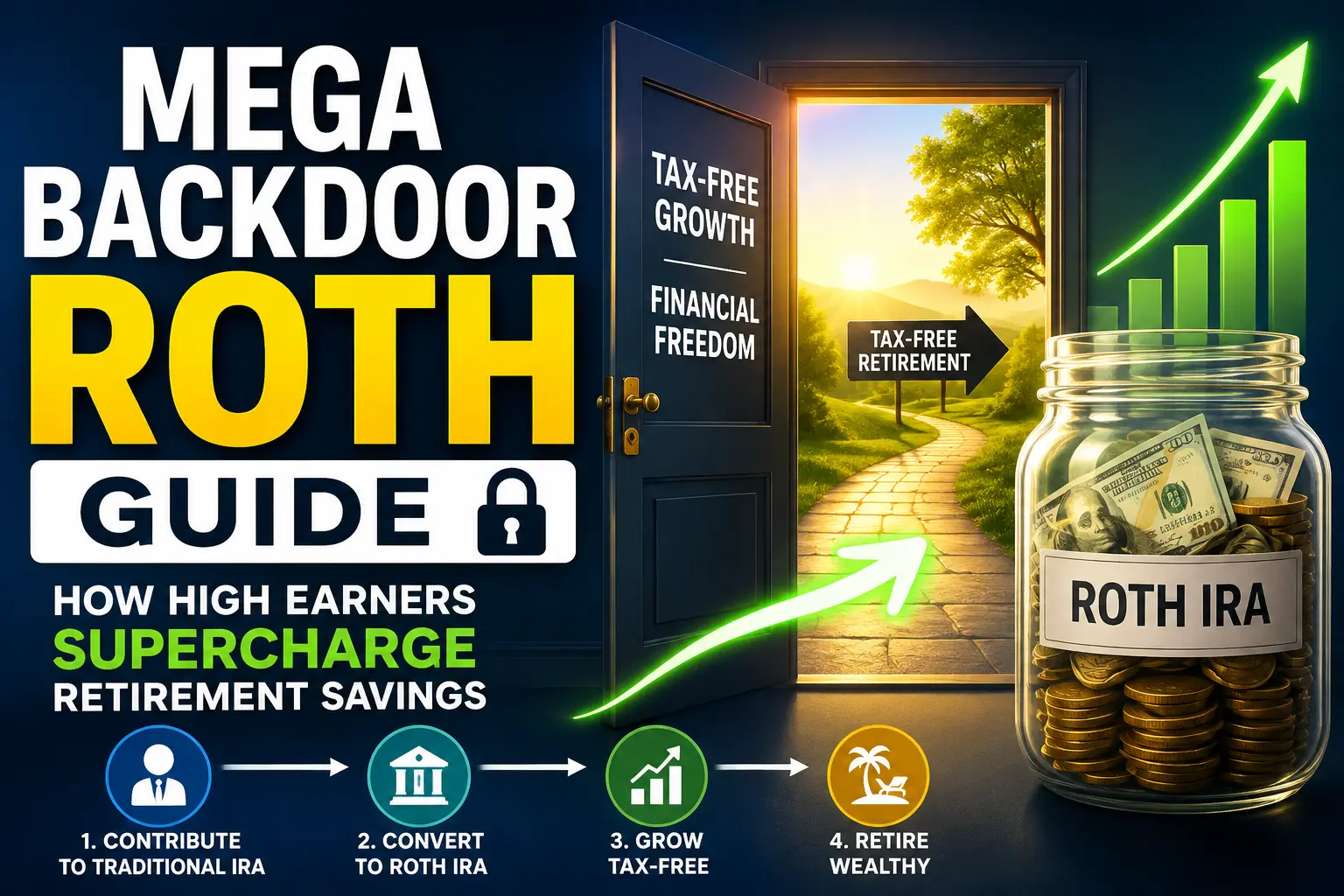
Direct Roth IRA contributions are barred for single filers earning over $168,000 or married couples filing jointly earning over $252,000.
While a standard Backdoor Roth IRA allows high earners to contribute up to $7,500, there is a far more powerful strategy available for high-income tech workers and corporate employees: The Mega Backdoor Roth.
Through a Mega Backdoor Roth strategy, eligible 401(k) plan participants can move up to $72,000 total in annual 401(k) contributions ($80,000 if age 50 or older) into tax-free Roth accounts.
This guide breaks down exactly how the Mega Backdoor Roth works, the specific plan criteria required to execute it, and a step-by-step walkthrough for Fidelity and Vanguard accounts.
What Is a Mega Backdoor Roth?
A Mega Backdoor Roth is a two-step financial strategy that leverages the total IRS 401(k) limit rather than just the standard employee elective deferral limit.
In 2026, the IRS caps standard elective 401(k) contributions (pre-tax or Roth) at $24,500.
Section 415(c) of the Tax Code sets the total annual addition limit across all 401(k) sources—including employer match and voluntary after-tax contributions—at $72,000 ($80,000 for age 50+).
Standard Pre-Tax/Roth Limit ($24,500)
  + Employer Match (e.g., $10,000)
  + Voluntary After-Tax Contributions ($37,500)
===================================================
Total IRS 401(k) Limit = $72,000
By filling that remaining gap with after-tax 401(k) contributions and immediately converting them into a Roth 401(k) or Roth IRA, high earners can bypass standard Roth IRA income restrictions and shield tens of thousands of dollars from income and capital gains taxes permanently.
The 2 Non-Negotiable 401(k) Plan Rules
Before attempting this strategy, review your employer’s 401(k) Plan Summary Description. The Mega Backdoor Roth only works if your employer’s plan allows two specific features:
- Voluntary After-Tax Contributions: Your plan must explicitly allow you to contribute funds beyond the $24,500 deferral limit using After-Tax dollars. (Note: “After-Tax” is legally distinct from “Roth 401(k)” deferrals).
- In-Service Conversions or Distributions: Your plan must permit either In-Plan Roth Conversions (moving funds from After-Tax to Roth 401(k) while still employed) or In-Service Distributions (rolling after-tax funds out of the 401(k) into an external Roth IRA).
If your company’s plan lacks these features, you cannot execute a Mega Backdoor Roth conversion.
Step-by-Step Execution Guide
Step 1: Max Out Your Standard 401(k) Elective Deferrals
Ensure you contribute the full $24,500 limit into your regular pre-tax or Roth 401(k). If your company offers a 401(k) match, make sure you contribute enough to receive 100% of the employer match first.
Step 2: Calculate Your Maximum After-Tax Allocation
Determine your maximum allowed After-Tax room using the formula below:
$72,000
- (Your Regular Pre-Tax/Roth 401k Amount)
- (Your Estimated Employer Match Amount)
= Max After-Tax Contribution Space
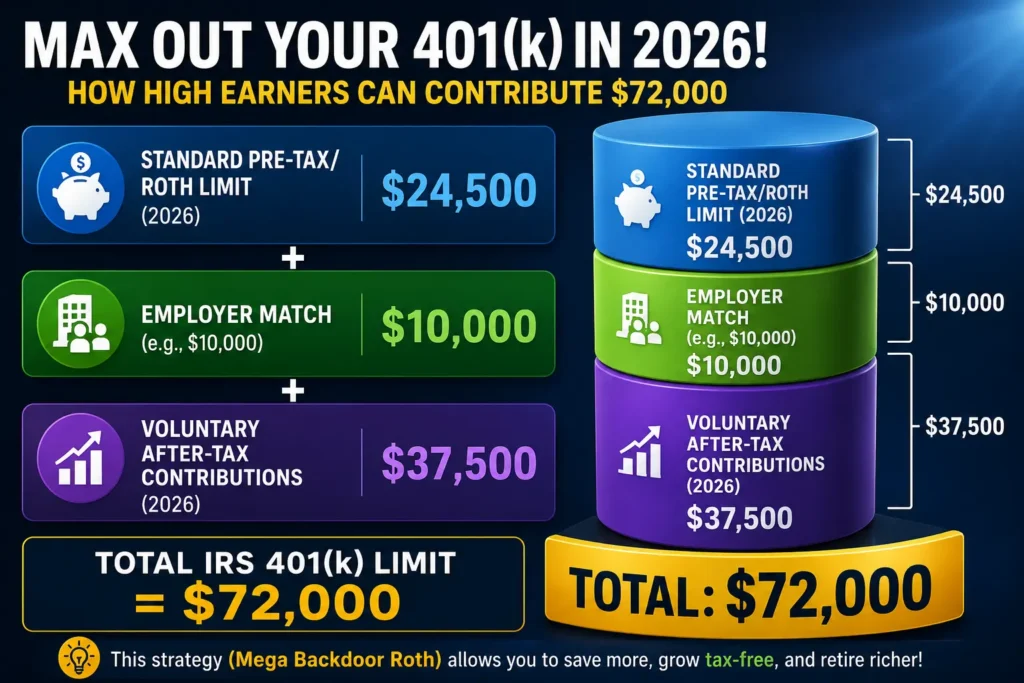
Example: If you contribute $24,500 and your employer matches $10,000, your remaining space for After-Tax contributions is $37,500 ($72,000 − $24,500 − $10,000).
Step 3: Enable After-Tax Payroll Deductions
Log into your retirement plan portal (e.g., Fidelity NetBenefits, Vanguard, or Schwab) and update your contribution elections. Allocate a percentage of your salary toward After-Tax 401(k) contributions until you reach your target amount.
Step 4: Execute the Immediate Conversion
To avoid paying taxes on earnings, convert after-tax dollars to Roth as quickly as possible.
- At Fidelity (Auto-Conversion): Call Fidelity NetBenefits or navigate online to set up Automatic In-Plan Spot Conversions. This automatically converts after-tax contributions to Roth 401(k) cash every pay period the day funds land in your account.
- At Vanguard: If auto-conversion isn’t active in your employer’s portal, navigate to
Transfers & Withdrawals>Convert After-Tax to Roth. Request an In-Plan Conversion to Roth 401(k) or an In-Service Rollover to a Vanguard Roth IRA.
Important Tax Considerations & Form 8606
Executing a Mega Backdoor Roth requires careful handling during tax season:
- Tax on Earnings: The principal after-tax dollars convert tax-free because income taxes were already paid. However, if your after-tax contributions sat in money market or index funds and accrued earnings before conversion, those earnings are taxable income in the year converted. Setting up automated daily/pay-period conversions minimizes taxable earnings.
- IRS Reporting (Form 1099-R): In January, your plan custodian will issue Form 1099-R. Box 1 shows the gross distribution, Box 2a shows taxable earnings (if any), and Box 5 shows your nontaxable after-tax basis. Report these figures on IRS Form 8606 or standard tax preparation software to confirm no double taxation occurs.
Some Interesting Questions
What is the difference between Roth 401(k) and After-Tax 401(k)?
A Roth 401(k) contribution is an elective deferral capped at $24,500 per year. An After-Tax 401(k) contribution is a separate category that sits in a taxable holding bucket, allowing you to bypass the $24,500 cap up to the $72,000 Section 415(c) limit before converting it to Roth.
Does the Pro-Rata Rule apply to a Mega Backdoor Roth?
No. The IRS Pro-Rata Rule applies to traditional IRA conversions when holding pre-tax IRA assets. A Mega Backdoor Roth takes place entirely inside a qualified workplace 401(k) plan, keeping your after-tax 401(k) basis separated from pre-tax IRAs.
What happens if I convert after-tax money that generated earnings?
You have two options:
- Convert both principal and earnings to a Roth account, paying ordinary income tax on the earnings portion for that tax year.
- Direct the principal basis into a Roth account and roll the taxable earnings portion into a Traditional pre-tax IRA to defer taxes.