Want to earn interest on cash without locking it away for years? Buying Treasury bills through Fidelity lets you purchase short-term U.S. government securities in your brokerage account. The process can be confusing if you have never used the fixed-income trading screen, especially when choosing between new-issue auctions and existing bills. This guide walks you through the steps, explains how much you need, shows how maturity payments work, and helps you decide whether Fidelity’s Auto Roll feature fits your cash-management plan.
Buying T-bills at Fidelity
- Open and fund an eligible Fidelity brokerage account.
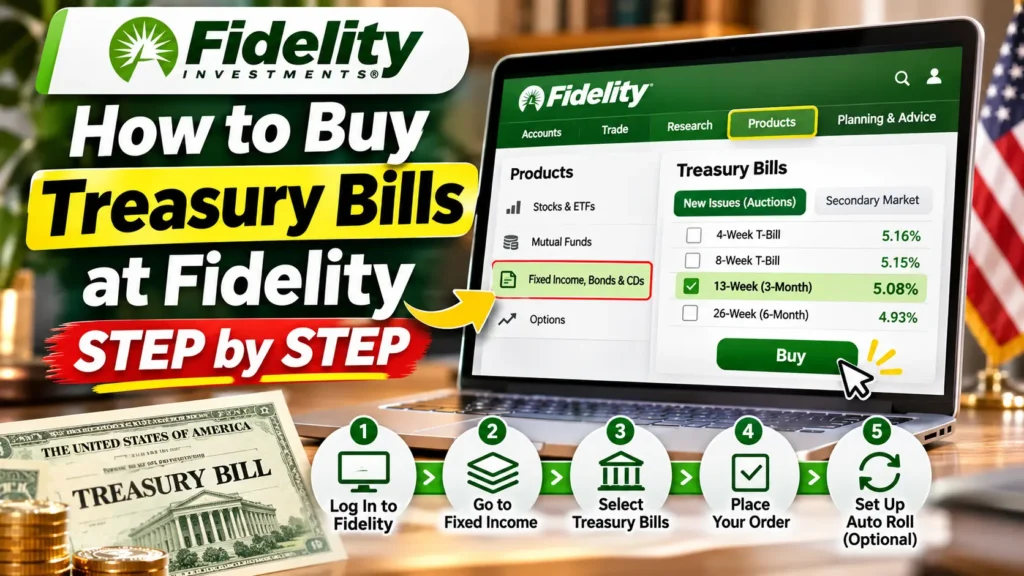
- Go to Products → Fixed Income, Bonds & CDs or use Fidelity’s fixed-income search.
- Choose New Issues for Treasury auction purchases or search the secondary market for existing bills.
- Select a maturity, review the estimated yield and purchase amount, and enter the quantity.
- Preview the order and submit it before the auction cutoff, if buying a new issue.
Fidelity lists a typical minimum of $1,000 in face value for Treasury bills. Online Treasury auction orders placed through Fidelity.com are free of charge under its published terms; representative-assisted orders incur a service fee.
Official source: Fidelity’s U.S. Treasury securities guide.
What Are Treasury Bills?
Treasury bills, commonly called T-bills, are short-term debt securities issued by the U.S. Department of the Treasury. They mature in one year or less and are generally sold at a discount to their face value.
Unlike Treasury notes and bonds, most T-bills do not make periodic interest payments. Instead, you receive the face value at maturity. The difference between your purchase price and the amount you receive is your return, assuming you hold the bill to maturity.
Example: How a Treasury bill earns money
Suppose you purchase a hypothetical T-bill with a $1,000 face value for $985. When it matures, you receive $1,000. Your gross return is $15.
Face value at maturity: $1,000
Purchase price: $985
Difference: $1,000 − $985 = $15
This is an illustration, not a current Fidelity quote. The actual purchase price depends on the auction result or secondary-market price.
Treasury bills are backed by the U.S. government and are generally considered to have very low credit risk. They are not risk-free in every respect: inflation can reduce purchasing power, and a bill sold before maturity can be worth more or less than its purchase price.
How to Buy Treasury Bills at Fidelity: Step by Step
Step 1: Open and fund your Fidelity account
You need an eligible Fidelity account that supports fixed-income trading. Many individual and joint brokerage accounts can hold Treasury securities. Eligible retirement accounts may also offer Treasury trading, subject to account rules.
If you already have a Fidelity brokerage account, check your available cash balance. Otherwise, open an eligible account and transfer funds from your bank using a supported funding method.
Make sure the money will be available by the purchase’s settlement date. A displayed account balance does not always mean every dollar is immediately available to trade.
Step 2: Open Fidelity’s Fixed Income section
Sign in to Fidelity on a web browser. Navigate to the Products menu and select Fixed Income, Bonds & CDs. From there, open the investment search or bond offerings page.
Fidelity periodically updates its interface, so menu labels may differ slightly. You can also start from its official U.S. Treasury securities page.
Step 3: Choose New Issues or the secondary market
For a newly issued Treasury bill, open the New Issues section and find the Treasury offerings. This route lets you submit an order for an upcoming U.S. Treasury auction.
If you want to buy a bill that has already been issued, search the secondary market. Existing bills can offer maturity dates that better match your needs, but their prices reflect current market conditions.
Step 4: Choose a Treasury bill maturity
Fidelity lists common T-bill terms such as 4, 6, 8, 13, 17, 26, and 52 weeks, subject to the current auction schedule and availability. A 13-week bill is commonly described as a 3-month Treasury bill.
Consider when you will need the money. A shorter term may return your cash sooner, while a longer term can lock in an auction yield for a longer period. Neither maturity is always better; available yields change with market conditions.
- 4–8 weeks: For cash you may need relatively soon.
- 13 weeks: A common choice for short-term cash planning.
- 26 weeks: For money you can leave invested for about six months.
- 52 weeks: For cash you do not expect to need for roughly one year.
Step 5: Review the auction or market details
Before placing an order, review the maturity date, estimated yield, issue or settlement date, and purchase amount. For auction orders, the final price and yield are determined by the auction rather than fixed at the moment you submit your order.
For secondary-market bills, pay close attention to the quoted price, yield to maturity, and maturity date. The yield to maturity is an annualized estimate of the return if you buy at the quoted price and hold the security to maturity, subject to the quote’s assumptions.
Step 6: Enter your quantity
Fidelity’s published Treasury bill information lists a minimum denomination of one bill, representing $1,000 in face value. The amount you pay is generally below the face value for a discount-priced bill.
| Quantity | Face value | What to remember |
|---|---|---|
| 1 bill | $1,000 | Typical minimum face value at Fidelity |
| 5 bills | $5,000 | Purchase price is based on the applicable discount |
| 10 bills | $10,000 | Check that sufficient cash is available |
Do not assume that you will pay exactly the face value. The order preview should show the estimated cost or price for the selected security.
Step 7: Preview and place the order
Review the order before submitting it. Confirm the account, security, quantity, estimated cost, maturity, and any Auto Roll selection.
- Confirm you selected a Treasury bill rather than a Treasury note, bond, or mutual fund.
- Verify the maturity date and quantity.
- Check the estimated yield and purchase amount.
- Review whether Auto Roll is enabled or disabled.
- Submit the order and check the order-status screen for confirmation.
For a new-issue order, make sure you submit before Fidelity’s stated cutoff. For a secondary-market order, the order may need to execute at the quoted price or within the limits you set.
New-Issue Treasury Bills vs. Secondary-Market T-bills
Fidelity allows customers to purchase Treasury securities at government auctions and on the secondary market. Each route has advantages.
| Feature | New issue | Secondary market |
|---|---|---|
| What you buy | A newly issued T-bill | An existing T-bill |
| Pricing | Determined by the Treasury auction | Based on current market prices |
| Yield certainty before order | Final auction yield is not known when you submit the order | Quoted yield is available before you submit, but execution price can vary |
| Maturity choice | Limited to currently offered issues | Choose among available existing bills |
| Online Fidelity auction fee | $0 under published terms | Check current transaction terms and quoted price |
| Best suited for | Planned purchases and recurring maturity schedules | Specific maturity needs or purchases between auctions |
Fidelity states that online Treasury auction orders placed through Fidelity.com are free of charge. Orders placed with a representative carry a published $19.95 service fee. Verify the current fee schedule before trading.
When Are Treasury Bills Auctioned?
The Treasury publishes an auction schedule for bills, including common 4-, 8-, 13-, 17-, 26-, and 52-week maturities. Many short-term bill auctions occur weekly, while 52-week bills are generally auctioned every four weeks. The schedule can change around holidays or other Treasury funding needs.
Three dates are especially important:
- Announcement date: The Treasury announces the offering details.
- Auction date: The auction determines the price and yield.
- Issue or settlement date: The bill is issued and the purchase is settled.
Use the official TreasuryDirect auction schedule to check upcoming dates. Fidelity’s listing and order deadline determine when you must submit your order through the brokerage.
How Fidelity T-bill Auto Roll Works
Fidelity’s Auto Roll service can automatically reinvest eligible maturing Treasury securities into another eligible issue. This can be useful if you want to maintain a short-term Treasury strategy without manually placing every new order.
With Auto Roll, your maturing investment proceeds are used to purchase a new eligible security according to the service’s terms. The new bill’s yield will reflect the new auction, so it may be higher or lower than the yield on your previous bill.
How to use Auto Roll
- Choose an eligible Treasury bill and open its order ticket.
- Look for the Auto Roll option in the order process, if available.
- Read the eligibility rules and confirm that the security and account qualify.
- Enable the option if you want automatic reinvestment.
- Monitor upcoming maturities and check that reinvestments match your cash needs.
Learn more on Fidelity’s Treasury securities page, which links to the Auto Roll service information and eligibility details.
Can You Buy 3-Month Treasury Bills at Fidelity?
Yes. A 13-week Treasury bill is the common equivalent of a three-month T-bill. To find one, open Fidelity’s fixed-income search, choose New Issues, and look for the Treasury bill with the 13-week term. Availability depends on the current auction calendar.
If you want to buy between auctions, look for existing bills in the secondary market and compare their remaining time to maturity. Check the actual maturity date rather than relying only on a term label.
Treasury Bill Taxes and Risks
How are T-bill earnings taxed?
Interest income from U.S. Treasury bills is generally subject to federal income tax but exempt from state and local income taxes. Tax reporting depends on the transaction and your circumstances. Treasury bill discount income is generally reported as interest when the bill matures, and Fidelity may provide the relevant tax form for a taxable account.
For the official explanation, see the IRS Publication 17 and IRS Topic 403: Interest Received.
What are the main risks?
- Early-sale risk: If you sell before maturity, the market price may be lower than what you paid.
- Inflation risk: Your return may not keep up with rising prices.
- Reinvestment risk: A maturing bill may need to be reinvested at a lower yield.
- Liquidity planning: Your money is committed until maturity unless you sell or otherwise access it under the account’s rules.
Treasury bills are not bank deposits and are not FDIC-insured. Their U.S. government backing means they have very low credit risk, but it does not eliminate market or inflation risk.
Should You Buy Individual T-bills or a Treasury Fund?
Individual Treasury bills and Treasury money market funds are different investments. A T-bill has a specific maturity date, and you receive its face value at maturity. A Treasury money market mutual fund holds a portfolio of short-term instruments and generally seeks to maintain a stable share price, but it does not have a single maturity date for your investment.
| Feature | Individual T-bill | Treasury money market fund |
|---|---|---|
| Maturity | Fixed date | No single maturity date for the fund investment |
| Purchase method | Buy a specific security at auction or on the secondary market | Buy fund shares |
| Return | Determined by purchase price and maturity proceeds if held to maturity | Income and yield vary with the fund’s portfolio and expenses |
| Access to cash | At maturity or by selling before maturity | Subject to fund transaction and settlement rules |
Fidelity offers money market funds, but a fund is not the same as buying a three-month Treasury bill directly. Compare holdings, yield, expenses, liquidity, and risk before choosing between them.
Frequently Asked Questions
1. How much money do I need to buy Treasury bills at Fidelity?
Fidelity lists a typical minimum of $1,000 in face value for a Treasury bill, with additional purchases in $1,000 increments. Your actual purchase cost is generally below face value for a discount-priced bill. Minimums can differ when buying directly through TreasuryDirect.
2. Does Fidelity charge a fee to buy Treasury bills?
Fidelity’s published terms state that online Treasury auction orders placed through Fidelity.com are free of charge. Orders placed with a representative carry a $19.95 service fee. Review current pricing and secondary-market transaction details before ordering.
3. Can I buy Treasury bills through Fidelity on a phone?
You can use a web browser on a phone to access Fidelity’s website, but the trading interface and features may differ from the desktop experience. Check Fidelity’s current mobile trading support for fixed-income securities before relying on the app.
4. What happens when a Treasury bill matures at Fidelity?
If you hold the bill to maturity, the face value is generally credited to your account according to the security’s terms. If Auto Roll is enabled for an eligible security, Fidelity may use the proceeds to purchase another eligible Treasury issue.
5. Can I sell a Treasury bill before maturity?
Yes, Treasury bills can generally be sold on the secondary market before maturity. However, the market price can fluctuate, so you could receive less than you paid. Selling early can also change your realized return.
6. Are Treasury bills exempt from state taxes?
Interest from U.S. Treasury bills is generally exempt from state and local income taxes but subject to federal income tax. Review IRS guidance or consult a qualified tax professional for your circumstances.
7. Is a 3-month Treasury bill the same as SPAXX?
No. A 13-week Treasury bill is an individual security with a set maturity date. Spaxx is a Fidelity government money market mutual fund. Their holdings, returns, tax treatment, liquidity, and investment structure differ.
8. Is TreasuryDirect better than Fidelity for buying T-bills?
It depends on how you manage your money. TreasuryDirect allows eligible investors to buy Treasury securities directly from the government, with a lower published minimum for bills. Fidelity offers brokerage account integration and access to both new issues and the secondary market. Compare minimums, transfer needs, available features, and fees before choosing.
Official Sources and Further Reading
- Fidelity: U.S. Treasury Securities — Available maturities, minimum denominations, auction fees, and Auto Roll information.
- TreasuryDirect: Treasury Bills — Official terms, maturities, minimums, and tax treatment.
- TreasuryDirect: Auction Schedule — Upcoming auction timing and issue dates.
- IRS: Interest Received — Federal and state tax treatment of Treasury interest.
- IRS Publication 17 — Federal income tax guidance.
Ready to buy your first Treasury bill?
Start by checking Fidelity’s available Treasury auctions and current estimated yields. Choose a maturity that matches when you may need the money, review the full order preview, and decide whether you want to manage maturities manually or use eligible Auto Roll features.
Explore Treasury bills at Fidelity | Check the Treasury auction schedule
Disclaimer
This article is for informational and educational purposes only and is not financial, investment, tax, or legal advice. Treasury yields, prices, auction dates, account features, fees, and eligibility requirements can change. Treasury bills have market and inflation risks, especially if sold before maturity. Review current terms directly with Fidelity, TreasuryDirect, and the IRS, and consult a qualified professional if you need advice tailored to your circumstances.
Related Posts:
- What Is FDLXX? Yield, Tax Perks & Who Should Use It
- ACA Open Enrollment 2027: Key Dates, Premium Increases, and What Lost Subsidies Mean for You
- Tax Brackets Married Filing Jointly: Rates & Calculator Guide
- How to Avoid State Taxes on Treasury Interest: A Guide for U.S. Investors
- Treasury Bills vs. CDs: Which Is Right for Short-Term Savings?