Schwab Checking vs Savings: Which Is Better in 2026?
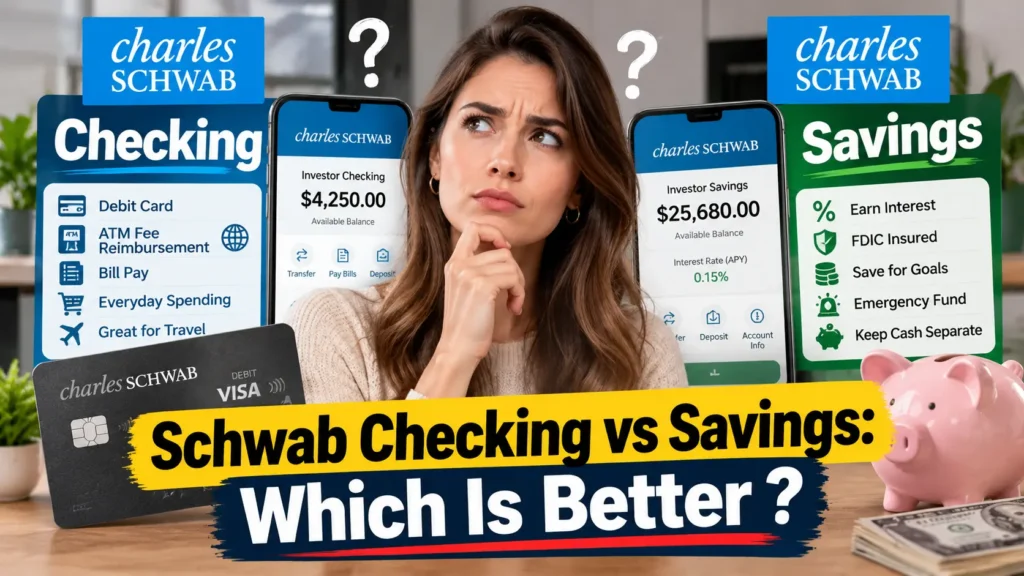
Choosing between Schwab Bank Investor Checking and Investor Savings comes down to how you use your money. Checking is designed for everyday transactions and offers a particularly attractive combination of worldwide ATM fee rebates and no foreign transaction fees. Savings is another option for holding Cash, but its interest rate is relatively low compared with many high-yield savings accounts. Here is how the accounts compare on interest, fees, debit-card access, insurance, and everyday convenience so you can decide where your money belongs.
TL;DR: Schwab Checking vs Savings
- Choose Investor Checking for everyday purchases, bill payments, direct deposits, and international travel.
- Choose Investor Savings if you want a separate bank savings account for cash reserves and prefer keeping savings apart from routine spending.
- Compare the APY before opening either account. Schwab’s published savings rate is low compared with many dedicated high-yield savings accounts.
- Consider a separate high-yield savings account if earning more interest on emergency savings is your priority.
Both Schwab Bank accounts generally have no monthly service fee and no minimum opening deposit. Schwab’s Investor Checking account requires a linked Schwab One brokerage account.
Verify current terms on the official Schwab Checking FAQ and Investor Savings page.
Schwab Checking vs Savings: Key Differences
Schwab Bank offers two consumer deposit accounts with overlapping features but different purposes. Investor Checking is built around everyday banking. Investor Savings is intended for setting money aside. Both offer online account access and ATM fee rebates, so the choice is not as simple as assuming that only checking can be used to access cash.
| Feature | Investor Checking | Investor Savings |
|---|---|---|
| Primary purpose | Everyday spending and payments | Holding savings and cash reserves |
| Monthly service fee | $0 | $0 |
| Minimum opening deposit | $0 | $0 |
| Interest rate | Variable; verify the current rate | Variable; verify the current rate |
| ATM fee rebates | Unlimited eligible ATM fee rebates worldwide | Unlimited eligible ATM fee rebates worldwide, according to Schwab’s published product information |
| Foreign transaction fees | No foreign transaction fees on eligible debit-card transactions under account terms | Check the current account and card terms; do not assume checking’s fee waiver applies identically |
| Debit card | Schwab Bank Visa Platinum Debit Card | Check current card availability and account terms |
| Checks and bill pay | Free standard checks and Schwab Bank Bill Pay | Check current account features and availability |
| Linked brokerage account | Required | Not generally required just to open Investor Savings |
| FDIC protection | Eligible deposits insured within applicable limits | Eligible deposits insured within applicable limits |
Schwab’s terms can change, and product features are not necessarily identical across account types. Consult the checking FAQ and savings account page before applying.
What Is Schwab Bank Investor Checking?
Schwab Bank Investor Checking is an online checking account designed for daily money management. It works alongside a Schwab One brokerage account, allowing customers to move money between banking and investing.
Key features include:
- No monthly service fee.
- No minimum balance requirement to maintain the account.
- A Schwab Bank Visa Platinum Debit Card.
- Unlimited eligible ATM fee rebates worldwide.
- No foreign transaction fees on eligible debit-card transactions under Schwab’s terms.
- Online bill pay, standard checks, and mobile check deposit.
- Account alerts and card lock/unlock security features.
- Transfers to and from a linked Schwab One brokerage account.
Why travelers often prefer Schwab checking
ATM fees can add up quickly when traveling. An ATM operator may charge its own fee even when your bank does not. Schwab’s eligible ATM fee reimbursement policy helps offset those charges, including qualifying fees at ATMs outside the United States.
The checking account’s foreign transaction fee policy can also make it attractive for eligible purchases abroad. Currency conversion still affects the amount you ultimately pay, and merchants may offer their own conversion options. When paying abroad, choosing the local currency rather than accepting a merchant’s conversion is often worth considering.
What Is Schwab Bank Investor Savings?
Investor Savings is Schwab Bank’s savings account for customers who want to hold cash separately from daily spending. It can be useful for emergency reserves, planned expenses, or money that you do not need to spend regularly.
Its main advantages include:
- No monthly service fee.
- No minimum opening deposit.
- FDIC insurance on eligible deposits within applicable limits.
- Online access and supported transfers.
- Mobile check deposit.
- Unlimited eligible ATM fee rebates worldwide, according to Schwab’s published savings account details.
However, a savings account is not automatically a high-yield account. Schwab Investor Savings has historically offered a low APY compared with many online savings competitors. If you are keeping thousands of dollars in emergency savings for months or years, that difference may matter more than the convenience of holding everything at one institution.
Is Schwab savings suitable for an emergency fund?
It can be, particularly if you value having cash at Schwab and want a separate account for unexpected expenses. But consider the account’s current interest rate, access arrangements, and your need for a higher return.
A high-yield savings account at another FDIC-insured bank may earn substantially more while still keeping emergency funds accessible. Compare rates and terms rather than assuming the familiar brand offers the best yield.
Schwab Checking vs Savings Interest Rate: Which Pays More?
The annual percentage yield (APY) measures the annual return on a deposit while accounting for compounding, assuming the rate and balance remain unchanged for the stated period. Both Schwab account rates are variable and can change.
Schwab’s published Investor Savings page has listed a 0.15% APY, while its checking rate has been listed at 0.01% APY in third-party comparisons. Because rates can change, confirm both rates directly before relying on these figures.
| Account or option | Illustrative APY | Best use |
|---|---|---|
| Schwab Investor Checking | 0.01% (verify current rate) | Everyday transactions and travel |
| Schwab Investor Savings | 0.15% (verify current rate) | Separate cash savings |
| External high-yield savings account | Varies by bank and offer | Potentially higher return on savings |
Rate note: The Schwab rates above are reference figures reported in published product information, not a guarantee of the rate available when you read this article. Check Schwab’s current savings page and official pricing and rate information.
Example: How much interest could you earn?
Suppose you keep $10,000 in savings for a full year. At a hypothetical 0.15% APY, you would earn approximately $15 in interest over a year, assuming the rate stays constant and ignoring taxes.
At a hypothetical 4.00% APY, the same balance would earn approximately $400 over a year under the same simplified assumptions. The difference would be about $385.
Schwab Debit Card and ATM Fees: Checking vs Savings
One common misconception is that Schwab’s savings account is difficult to access. Schwab’s published Investor Savings page also advertises unlimited worldwide ATM fee rebates. That means ATM reimbursement alone may not settle the decision between checking and savings.
The checking account has a clearer everyday-payment role. It includes a Visa debit card, bill pay, checks, and no foreign transaction fees on eligible card transactions. These features can make it a more natural account for receiving income and paying recurring expenses.
For savings, confirm which card and payment features are currently available under the account terms. Do not assume every checking feature, especially the foreign transaction fee waiver or payment services, applies identically to savings.
Also remember that Schwab does not generally provide a way to deposit physical cash directly into these online accounts. If you regularly receive cash, you may need a separate bank or credit union that accepts cash deposits.
Are Schwab Checking and Savings FDIC-Insured?
Eligible deposits in Schwab Bank Investor Checking and Investor Savings are insured by the Federal Deposit Insurance Corporation (FDIC), subject to applicable rules and limits. The standard limit is $250,000 per depositor, per insured bank, per ownership category.
For example, checking and savings balances held in the same ownership category at the same insured bank generally count toward the same $250,000 limit. Opening two accounts at the same bank does not automatically double your coverage.
Schwab’s brokerage account is different from its bank deposit accounts. Investments held in a brokerage account are not bank deposits and can lose value. SIPC protection may apply to eligible brokerage customer assets if a member brokerage firm fails and assets are missing, but SIPC does not protect against ordinary investment losses.
For the official rules, review the FDIC’s deposit insurance guide and SIPC’s explanation of investor protection.
Why This Choice Matters in 2026
Inflation and changing interest rates make it important to distinguish money needed for immediate expenses from money that can remain in savings. When prices rise, cash that earns little interest can lose purchasing power over time.
That does not mean every dollar should be moved to the highest-yielding account. Money for rent, groceries, insurance premiums, and unexpected bills needs to be accessible. The better approach is to compare the account’s APY with its convenience, fees, and withdrawal arrangements.
For checking, the value may come from fee savings and payment features. For savings, the return on your balance becomes more important as the balance and holding period increase.
To follow U.S. inflation trends, consult the Bureau of Labor Statistics Consumer Price Index. For guidance on comparing deposit accounts and understanding bank fees, see the Consumer Financial Protection Bureau’s bank account resources.
Which Schwab Account Should You Choose?
Choose Investor Checking if:
- You want an everyday account for purchases, bills, and direct deposits.
- You travel internationally and value ATM fee rebates.
- You want checking features integrated with your Schwab brokerage account.
- You want online bill pay, checks, and a debit card.
Choose Investor Savings if:
- You want to separate reserve money from everyday spending.
- You prefer holding cash in a dedicated bank savings account.
- You understand its current APY and are comfortable with the return.
- You want a savings account without a monthly service fee.
Consider using both if:
- You want checking for everyday payments and savings for planned expenses.
- You value keeping your cash organized into separate balances.
- You are comfortable managing both accounts and monitoring their rates.
Consider a high-yield savings account elsewhere if:
- Your main priority is earning more interest on an emergency fund.
- You do not need all your cash held at Schwab.
- You have compared the APY, fees, transfer times, and FDIC coverage.
Frequently Asked Questions
1. Is Schwab checking better than Schwab savings?
Schwab Investor Checking is generally better for everyday transactions and international travel. Investor Savings is designed for setting cash aside. Both have no monthly service fee and advertise ATM fee rebates, so consider payment features and interest rates when deciding.
2. What is the Schwab checking account interest rate?
The checking account earns a variable rate. Published comparisons have listed its APY at 0.01%, but rates may change. Check Schwab’s current rate information before opening an account.
3. Does Schwab savings pay more interest than checking?
Investor Savings has historically paid a higher APY than Investor Checking. However, both rates can be low compared with dedicated high-yield savings accounts. Compare current rates rather than relying on historical figures.
4. Does Schwab savings offer ATM fee reimbursement?
Yes. Schwab’s published Investor Savings information advertises unlimited worldwide ATM fee rebates. Review the current account terms for the exact eligibility and reimbursement conditions.
5. Do I need a brokerage account for Schwab checking?
Yes. Schwab Bank Investor Checking is linked to a Schwab One brokerage account. Schwab states that the accounts have no monthly service fees when opened together, although other brokerage fees and investment expenses may apply.
6. Can I use Schwab checking internationally?
Yes. The checking account offers worldwide ATM fee rebates and no foreign transaction fees on eligible debit-card transactions under its terms. Currency conversion rates and merchant conversion choices can still affect the total cost.
7. Is Schwab Investor Savings a high-yield savings account?
Not by typical high-yield savings standards. Its published APY has been relatively low compared with many online savings accounts. If earning interest is your priority, compare current rates from multiple FDIC-insured banks.
8. Can I open both Schwab checking and savings?
Eligible customers can generally maintain both accounts. Using checking for regular payments and savings for reserves can help with budgeting, but compare the interest rate and features of each account before deciding how much money to keep in either one.
Sources and Further Reading
- Charles Schwab: Investor Checking FAQs — Account requirements, ATM rebates, payments, and fees.
- Charles Schwab: Investor Savings — Savings features, current advertised APY, and account information.
- Schwab MoneyWise: Choosing the Right Accounts — Educational information about account selection.
- NerdWallet: Charles Schwab Bank Review — Independent account review and comparison.
- FDIC: Deposit Insurance — Official deposit insurance rules.
- CFPB: Bank Account Resources — Consumer guidance on bank accounts and fees.
- U.S. Bureau of Labor Statistics: CPI — Official inflation data.
Disclaimer
This article is for informational and educational purposes only. It does not constitute financial, investment, tax, or legal advice. Interest rates, account features, fees, eligibility, and insurance rules can change. Verify current information directly with Charles Schwab Bank and the relevant official agencies. Consider speaking with a qualified financial professional if you need advice tailored to your circumstances.
Ready to choose your Schwab account?
Start by checking the current APY and account terms. If everyday payments and international ATM access are your priorities, compare Investor Checking’s benefits. If your goal is building savings, compare Investor Savings with competitive high-yield savings accounts before moving your cash.
Related Posts:
- What Is FDLXX? Yield, Tax Perks & Who Should Use It
- ACA Open Enrollment 2027: Key Dates, Premium Increases, and What Lost Subsidies Mean for You
- Tax Brackets Married Filing Jointly: Rates & Calculator Guide
- How to Avoid State Taxes on Treasury Interest: A Guide for U.S. Investors
- Treasury Bills vs. CDs: Which Is Right for Short-Term Savings?