If you have cash sitting in a Charles Schwab brokerage account, you may be wondering whether SNSXX or SWVXX is the better place to keep it.
Both are Schwab money market mutual funds designed to provide income while maintaining liquidity and seeking to preserve your investment’s value.
But there’s an important difference:
SNSXX invests in U.S. Treasury obligations, while SWVXX invests in a broader mix of short-term debt issued by corporations, financial institutions, and government-related entities.
That difference affects the funds’ yields, credit exposure, and potential state tax benefits.
As of October 8, 2026, Schwab reported a 7-day yield of 3.55% for SNSXX and 3.70% for SWVXX. SWVXX was paying more at that snapshot, but its higher yield does not automatically make it the better choice for every investor.
In this guide, we’ll compare SNSXX vs. SWVXX, explain their current yields and fees, examine their tax treatment, and show when each fund may make sense for your cash.
SNSXX vs. SWVXX
Quick Comparison
Compare yields, expenses, investments, tax considerations, and key features.
| Feature | SNSXX Treasury Money Fund | SWVXX Prime Advantage Money Fund |
|---|---|---|
| Full fund name | Schwab U.S. Treasury Money Fund — Investor Shares | Schwab Prime Advantage Money Fund — Investor Shares |
| Fund category | Government money market | Prime money market |
| Main investments | U.S. Treasury obligations | Short-term debt from corporate, financial, and government-related issuers |
| 7-day yield (Oct. 8, 2026) | 3.55% Annualized yield | 3.70% Annualized yield |
| Net expense ratio | 0.34% | 0.34% |
| Gross expense ratio | 0.35% | 0.35% |
| Minimum initial investment | No minimum | No minimum |
| Target share price | $1.00 per share | $1.00 per share |
| FDIC-insured | No | No |
| Potential state tax benefit | Qualifying Treasury income is generally exempt from state and local income taxes, subject to applicable rules. | Tax treatment depends on the income source. Do not assume the same Treasury-related exemption. |
| Best suited for | Investors prioritizing Treasury exposure and potential state-tax benefits. | Investors seeking potentially higher income from a broader short-term portfolio. |
Important: Money market mutual funds are not FDIC-insured or guaranteed by the government. They seek to maintain a $1.00 share price, but investors can lose money. Yields can change. Verify current yields, expenses, minimums, and tax information with Schwab before investing.
Source: Schwab Asset Management’s money fund yield table, dated October 8, 2026. Yields change over time and are not guaranteed. Official Schwab yield data.
What Is SNSXX?
SNSXX is the Schwab U.S. Treasury Money Fund — Investor Shares. It seeks to provide the highest current income consistent with stability of capital and liquidity.
The fund typically invests in securities backed by the full faith and credit of the U.S. government, with a focus on U.S. Treasury obligations.
Treasury bills, notes, and other Treasury securities are used to generate income for the fund. The fund distributes income to shareholders, subject to its distribution policies and investment results.
Why investors choose SNSXX
1. Treasury-focused holdings
SNSXX is designed for investors who want their money market investments concentrated in U.S. Treasury obligations rather than a broader mix of corporate and financial institution debt.
This can be appealing if your priority is the type of assets held in the fund, not simply the highest available yield.
2. Potential state income tax savings
Interest attributable to qualifying U.S. Treasury obligations is generally exempt from state and local income taxes.
Because SNSXX focuses on Treasury securities, it may offer a meaningful tax advantage for investors who pay state income tax. The actual benefit depends on the fund’s qualifying income and the rules in your state.
3. Short-term cash management
SNSXX invests in short-term securities and seeks to maintain a stable $1 share price. Investors may use it for cash they want to keep invested while waiting for another investment opportunity or a planned expense.
What Is SWVXX?
SWVXX is the Schwab Prime Advantage Money Fund — Investor Shares. It seeks to provide current income consistent with stability of capital and liquidity.
Unlike SNSXX, SWVXX is a prime money market fund. It invests in high-quality, short-term money market instruments issued by U.S. and foreign issuers, including corporations and financial institutions.
That broader investment universe is an important reason its yield can differ from a Treasury-focused fund.
Why investors choose SWVXX
1. A potentially higher yield
Prime money market funds can offer higher yields than Treasury-focused alternatives because they invest in a different mix of short-term instruments with different credit and liquidity characteristics.
As of October 8, 2026, SWVXX’s 7-day yield was 3.70%, compared with 3.55% for SNSXX.
That difference can be attractive to investors who want to earn income on idle cash.
2. A diversified short-term portfolio
SWVXX invests across different issuers and types of short-term debt. Diversification can spread exposure across multiple holdings, although it does not eliminate credit or liquidity risk.
3. No minimum initial investment
Schwab lists no minimum initial investment for SWVXX Investor Shares. This makes the fund accessible to investors with relatively small balances, subject to account eligibility and other requirements.
What to know before buying SWVXX
SWVXX is not a Treasury-only fund. Its broader holdings can create different credit and liquidity risks from those of SNSXX.
Its income also does not receive the same blanket treatment as interest from direct U.S. Treasury obligations. Do not assume that all SWVXX distributions qualify for a state income tax exemption.
Finally, SWVXX is not FDIC-insured. Like other money market mutual funds, it seeks to maintain a stable $1 share price but cannot guarantee that outcome.
SNSXX vs. SWVXX: Latest Yields and Fees
SNSXX vs. SWVXX: Yield Comparison
Schwab’s published money fund yields as of October 8, 2026.
| Metric | SNSXX | SWVXX |
|---|---|---|
| 7-day yield | 3.55% | 3.70% |
| Yield difference | — | +0.15 percentage points |
| Gross expense ratio | 0.35% | 0.35% |
| Net expense ratio | 0.34% | 0.34% |
| Minimum initial investment | None | None |
Source:
Schwab Asset Management — Money Fund Yields
.
Note: The 7-day yield is a standardized measure of recent
fund income, expressed as an annualized rate. It is not a guaranteed future
return, and yields can change.
How much could you earn on $10,000?
SNSXX vs. SWVXX: Estimated Annual Income
See how much income different investment amounts could generate using the October 8, 2026, 7-day yields of 3.55% for SNSXX and 3.70% for SWVXX.
| Investment Amount | SNSXX 3.55% |
SWVXX 3.70% |
Difference |
|---|---|---|---|
| $5,000 | $177.50 | $185.00 | $7.50 |
| $10,000 | $355.00 | $370.00 | $15.00 |
| $25,000 | $887.50 | $925.00 | $37.50 |
| $50,000 | $1,775.00 | $1,850.00 | $75.00 |
| $100,000 | $3,550.00 | $3,700.00 | $150.00 |
Calculation: Investment amount × assumed annualized yield. These estimates do not account for taxes or changes in yield and assume the stated rates remain constant for a full year. Actual distributions may differ, and the 7-day yield is not a guaranteed annual return.
Is SWVXX worth the extra risk for 0.15% more?
That depends on your priorities.
On a $10,000 balance, the difference is approximately $15 per year before taxes if the yields stay unchanged.
Some investors may prefer SNSXX’s Treasury-focused portfolio even if its yield is slightly lower. Others may consider SWVXX’s higher yield worth evaluating in exchange for exposure to a broader range of short-term issuers.
The right comparison should consider your after-tax income, not just the yield displayed on the fund page.
SNSXX vs. SWVXX: Which Is Better for Taxes?
Taxes can change which fund is more attractive, particularly if you hold either fund in a taxable brokerage account.
Both funds generally generate income subject to federal income tax. Their state tax treatment can differ because of the securities they hold.
SNSXX and state income taxes
Interest from qualifying U.S. Treasury obligations is generally exempt from state and local income taxes.
SNSXX’s Treasury-focused portfolio may therefore offer state tax benefits. However, you should use Schwab’s annual tax information to determine the actual percentage of distributions attributable to qualifying Treasury income.
The exemption is not a reason to assume every distribution is tax-free. Your state’s rules and the fund’s reported income composition matter.
SWVXX and state income taxes
SWVXX holds a broader mix of short-term debt, including instruments issued by corporations and financial institutions.
Income from these holdings generally does not receive the same state tax exemption as qualifying direct Treasury interest. The actual treatment depends on the income source and applicable tax rules.
For a taxable brokerage account, SNSXX may have an advantage for investors in states with meaningful income taxes. But the size of that advantage needs to be calculated.
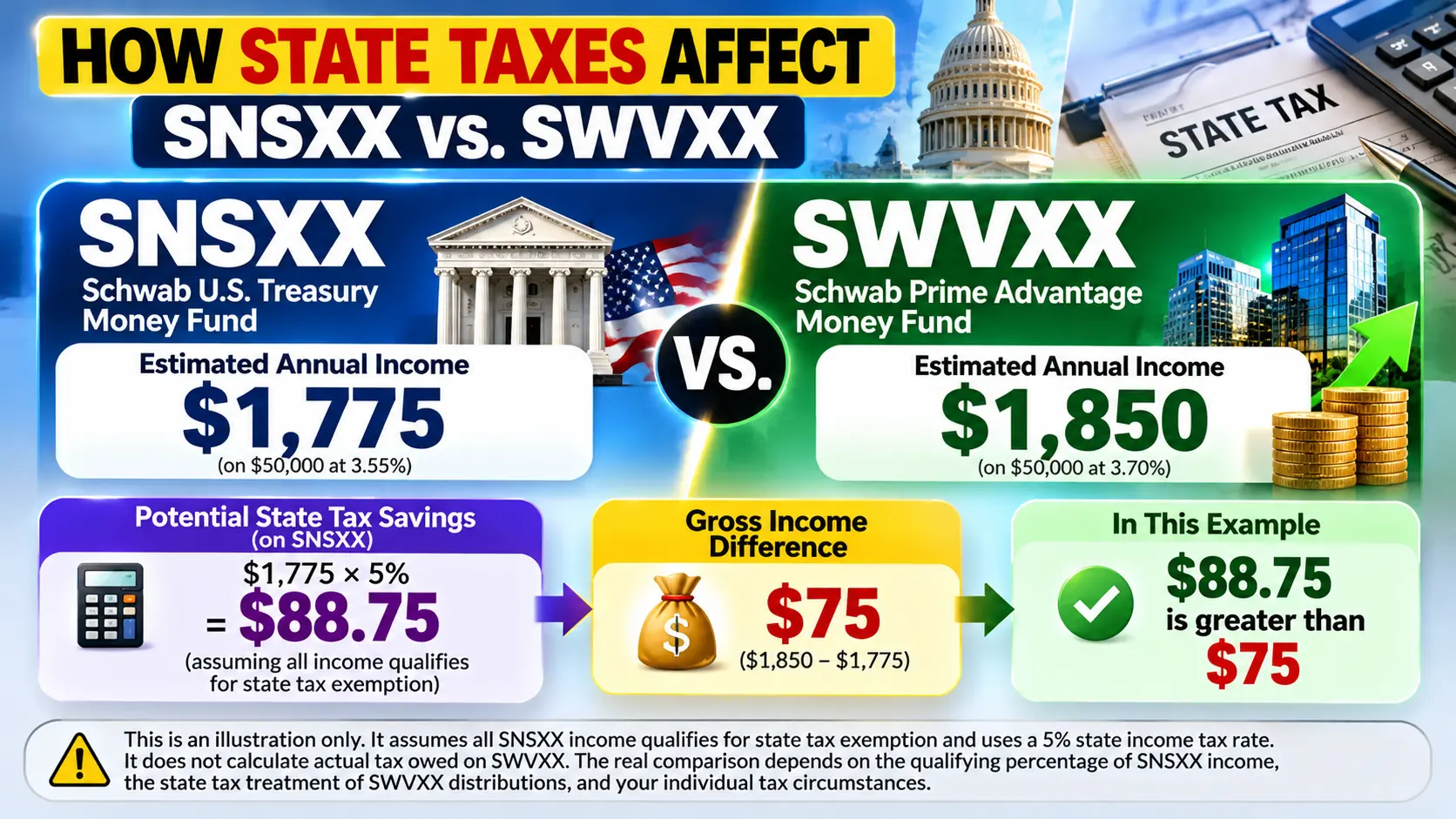
Example: How state taxes affect the comparison
Suppose you invest $50,000 and use the October 8 yields for illustration.
- SNSXX estimated annualized income: $1,775
- SWVXX estimated annualized income: $1,850
- SWVXX’s estimated income advantage: $75
Now suppose, purely for illustration, that all $1,775 of SNSXX’s income qualifies for state tax exemption and your state income tax rate is 5%.
The potential state tax savings on that income would be:
$1,775 × 5% = $88.75
That amount is greater than the $75 gross income difference in this example. But this is not a forecast of actual tax savings: it assumes all SNSXX income qualifies and does not calculate the actual tax owed on SWVXX.
The real comparison requires the qualifying percentage of SNSXX income, the state tax treatment of SWVXX distributions, and your individual tax circumstances.
How to verify your tax savings
Before filing your return:
- Obtain Schwab’s annual tax information for SNSXX and SWVXX.
- Find the percentage of each fund’s income attributable to qualifying U.S. government obligations.
- Check your state’s rules for exempting that income.
- Calculate the potential state tax savings using your applicable tax rate.
- Consult a tax professional if your state has special requirements.
If you hold the funds in a tax-advantaged account, such as an IRA, current state tax treatment may be less important to your immediate decision. The rules for distributions from the retirement account still apply.
SNSXX vs. SWVXX: Which Fund Is Safer?
Both funds are designed for short-term cash management, but they do not have identical risk profiles.
SNSXX focuses on U.S. Treasury obligations. SWVXX invests in a broader range of short-term instruments, including corporate and financial institution debt.
The difference matters because the financial strength of an issuer and the liquidity of its securities can affect the risk of a money market portfolio.
Does SNSXX guarantee your principal?
No. SNSXX seeks to maintain a stable $1 share price, but it cannot guarantee that the share price will never fall.
Its Treasury-focused portfolio can reduce exposure to corporate credit risk, but it does not make the fund identical to a Treasury bill held directly or a government-insured bank account.
Can SWVXX lose money?
Yes. SWVXX also seeks to maintain a stable $1 share price, but investors can lose money in a money market mutual fund.
Its broader portfolio introduces different credit and liquidity exposures from those of SNSXX. Diversification does not eliminate these risks.
Are either of these funds FDIC-insured?
No. Neither SNSXX nor SWVXX is an FDIC-insured deposit account.
The government backing of eligible securities held by a fund does not extend to a guarantee of the fund’s shares. Schwab states that its money funds are not insured or guaranteed by the FDIC or another government agency.
If your primary objective is deposit insurance and immediate access to cash, compare these funds with an eligible FDIC-insured bank deposit account.
SNSXX vs. SWVXX for an Emergency Fund
An emergency fund is meant to be available when life does not go according to plan. That could mean losing a job, repairing a car, paying an unexpected medical bill, or fixing a broken appliance.
The best place for emergency savings is not necessarily the fund with the highest yield.
When SNSXX may make sense
SNSXX may be worth considering if:
- You want a Treasury-focused money market fund.
- You already have a Schwab brokerage account.
- You understand the fund’s purchase, redemption, and settlement process.
- You may benefit from state tax treatment on qualifying Treasury income.
- You accept the risks associated with a money market mutual fund.
When SWVXX may make sense
SWVXX may be worth considering if:
- You want exposure to a broader portfolio of short-term debt.
- Its current yield is attractive relative to available alternatives.
- You understand its credit and liquidity risks.
- You are comfortable with the fund’s tax treatment.
- You do not need every dollar to function as immediately spendable checking-account cash.
Should you keep your entire emergency fund in SNSXX or SWVXX?
Not necessarily.
Consider keeping the portion you might need immediately in a bank account that provides suitable access and FDIC insurance. A money market fund may be worth considering for additional reserves, but only if its risks and access arrangements fit your needs.
If you’re comparing Treasury ETFs with money market funds for emergency savings, read our guide to SGOV vs. SPAXX for an emergency fund. It explains some of the trade-offs between short-term Treasury ETF exposure and a money market fund.
Is SNSXX or SWVXX a Better Place for Idle Cash at Schwab?
One practical detail often gets overlooked: buying a money market fund is not necessarily the same as leaving uninvested cash in your brokerage account.
Schwab offers different cash features depending on the account and its eligibility. SNSXX and SWVXX should not automatically be treated as the default cash position.
Before moving money into either fund:
- Check which cash feature your account currently uses.
- Confirm that SNSXX or SWVXX is available for purchase in your account.
- Review the order cutoff and settlement information.
- Understand how to redeem shares and transfer proceeds when you need cash.
- Keep enough readily accessible money for pending payments and unexpected expenses.
This matters if you intend to use a fund for bills or emergencies. A fund can be liquid without working exactly like a checking account.
SNSXX vs. SWVXX: Which Should You Choose?
SNSXX vs. SWVXX: Estimated Annual Income
See how much income different investment amounts could generate using the October 8, 2026, 7-day yields of 3.55% for SNSXX and 3.70% for SWVXX.
| Investment Amount | SNSXX 3.55% |
SWVXX 3.70% |
Difference |
|---|---|---|---|
| $5,000 | $177.50 | $185.00 | $7.50 |
| $10,000 | $355.00 | $370.00 | $15.00 |
| $25,000 | $887.50 | $925.00 | $37.50 |
| $50,000 | $1,775.00 | $1,850.00 | $75.00 |
| $100,000 | $3,550.00 | $3,700.00 | $150.00 |
Calculation: Investment amount × assumed annualized yield. These estimates do not account for taxes or changes in yield and assume the stated rates remain constant for a full year. Actual distributions may differ, and the 7-day yield is not a guaranteed annual return.
My take
For investors who prioritize Treasury exposure and potential state tax savings, SNSXX deserves serious consideration.
For investors who want to compare income from a broader short-term portfolio, SWVXX may be attractive, particularly when its yield is higher.
Neither fund is automatically better. The most useful comparison is the after-tax income you expect to receive relative to the risks you are willing to accept.
Frequently Asked Questions
Is SNSXX better than SWVXX?
SNSXX may be a better fit for investors who prioritize U.S. Treasury exposure and potential state tax savings. SWVXX may appeal to investors who prefer a broader short-term portfolio and want to evaluate its potentially higher yield. The better choice depends on your taxes, cash needs, and risk tolerance.
Why does SWVXX have a higher yield than SNSXX?
Prime money market funds can earn income from a broader range of short-term instruments, including corporate and financial institution debt. Those holdings have different credit and liquidity characteristics from Treasury obligations. Yield differences change with market conditions and portfolio holdings.
Is SNSXX state-tax-free?
Qualifying interest from U.S. Treasury obligations is generally exempt from state and local income taxes. However, you should use Schwab’s annual tax information and your state’s rules to determine how much SNSXX income qualifies.
Is SWVXX state-tax-free?
Do not assume that SWVXX income is state-tax-free. Its broader portfolio includes non-Treasury investments, and the state tax treatment depends on the source of the income and applicable rules.
Are SNSXX and SWVXX FDIC-insured?
No. They are money market mutual funds, not FDIC-insured bank deposits.
Can I lose money in SNSXX or SWVXX?
Yes. Both funds seek to maintain a stable $1 share price, but neither guarantees that investors will never lose money.
Do SNSXX and SWVXX have a minimum investment?
Schwab’s October 8, 2026, fund yield table lists no minimum initial investment for both SNSXX and SWVXX Investor Shares. Confirm the latest account and trading requirements before investing.
Can I use SNSXX or SWVXX as my emergency fund?
You can consider a money market fund for some emergency reserves, but neither is FDIC-insured or guaranteed to maintain its share price. Keeping immediately needed money in an accessible insured bank account may be more appropriate.
Does a higher 7-day yield mean SWVXX will earn more over the next year?
No. A 7-day yield measures recent income under a standardized calculation. It can change as short-term interest rates and portfolio conditions change. The current yield is not a promise of future income.
Final Verdict: SNSXX vs. SWVXX
SNSXX and SWVXX are both Schwab money market mutual funds, but they serve different preferences.
SNSXX focuses on U.S. Treasury obligations and may offer state tax benefits on qualifying income. SWVXX invests in a broader range of short-term debt and may offer a higher yield in some market conditions.
As of October 8, 2026, SWVXX had the higher published 7-day yield. The difference was 0.15 percentage points, or about $15 per year on $10,000 if both yields remained unchanged.
Before choosing, compare the latest yields, review the funds’ prospectuses, check the tax treatment in your state, and make sure the fund’s liquidity fits your cash needs.
The best choice is not necessarily the fund with the highest yield today. It is the fund whose income, investment approach, tax treatment, and risks make sense for your situation.
Financial disclaimer: This article is for educational purposes only and is not individualized investment, tax, or legal advice. Money market mutual funds are not FDIC-insured, and investors can lose money. Yields and fund details can change. Review Schwab’s current prospectus and consult a qualified tax professional about your circumstances.
Related Reads:
- What Is FDLXX? Yield, Tax Perks & Who Should Use It
- ACA Open Enrollment 2027: Key Dates, Premium Increases, and What Lost Subsidies Mean for You
- Tax Brackets Married Filing Jointly: Rates & Calculator Guide
- How to Avoid State Taxes on Treasury Interest: A Guide for U.S. Investors
- Treasury Bills vs. CDs: Which Is Right for Short-Term Savings?