Let’s face it: managing money feels like a second job.
You’re juggling multiple accounts, tracking expenses manually, and still wondering where your paycheck went.
The good news?
Your bank’s app has likely evolved into a powerful financial hub. In 2026, bank-affiliated budgeting tools are no longer an afterthought—they’re a free, secure, and surprisingly sophisticated way to take control of your finances without downloading another app or paying another subscription fee.
Topic in Short
Bank-affiliated budgeting tools are built directly into your financial institution’s mobile app or online portal.
They automatically track and categorize your spending, help you set savings goals, and provide real-time alerts—all for free.
For most Americans, these built-in features offer 90% of the value of premium apps without the extra cost.
They are generally safe, use bank-level encryption, and provide read-only access to your data. The best options in 2026 come from banks like Ally, Capital One, Wells Fargo, and SoFi.
The 2026 Financial Landscape
With persistent inflation and evolving interest rates, every dollar counts. The U.S. personal savings rate has fluctuated, and many households are feeling the pinch of higher costs for essentials.
In this environment, visibility into your cash flow isn’t a luxury – it’s a necessity. Bank-affiliated tools give you that visibility in real-time, helping you spot spending leaks and adjust before you overdraft.
As subscription fatigue grows (the average American now spends over $200 a month on subscriptions), using your bank’s free tools is a smart way to fight back against “subscription creep” without adding another recurring charge to your budget.
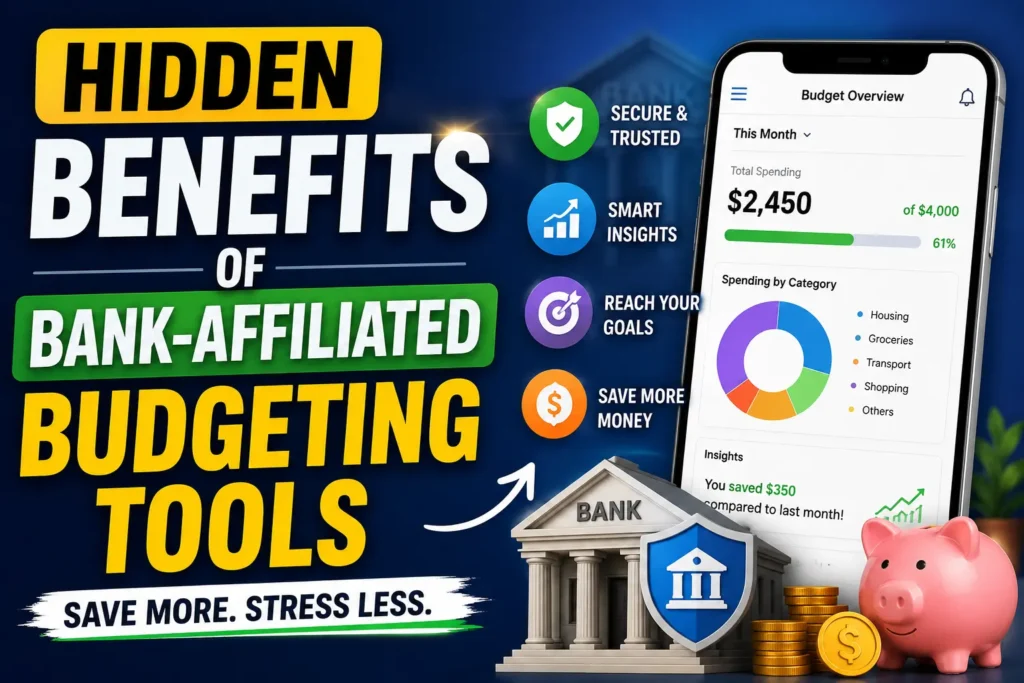
What Exactly Are Bank-Affiliated Budgeting Tools?
These are personal finance management (PFM) features integrated into your bank’s existing digital platform.
They use financial data aggregators (like Plaid or Finicity) to securely pull your transaction data and present it in an organized dashboard.
Unlike third-party apps that require you to share your login credentials with an outside company, bank-affiliated tools keep your data within the bank’s own secure ecosystem.
The Top 5 Benefits of Bank-Affiliated Budgeting Tools
1. Zero Cost, Maximum Value
The most obvious benefit is the price: free.
While popular third-party apps like YNAB can cost $109 per year or premium aggregators like Origin charge $12.99 a month, your bank’s tools are included with your account.
This is a significant advantage in 2026, as many standalone apps are putting advanced features behind paywalls.
By using your bank’s built-in features, you can get robust budgeting and tracking without adding to your monthly expenses.
2. Seamless, Automatic Tracking
Gone are the days of manual spreadsheets.
Bank-affiliated tools automatically sync with your checking, savings, and credit card accounts (if you have them with the same bank) to categorize every transaction. This automation provides a real-time, accurate picture of your finances.
For example, Wells Fargo’s Budget Watch updates your budget every business day, using your actual spending history to show you exactly where you stand.
3. Goal-Oriented Savings Features
Many banks now offer “sub-accounts” or “buckets” to help you save for specific goals—a concept often called “sinking funds”.
Ally Bank is a leader here with its “buckets” feature, which lets you create up to 30 different savings goals within a single account, such as “Emergency Fund,” “Vacation,” or “New Car”.
Similarly, Capital One offers “Vaults” within its 360 Savings account for goal-oriented saving. This structure helps you mentally separate your money without needing to open multiple accounts.
4. Enhanced Spending Awareness and Alerts
These tools don’t just track; they inform.
They provide visual breakdowns of your spending, often with color-coded charts that make it easy to see where you’re over budget.
Capital One’s Eno virtual assistant goes a step further by identifying recurring charges and subscriptions, helping you spot and eliminate hidden fees you might have forgotten about. Bank of America offers similar insights with interactive charts that highlight spending trends.
5. Superior Security and Peace of Mind
Security is a top concern, and rightfully so.
When you use a tool provided directly by your bank, you avoid the potential risks of sharing your credentials with a third-party aggregator. Bank-affiliated tools use the same bank-level encryption (256-bit SSL) as your mobile banking app.
They typically have “read-only” access, meaning they can view your transactions to help you budget but cannot initiate payments or transfers. This significantly reduces the risk of unauthorized transactions, even if the budgeting interface were compromised.
Best Budgeting Bank Accounts: A 2026 Comparison
When to Use Your Bank’s Tools vs. a Third-Party App
Pro Tip: “Start with your bank’s built-in budgeting tools for free, then layer a third-party app only if you need multi-bank views, goal tracking, and better reporting,” advises a 2026 industry analysis. If you have accounts at multiple banks, a financial aggregator like Empower (free) or Monarch Money ($14.99/mo) might be worth considering for a consolidated view. However, for the vast majority of consumers with a primary bank, the built-in tools are more than sufficient.
Readers Questions:
Is it safe to link bank accounts to budgeting tools?
Yes, it is generally safe when using a reputable, established bank or app with strong security practices. Bank-affiliated tools are particularly secure because they operate within the bank’s own encrypted environment and typically use read-only access, meaning they can see your data but cannot move your money.
What is the $3000 rule for banks?
The “$3000 rule” often refers to a guideline suggesting you should keep a minimum of $3,000 in your checking account to avoid overdraft fees and cover unexpected expenses. While not an official banking regulation, it’s a common personal finance benchmark. Bank budgeting tools can help you track your balance to ensure you consistently meet this or your own personalized buffer.
Which bank has the best budgeting tools?
Based on 2026 reviews, Ally Bank is praised for its flexible “buckets” system, Capital One for its virtual assistant Eno, and Wells Fargo for its straightforward Budget Watch feature. The “best” depends on your specific needs, whether that’s goal setting, subscription tracking, or visual spending reports.
Is YNAB really worth it?
YNAB (You Need A Budget) is worth it if you are committed to its zero-based budgeting method and need the discipline it provides. However, at $109/year, it’s a significant expense. For many, the free tools offered by their bank can provide similar functionality without the annual cost.
Conclusion & Your Next Step
In 2026, your bank is more than just a place to store money—it’s a powerful financial command center. Bank-affiliated budgeting tools offer a secure, free, and effective way to track spending, save for goals, and gain clarity on your financial health.
Your Call to Action: Open your bank’s mobile app right now. Navigate to the budgeting or spending tracker section. Spend 10 minutes exploring the features available to you. Set up your first savings goal or review your spending categories. You might be surprised at how much control you can gain with tools you already have.
Disclaimer: This article is for informational and educational purposes only and does not constitute financial, legal, or professional advice. You should consult with a qualified financial advisor or other professional for advice tailored to your specific situation. All financial decisions are your own responsibility.