
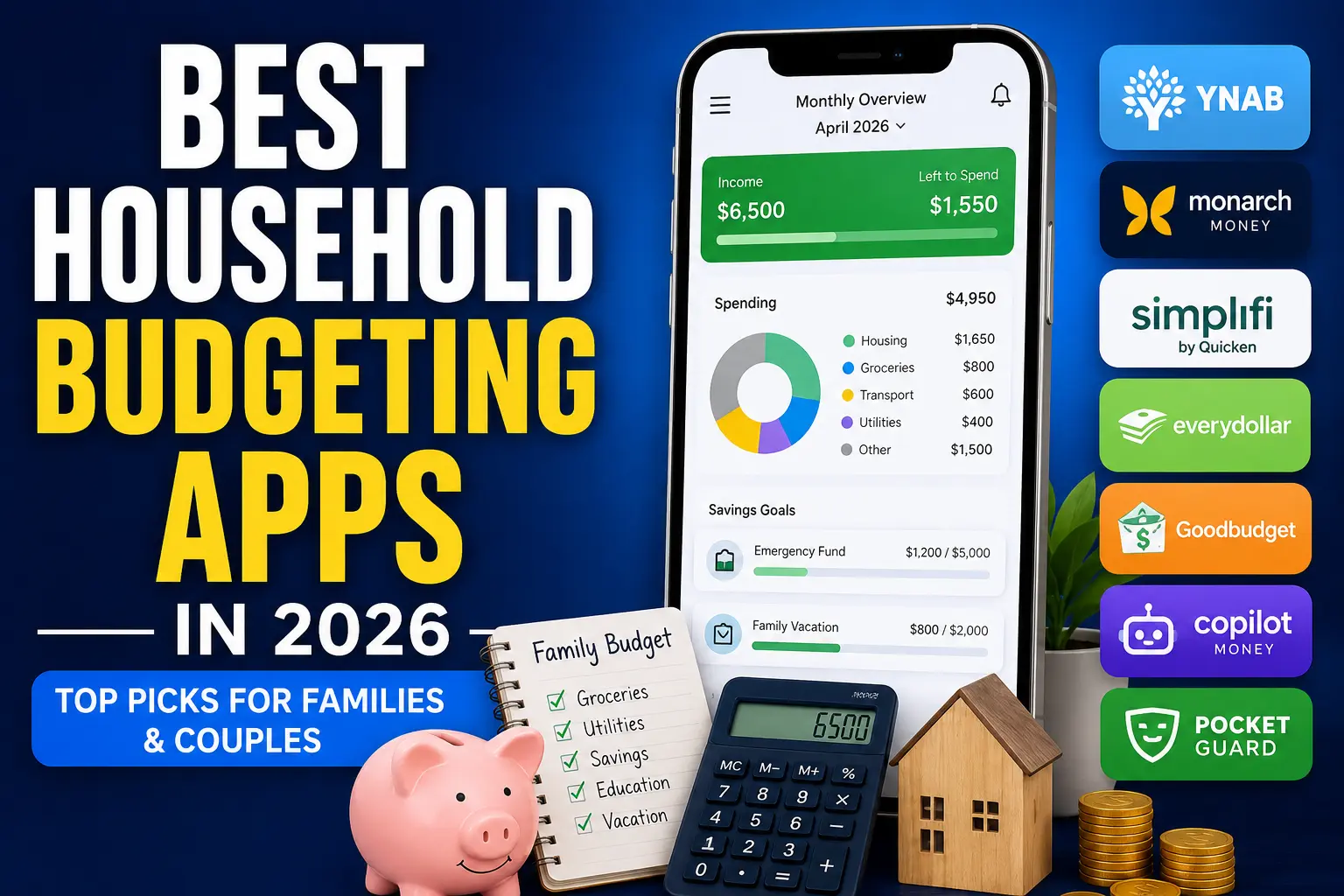
Managing a household budget can get complicated quickly.
Between groceries, utilities, subscriptions, credit cards, savings goals, debt payments, and unexpected expenses, it is easy to lose track of where your money is going.
The right household budgeting app can bring everything into one place, help family members stay on the same page, and make it easier to decide how much you can safely spend each month.
But not every budgeting app works the same way.
Some are designed for hands-on zero-based budgeting, while others focus on automatic expense tracking, cash-flow forecasting, investments, or simple shared budgets.
After comparing the leading options available in 2026, YNAB, Monarch Money, and Quicken Simplifi stand out as the strongest choices for most households, while EveryDollar, Goodbudget, Copilot Money, and PocketGuard can be better fits for specific budgeting styles.
Best Household Budgeting Apps at a Glance
| Budgeting App | Best For | Starting Price* | Bank Sync | Family/Household Strength |
|---|---|---|---|---|
| YNAB | Serious, hands-on budgeting | $14.99/month or $109/year | Yes | Excellent |
| Monarch Money | Couples and complete household finances | $14.99/month or $99.99/year | Yes | Excellent |
| Quicken Simplifi | Best value and automated planning | $3.99/month billed annually | Yes | Very Good |
| EveryDollar | Zero-based budgeting beginners | Free; premium available | Premium | Good |
| Goodbudget | Envelope budgeting | Free; premium available | Premium | Good |
| Copilot Money | Apple households | $13/month or $95/year | Yes | Limited |
| PocketGuard | Simple spending control | Premium available | Yes | Good |
*Prices can change, promotions may apply, and taxes may vary. Verify current pricing before subscribing. Current published pricing shows YNAB at $109/year, Monarch Money at $99.99/year, and Quicken Simplifi at $3.99/month billed annually.
Our Top Picks of Best Household Budgeting Apps
1. YNAB – Best Household Budgeting App Overall
Best for: Families and couples who want a structured budgeting system
Why we recommend it: YNAB is one of the strongest choices if your household needs more than an expense tracker. Its zero-based budgeting approach encourages you to give every dollar a specific job before you spend it.
Instead of simply showing what you spent last month, YNAB encourages you to plan how your available money will be used.
That makes it particularly useful for households trying to:
- Control overspending
- Build emergency savings
- Pay down debt
- Plan for irregular expenses
- Coordinate spending between partners
- Create sinking funds
- Stop living paycheck to paycheck
YNAB currently costs $109 per year or $14.99 per month and offers a 34-day free trial. It works on mobile and web, supports bank syncing or manual transactions, and allows a subscription to be shared with loved ones.
Pros
- Excellent zero-based budgeting methodology
- Strong goal and savings planning
- Good for couples and families
- Bank synchronization
- Web, iOS, and Android access
- Manual transaction entry is available
- Strong educational resources
Cons
- More expensive than some alternatives
- Requires more active participation
- Can take time to learn
- Not ideal if you only want passive expense tracking
Bottom line: If your household is serious about changing its spending habits rather than simply watching transactions, YNAB is arguably the best choice.
2. Monarch Money – Best for Couples and Complete Household Finances
Best for: Couples who want budgeting, account aggregation, investments, and net-worth tracking in one place
Monarch Money is particularly attractive for households that want a complete financial dashboard, not just a budgeting tool.
You can bring multiple financial accounts into one view, track spending, create goals, monitor investments, and collaborate with a partner.
Monarch says it supports connections to more than 13,000 financial institutions and allows users to invite a partner or advisor at no additional cost. Its features include budgeting, custom reports, investment tracking, subscription tracking, goals, and customizable dashboards.
Its Core plan is currently listed at $99.99 per year, equivalent to about $8.33 per month when billed annually, with a seven-day trial.
Pros
- Excellent for couples
- Shared financial visibility
- Strong account aggregation
- Investment tracking
- Net-worth monitoring
- Custom reports
- Goal tracking
- Clean, modern interface
- Web, iOS, and Android
Cons
- No permanent free version
- More expensive than basic budgeting tools
- Some advanced planning features may require higher-tier plans
Bottom line: Monarch Money is arguably the best household finance hub if you want budgeting plus investments, net worth, subscriptions, and shared financial planning.
3. Quicken Simplifi – Best Value for Most Households
Best for: Families that want automatic budgeting without paying a premium price
Quicken Simplifi takes a different approach from YNAB.
Rather than requiring you to manually assign every dollar before spending, Simplifi creates a Spending Plan based on your income, bills, subscriptions, savings goals, and spending.
The app then shows how much money you have left to spend.
Quicken currently lists Simplifi at $3.99 per month when billed annually, although promotional pricing can change. It supports web and mobile access and connects to more than 14,000 financial institutions.
Its Spending Plan can accommodate different approaches, including zero-based budgeting, envelope budgeting, and the 50/30/20 method.
Pros
- Low annual cost compared with many competitors
- Automatic Spending Plan
- Cash-flow projections
- Savings goals
- Investment tracking
- Customizable reports
- Strong account connectivity
- Good for households that dislike complicated budgeting systems
Cons
- Less hands-on than YNAB
- Some users may prefer a traditional category-based budget
- Promotional pricing can change
Bottom line: For households that want a modern budgeting app without spending around $100 per year, Quicken Simplifi is one of the strongest value choices.
4. EveryDollar – Best for Zero-Based Budgeting Beginners
Best for: Households that prefer a straightforward zero-based budget
EveryDollar is built around the idea of planning your income before spending it. That makes it a natural fit for households following a zero-based budgeting philosophy.
It offers a free version, while premium features add capabilities such as automatic bank connections. Current 2026 comparisons list premium pricing at about $79.99 per year, although users should verify the current offer before subscribing.
Pros
- Straightforward interface
- Zero-based budgeting
- Free option available
- Useful for debt-focused households
- Easy category-based planning
Cons
- Automatic bank syncing requires premium
- Less comprehensive than Monarch for investments
- Less flexible than some competitors
Bottom line: EveryDollar is a good choice if your household wants a simple, structured monthly budget without the complexity of a full financial dashboard.
5. Goodbudget – Best Digital Envelope Budgeting App
Best for: Families that like the traditional envelope budgeting method
Goodbudget takes the classic cash-envelope system and puts it on your phone and computer.
Instead of physically putting cash into envelopes labeled “Groceries,” “Gas,” “Entertainment,” or “Utilities,” you allocate digital money to different spending categories.
Goodbudget offers a free version and paid plans. Its Premium plan includes bank synchronization and has been listed at $10 per month or $80 per year.
Pros
- Simple envelope system
- Good for couples
- Free version
- Works across devices
- Helps control category spending
- Useful for people who prefer manual budgeting
Cons
- Less sophisticated investment tracking
- Manual budgeting can require more work
- Bank-sync features are tied to premium
Bottom line: Goodbudget is especially useful if your household understands and enjoys envelope budgeting but does not want to carry physical cash.
6. Copilot Money – Best for Apple Households
Best for: iPhone, iPad, and Mac users who prioritize design and automation
Copilot Money focuses heavily on an attractive, easy-to-use interface and automated financial tracking.
It combines spending analysis, budgeting, recurring expense detection, cash-flow information, savings goals, and investment tracking.
Current 2026 comparisons list Copilot at approximately $95 per year or $13 per month, with a free trial. It is primarily designed for Apple’s ecosystem rather than Android households.
Pros
- Excellent user interface
- Strong transaction categorization
- Automated spending analysis
- Investment tracking
- Cash-flow monitoring
- Great fit for Apple users
Cons
- No Android app
- Less suitable for households using mixed devices
- Primarily designed around an individual rather than extensive household collaboration
Bottom line: Copilot is worth considering if everyone who needs access uses Apple devices and you want a polished, highly automated experience.
7. PocketGuard – Best for “How Much Can I Spend?”
Best for: Households that want a simple answer to one question: “How much money can we safely spend?”
PocketGuard takes a simplified approach to budgeting. Rather than making users constantly analyze categories, it focuses on helping you understand your available spending money after accounting for bills, expenses, and financial goals.
That can be particularly helpful for people who find traditional budgeting systems overwhelming.
Pros
- Simple approach
- Automatic account connections
- Clear spending information
- Useful for people who dislike detailed budgets
- Supports debt-planning features
Cons
- Less comprehensive than Monarch
- Less methodical than YNAB
- Advanced features require a paid plan
Bottom line: PocketGuard is a good option when your household needs spending clarity more than a sophisticated budgeting methodology.
All Best Household Budgeting Apps Compared
The biggest difference between these apps is not the number of features. It is how they expect you to manage money.
| App | Budgeting Style | Best Household Use | Investment Tracking | Ease of Use |
|---|---|---|---|---|
| YNAB | Zero-based | Couples/families serious about budgeting | Limited | Moderate |
| Monarch Money | Flexible | Complete household finances | Yes | Easy |
| Quicken Simplifi | Automated spending plan | Everyday household budgeting | Yes | Easy |
| EveryDollar | Zero-based | Structured monthly budgets | Limited | Easy |
| Goodbudget | Envelope | Category-based spending control | Limited | Moderate |
| Copilot | Automated | Apple households | Yes | Very easy |
| PocketGuard | Simplified | Safe-to-spend tracking | Some | Easy |
How to Choose the Best Household Budgeting App
The best app depends on how your household actually handles money.
Choose YNAB if you want to change your spending habits
YNAB is best when budgeting needs to be an active household process.
If you and your partner regularly ask:
- “Can we afford this?”
- “How much should we put toward savings?”
- “Why are we always overspending?”
- “How much can we spend on groceries?”
- “How should we prepare for annual bills?”
YNAB’s methodology can be extremely useful.
Choose Monarch Money if you want everything in one dashboard
Monarch makes more sense when your household wants to see the entire financial picture.
It is particularly useful if you have:
- Multiple checking accounts
- Credit cards
- Investments
- Retirement accounts
- Savings accounts
- Recurring subscriptions
- Multiple financial goals
Its ability to combine budgeting, investments, goals, and household collaboration makes it one of the strongest all-around choices.
Choose Quicken Simplifi if you want affordability
If paying $100+ per year for a budgeting app feels excessive, Simplifi deserves serious consideration.
Its Spending Plan automatically updates as your finances change, while projected cash flow helps you look ahead instead of simply reviewing last month’s transactions.
Choose Goodbudget if you like envelopes
If your household already thinks in terms of spending buckets—groceries, restaurants, transportation, entertainment, clothing, and so on—Goodbudget’s digital envelope system can feel intuitive.
Choose EveryDollar if you want a simple zero-based budget
EveryDollar is a good middle ground for people who want the discipline of zero-based budgeting without the broader financial-management features found in apps such as Monarch.
Choose Copilot if everyone uses Apple devices
Copilot’s polished experience makes it attractive for Apple-focused households, but its platform limitations should be considered before subscribing.
What Features Should a Household Budgeting App Have?
Before paying for an app, look beyond the marketing.
1. Multiple-user access
A household budgeting app should make it easy for partners or family members to see the same financial plan.
Ideally, both people should be able to:
- View transactions
- Add transactions
- Review budgets
- Track goals
- See upcoming bills
- Understand available spending money
2. Automatic bank synchronization
Automatic synchronization can save significant time.
Instead of entering every purchase manually, transactions can be imported and categorized automatically.
However, you should still review imported transactions regularly.
3. Shared financial goals
Look for support for goals such as:
- Emergency fund
- Vacation
- Home repairs
- Car replacement
- Annual insurance
- Holiday spending
- Education
- Large purchases
4. Recurring bill tracking
Your app should help you see recurring expenses before they hit your bank account.
This is especially useful for subscriptions, utilities, insurance premiums, memberships, and loan payments.
5. Cash-flow forecasting
A budget tells you what you planned.
A cash-flow forecast helps you understand what may happen next.
This can be particularly important for households with irregular income or large annual expenses.
6. Investment and net-worth tracking
If you want one app for your complete financial picture, consider whether it can track:
Monarch and Quicken Simplifi are particularly strong in this area.
7. Security and privacy
A budgeting app may connect to extremely sensitive financial information.
Before signing up, check:
- How accounts are connected
- Whether your data is encrypted
- Whether the company sells personal data
- What security controls are available
- Whether you can delete your data
- Whether multi-factor authentication is supported
For example, Monarch states that it does not sell financial data to third parties and describes its experience as ad-free.
Are Paid Budgeting Apps Worth It?
Sometimes.
A $100-per-year budgeting app may sound expensive, but the cost becomes easier to justify if the tool helps your household identify unnecessary spending or consistently save more.
For example, if an app helps you reduce unnecessary spending by only $25 per month, that is $300 per year—more than the annual cost of several premium budgeting apps.
The important question is not:
“Is the app free?”
It is:
“Will this app help our household make better financial decisions consistently?”
A free app that you stop using after two weeks is less valuable than a paid app that helps you stick to a budget for an entire year.
Free vs. Paid Household Budgeting Apps
Free apps can work well if you are comfortable entering transactions manually or using basic budgeting features.
Paid apps tend to offer more advanced capabilities such as:
- Automatic bank synchronization
- Advanced reports
- Investment tracking
- Cash-flow forecasting
- Goal planning
- Household collaboration
- Automated categorization
EveryDollar and Goodbudget offer free options, while YNAB, Monarch Money, and Quicken Simplifi use paid subscription models for their core experiences.
Which Budgeting App Is Best for Couples?
For most couples, the shortlist should start with Monarch Money and YNAB.
Choose Monarch Money if both partners want a shared view of accounts, investments, goals, and household finances.
Choose YNAB if both partners are willing to actively participate in assigning money to categories and following a structured budget.
Quicken Simplifi is another strong choice if affordability and automated planning are more important than a strict budgeting methodology.
Which Budgeting App Is Best for Families?
For families, consider:
- YNAB — Best for disciplined household budgeting
- Monarch Money — Best for comprehensive financial visibility
- Quicken Simplifi — Best value
- Goodbudget — Best for envelope-style budgeting
- EveryDollar — Best for simple zero-based budgeting
The right choice depends on whether your priority is behavior change, financial visibility, simplicity, or cost.
Which Budgeting App Is Best for Beginners?
If you’ve never maintained a household budget before, start with an app that does not overwhelm you.
Quicken Simplifi is a strong starting point because its Spending Plan can automatically account for income, bills, subscriptions, savings goals, and spending.
EveryDollar is another good choice if you specifically want to learn zero-based budgeting.
If you’re willing to spend more time learning a system, YNAB can provide a more structured approach.
Best Household Budgeting Apps: Final Verdict
There is no single budgeting app that is perfect for every household.
But the current market makes the choice easier if you match the app to your budgeting style.
Our overall picks for 2026 are:
- Best overall: YNAB
- Best for couples: Monarch Money
- Best value: Quicken Simplifi
- Best for zero-based beginners: EveryDollar
- Best envelope budgeting: Goodbudget
- Best for Apple users: Copilot Money
- Best for simple spending control: PocketGuard
If you want a budgeting system that can fundamentally change how your household handles money, start with YNAB.
If you want a complete shared financial dashboard, Monarch Money is the stronger choice.
And if you want a lower-cost option that combines budgeting, spending analysis, savings goals, investments, and cash-flow forecasting, Quicken Simplifi is difficult to overlook.
Ultimately, the best household budgeting app is the one that both people in your household will actually use every week.