Active fundamental equity is an investment approach where portfolio managers use human judgment, deep company research, and bottom-up analysis to select individual stocks with the goal of outperforming the broader market (generating “alpha”).
Unlike passive index funds that simply track the market, active fundamental managers dig into financial statements, competitive advantages, management quality, and industry dynamics to find undervalued or high-growth companies.
Key 2026 takeaway:
With the S&P 500’s top 10 stocks now representing nearly 40% of the index, index concentration risk is at historic highs. Active fundamental equity offers a compelling alternative for U.S. investors seeking diversification and the potential for above-market returns in a volatile, AI-driven market environment
What Is Active Fundamental Equity?
Active fundamental equity is one of the two primary approaches to active equity management, the other being quantitative (systematic) investing.
According to the CFA Institute, fundamental approaches “stress the use of human judgment in processing information and making investment decisions,” whereas quantitative approaches “rely more heavily on rules-based quantitative models”. Practitioners often refer to fundamental approaches as “discretionary” and quantitative approaches as “systematic”.
The Fundamental Active Investment Process
The fundamental active investment process typically follows these steps:
- Define the investment universe – Establish the pool of eligible stocks (e.g., U.S. large-cap, global equities, small/mid-cap).
- Prescreen the universe – Filter for basic criteria like market cap, liquidity, or sector.
- Understand the industry and business – Conduct deep-dive research into competitive dynamics, business models, and industry trends.
- Company-level fundamental analysis – Evaluate financial statements, cash flows, return on equity (ROE), management quality, and corporate governance.
- Valuation assessment – Determine intrinsic value and compare to market price to identify mispriced securities.
- Portfolio construction – Build a diversified portfolio of high-conviction positions.
Pro Tip: Fundamental managers typically follow either a value-based approach (buying undervalued stocks) or a growth-based approach (buying stocks with above-average growth potential)—or a blend of both.
Why Active Fundamental Equity Matters in 2026
The Index Concentration Problem
Passive indexing has dominated U.S. equity flows for over a decade, but 2026 presents a unique challenge. As of March 2026, the top 10 companies in the S&P 500 represent nearly 40% of the entire index. This extreme concentration means that passive investors are making a concentrated bet on a handful of mega-cap tech stocks—whether they realize it or not.
Dispersion Creates Opportunity
BlackRock’s Q3 2026 Equity Market Outlook notes that “finding alpha today requires digging deeper into the dominant AI theme to uncover unexpected interconnections—and opportunities”. The firm sees compelling prospects in energy, infrastructure, and healthcare sectors that are often overlooked by passive benchmarks.
Resilient U.S. Economy
Despite elevated inflation and hawkish Federal Reserve expectations, the U.S. economy has remained resilient through 2026, with labor markets rebounding and growth expected to hold momentum. This creates a constructive backdrop for active stock pickers who can identify companies poised to benefit from specific economic trends.
Geopolitical Uncertainty
Geopolitical uncertainty has been at the forefront in 2026, driving volatility and dispersion across asset classes. Active fundamental managers can navigate this complexity by focusing on company-specific fundamentals rather than broad market movements.
How Major Asset Managers Approach Active Fundamental Equity
BlackRock Fundamental Equities
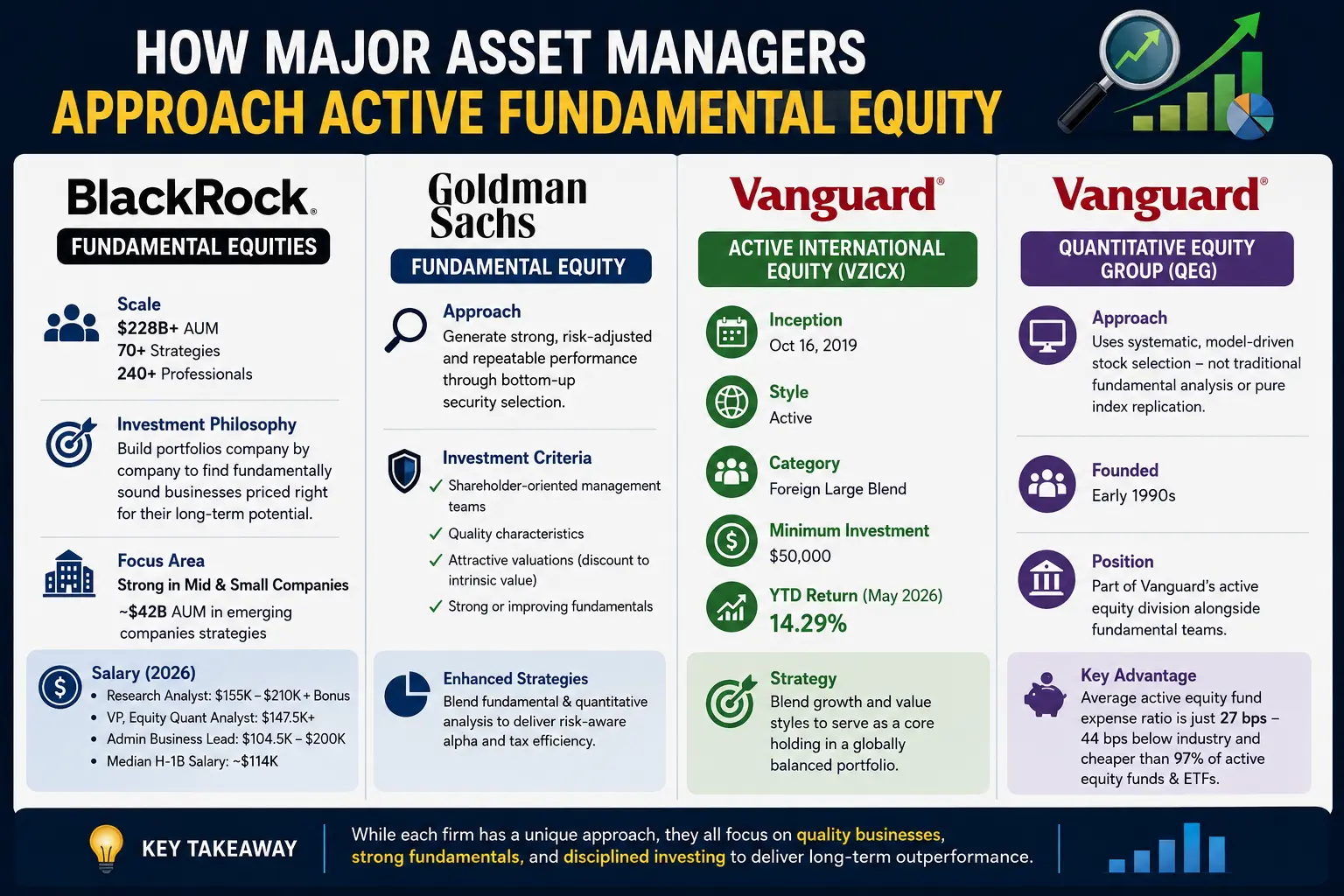
BlackRock’s Fundamental Equities (FE) business is a key division within the firm’s Portfolio Management Group, with over $228 billion in assets under management across 70+ strategies and 240+ investment professionals.
Investment Philosophy: BlackRock’s fundamental equity investors “build portfolios company by company, digging deep to assess the core merits of individual businesses and gain a thorough understanding of their long-term potential”. The goal is “outperforming the market by constructing a diversified portfolio of fundamentally sound companies that are priced right for their prospects”.
BlackRock Fundamental Equities Salary (2026):
- Research Analyst, Income & Value Investment Team (New York): $155,000 – $210,000/year + annual discretionary bonus
- Vice President, Equity Quant Research Analyst: $147,500+/year
- Administrative Business Lead: $104,500 – $200,000/year
- Median H-1B salary at BlackRock: ~$114,000
BlackRock Fundamental Mid & Small Company: BlackRock’s Smaller Companies Trust aims to achieve long-term capital growth by investing in small and mid-sized companies, using an active, bottom-up stock-picking approach where “the starting point is always the individual business rather than a macroeconomic view”. The firm’s emerging companies team manages approximately $42 billion in AUM across multiple strategies.
Goldman Sachs Fundamental Equity
Goldman Sachs Asset Management (GSAM) offers both fundamental and quantitative approaches to equity investing, spanning investment styles, regions, and market caps. The firm’s Fundamental Equity team aims to “generate strong, risk-adjusted and repeatable performance over the long term primarily through bottom-up security selection”.
Goldman Sachs Enhanced Fundamental Equity Strategies: These strategies blend fundamental and quantitative analysis, seeking to deliver “risk aware alpha and tax efficiency”.
Investment Criteria: The team seeks companies with:
- Shareholder-oriented management teams
- Quality characteristics
- Attractive valuations (trading at a discount to intrinsic value)
- Strong or improving fundamentals
Vanguard Active International Equity
While Vanguard is best known for passive indexing, the firm also offers actively managed funds. The Vanguard International Core Stock Fund Admiral Shares (VZICX) is an actively managed fund offering exposure to developed and emerging non-U.S. markets.
Key Facts:
- Ticker: VZICX
- Inception: October 16, 2019
- Management Style: Active
- Category: Foreign Large Blend
- Minimum Investment: $50,000
- YTD Return (as of May 2026): 14.29%
The fund’s advisors look to “construct a portfolio that blends growth and value styles to serve as a core holding in a globally balanced portfolio”.
Vanguard Quantitative Equity Group
Vanguard’s Quantitative Equity Group (QEG) manages a suite of actively managed funds that use “systematic, model-driven stock selection rather than traditional fundamental analysis or pure index replication”. Founded in the early 1990s, the QEG sits inside Vanguard’s active equity division alongside its fundamental stock-picking teams.
Key Advantage: Vanguard’s average active equity fund expense ratio is just 27 basis points—roughly 44 bps below industry levels and cheaper than 97% of all active equity funds and ETFs.
Active Fundamental Equity vs. Passive Indexing: The 2026 Debate
| Factor | Active Fundamental Equity | Passive Indexing |
|---|---|---|
| Approach | Human judgment + deep research | Rules-based index tracking |
| Goal | Outperform benchmark (generate alpha) | Match benchmark returns |
| Cost | Higher (0.50% – 1.00% typical) | Lower (as low as 0.03%) |
| Concentration Risk | Managed through active stock selection | High (top 10 stocks = 40% of S&P 500) |
| Flexibility | Can avoid overvalued sectors | Must hold all index constituents |
| Best For | Investors seeking diversification & alpha | Cost-conscious, passive investors |
Expert Insight: “A passive US Equity allocation may introduce less obvious, but meaningful, risk into portfolios” due to heightened index concentration. In a market characterized by wide dispersion in earnings and valuations, active investing may have an edge over passive strategies in 2026.
BlackRock’s 2026 Equity Outlook
BlackRock’s Q3 2026 Equity Market Outlook remains constructive on equities, with several key themes:
- Strong Earnings Trends: Earnings have been strong across sectors and geographies.
- AI Opportunity: The firm remains constructive on the long-term AI opportunity, identifying beneficiaries across a multi-year investment cycle.
- Diversification: Finding alpha requires looking beyond the dominant AI theme to uncover unexpected interconnections and opportunities.
- Emerging Markets: BlackRock prefers emerging over developed market equities, given the centrality of many EM countries in the ongoing AI buildout.
- Energy & Infrastructure: AI proliferation requires vast amounts of power, creating opportunity in energy and infrastructure stocks.
Is Active Fundamental Equity Right for You?
Consider active fundamental equity if you:
- Want to potentially outperform the market (not just match it)
- Are concerned about index concentration risk
- Have a long-term investment horizon (5+ years)
- Are willing to pay higher fees for potential alpha
- Value professional research and active portfolio management
Consider passive indexing if you:
- Prioritize low costs above all else
- Believe markets are efficient and difficult to beat
- Want simple, set-it-and-forget-it investing
- Have a shorter time horizon
Conclusion
Active fundamental equity represents a time-tested approach to stock market investing that leverages human expertise, deep company research, and disciplined portfolio construction to seek market-beating returns. In 2026, with the S&P 500 more concentrated than ever and dispersion creating opportunities for skilled stock pickers, active fundamental strategies deserve serious consideration from U.S. investors seeking diversification and alpha potential.
Whether you’re exploring BlackRock’s fundamental equities platform, Goldman Sachs’ enhanced fundamental strategies, or Vanguard’s low-cost active offerings, the key is to understand your own investment goals, risk tolerance, and time horizon before making a decision.
Ready to Take the Next Step?
Start by evaluating your current portfolio’s exposure to index concentration risk. Then, consider speaking with a fiduciary financial advisor who can help you determine whether active fundamental equity strategies align with your long-term financial goals. For self-directed investors, research funds from BlackRock, Goldman Sachs, and Vanguard that match your investment style and risk profile.
Disclaimer
This article is for informational purposes only and does not constitute professional financial, investment, or legal advice. All investment strategies and investments involve risk of loss. Past performance is not indicative of future results. The information provided herein is based on sources believed to be reliable, but accuracy is not guaranteed. You should consult with a qualified financial advisor or investment professional before making any investment decisions. Reference to specific firms, funds, or strategies does not constitute an endorsement or recommendation.