

If you own a home in the U.S., your property may be one of your biggest financial assets. But having substantial home equity doesn’t necessarily mean you have easy access to that money.
Two options homeowners may consider are a HELOC (Home Equity Line of Credit) and a Home Equity Investment (HEI) such as Splitero.
The difference is important. A HELOC lets you borrow against your home and repay the balance with interest, while Splitero provides a lump sum in exchange for a contractual share of your home’s future value.
So which is better in 2027?
The answer depends on your cash-flow needs, income, credit profile, expected time in the home, and how much future appreciation you’re willing to share.
In this guide, we’ll compare Splitero vs HELOC side by side, including costs, repayment, tax considerations, risks, and real-world examples.
What Is Home Equity?
Home equity is the portion of your home’s current value that you own.
The basic calculation is:
Home Equity = Current Home Value − Mortgage Balance − Other Liens
For example, if your home is worth $600,000 and you owe $350,000 on your mortgage, your approximate equity is:
$600,000 − $350,000 = $250,000
Your equity can increase when:
- You pay down your mortgage.
- Your home’s market value increases.
- You make improvements that increase the property’s value.
Homeowners can potentially access that equity through a HELOC, home equity loan, cash-out refinance, or a home equity investment.
But each option works differently and has different costs.
What Is a HELOC?
A HELOC, or Home Equity Line of Credit, is a revolving line of credit secured by your home.
Instead of receiving one fixed lump sum, you generally receive a credit limit and can borrow from it as needed during the draw period.
For example, a lender might approve a $100,000 HELOC. You could initially borrow $30,000, later borrow another $20,000, and ultimately use up to your available credit limit, subject to the lender’s terms.
How Does a HELOC Work?
Most HELOCs have two primary phases:
1. Draw period
During the draw period, you can access available credit.
Depending on the lender’s terms, you may make payments while continuing to borrow from the available line.
2. Repayment period
Once the draw period ends, you generally can no longer borrow under the same terms and must repay the outstanding balance.
HELOCs commonly have variable interest rates, which means your borrowing cost can change over time.
HELOC advantages
A HELOC can be attractive because:
- You can borrow only what you need.
- You can access funds repeatedly during the draw period.
- You retain your home’s future appreciation.
- You don’t necessarily have to take the entire credit line at once.
- It can be useful for renovations or other qualifying expenses.
HELOC disadvantages
The drawbacks include:
- Monthly payments.
- Variable interest rates on many HELOCs.
- Interest costs that can accumulate over time.
- Qualification requirements based on factors such as credit, income and equity.
- Your home serves as collateral.
If you fail to meet your obligations, foreclosure can ultimately become a risk.
What Is Splitero?
Splitero offers a different approach through a Home Equity Investment (HEI).
Instead of providing a traditional loan, Splitero provides cash upfront in exchange for a contractual share of your home’s future value.
Splitero describes its product as an Option Purchase Agreement, rather than a conventional loan. The homeowner receives money upfront and later repurchases the option according to the agreement’s terms. There are no monthly HEI payments.
Splitero currently says homeowners can receive up to 25% of their home’s initial appraised value, subject to its eligibility and underwriting requirements. The investment amount is reduced by applicable origination fees and costs.
How Splitero works
The process generally looks like this:
- You apply and determine whether you qualify.
- Your home is professionally appraised.
- Splitero determines the investment amount and contractual terms.
- You receive the proceeds, less applicable fees and costs.
- You eventually settle the investment through an eligible exit such as a sale, refinance or cash settlement.
Splitero says its term generally runs alongside the senior mortgage or at least 10 years, with a maximum term of 30 years.
Does Splitero charge interest?
Splitero’s HEI is not structured as a traditional interest-bearing loan, and there are no monthly HEI payments.
However, that doesn’t mean accessing the money is free.
The homeowner gives Splitero a contractual share of future home value. There are also transaction costs.
Splitero currently lists a 4.99% origination fee, which is deducted from the investment proceeds. It also estimates approximately $1,000 in third-party closing costs, including appraisal, escrow, title and recording costs, although actual costs can vary.
Splitero vs HELOC: Key Differences
| Feature | Splitero | HELOC |
|---|---|---|
| Product type | Home Equity Investment | Revolving credit |
| Money received | Lump sum | Borrow as needed |
| Monthly HEI/loan payment | No monthly HEI payment | Generally required |
| Traditional interest | No | Yes |
| Future appreciation | Shared according to agreement | You generally keep it |
| Repayment/exit | Sale, refinance, cash settlement or other permitted exit | Monthly repayment |
| Credit requirements | Product-specific | Lender-specific |
| Income requirements | Splitero says no income requirement | Typically evaluated |
| Upfront fees | Yes | Varies by lender |
| Home as collateral/security | Contractual lien/security interest | Yes |
| Best suited for | Payment-free lump-sum access | Flexible borrowing |
The most important difference is simple:
A HELOC creates debt. A home equity investment exchanges some future home value for cash today.
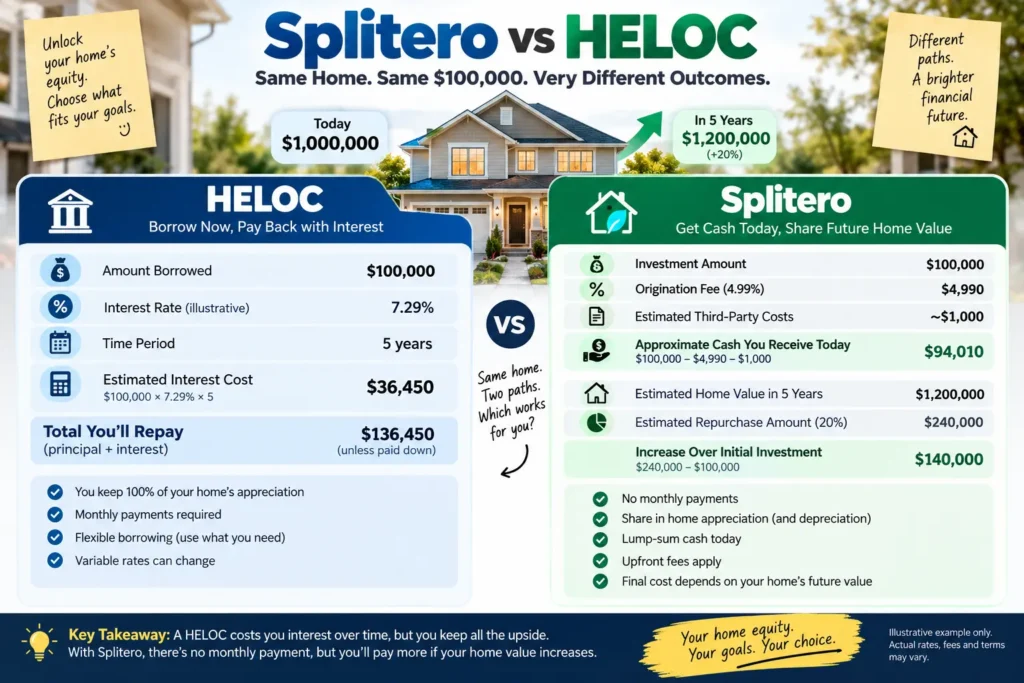
Splitero vs HELOC Cost Example
This is where the comparison gets more interesting.
Let’s assume a homeowner wants approximately $100,000 from their home.
For illustration, we’ll compare:
- A $100,000 HELOC
- A $100,000 Splitero investment
- A five-year holding period
- A home that appreciates from $1 million to $1.2 million
This is an illustrative example, not a quote or prediction. Actual HELOC rates, Splitero terms, property values and fees can differ.
HELOC example
Assume the homeowner borrows $100,000 at an illustrative 7.29% annual rate for five years.
If we simplify the example by assuming the full $100,000 balance remains outstanding for the entire five years:
$100,000 × 7.29% × 5 = $36,450
So the approximate interest cost would be $36,450.
The homeowner would still owe the $100,000 principal unless it had been repaid through the monthly payments.
Importantly, a real HELOC is usually more complicated because the rate can change and the outstanding balance can change as the homeowner makes payments or additional draws.
The homeowner also retains the home’s future appreciation.
Splitero example
Now consider Splitero’s own published five-year illustrative scenario.
The example starts with:
- Initial home value: $1,000,000
- Splitero investment: $100,000
- Estimated future home value: $1,200,000
- Estimated repurchase amount: $240,000
Splitero says the $240,000 figure represents 20% of the estimated $1.2 million repurchase value or the applicable Safety Cap, whichever is less.
The homeowner also pays a 4.99% origination fee.
On a $100,000 investment:
4.99% × $100,000 = $4,990
If approximately $1,000 in third-party closing costs also applied, the homeowner could receive roughly:
$100,000 − $4,990 − $1,000 = $94,010
The actual amount received can vary because the third-party costs and transaction terms are property-specific.
After five years, using Splitero’s illustrative $1.2 million home value:
Estimated repurchase amount = $240,000
So the difference between the original $100,000 investment and the illustrative $240,000 repurchase amount is:
$240,000 − $100,000 = $140,000
And the homeowner also paid the applicable upfront costs.
Side-by-side illustration
| Cost factor | HELOC | Splitero |
|---|---|---|
| Initial amount | $100,000 | $100,000 |
| Illustrative interest/repurchase cost | $36,450 interest* | $140,000 difference in illustrative repurchase amount* |
| Upfront origination fee | Varies | $4,990 |
| Approx. third-party costs | Varies | ~$1,000 |
| Monthly HEI/loan payments | Yes | No monthly HEI payment |
| Future appreciation | Homeowner keeps it | Shared according to agreement |
*These are simplified illustrations, not directly equivalent financing quotes. The HELOC example assumes a constant 7.29% rate and a $100,000 average outstanding balance for five years. The Splitero example uses Splitero’s currently published illustrative scenario. Actual costs depend on the specific contract, rate, home value and repayment timing.
Why this example matters
At first glance, the HELOC may look more expensive because you’re paying interest every month.
But a HEI can become significantly more expensive if the property appreciates substantially because the investor participates in the home’s future value.
That’s why “no interest” does not automatically mean “lower cost.”
For homeowners expecting strong appreciation, the amount of future equity given up can be much more important than the absence of a monthly payment.

What Happens If Your Home Value Goes Up?
This is one of the biggest differences between a HELOC and Splitero.
Suppose your home is worth $600,000 today and eventually increases to $800,000.
With a HELOC
You generally keep the $200,000 increase in value.
You still have to repay the HELOC balance and applicable interest, but the lender doesn’t normally receive a percentage of your home’s appreciation simply because the property became more valuable.
With Splitero
The investment is tied to your home’s future value according to your agreement.
Splitero says it shares in the appreciation or depreciation of the property.
That means significant appreciation can increase the amount you need to pay when you eventually repurchase the investment.
This is one of the most important factors to consider before signing an HEI agreement.
What Happens If Your Home Value Falls?
The two products can also behave differently when property values decline.
With a HELOC, your outstanding debt doesn’t automatically fall just because your home’s market value declines.
For example, if you borrowed $100,000 and the home’s value subsequently dropped by $100,000, you would generally still owe the HELOC balance and applicable interest.
With Splitero, the investment is based on the home’s value at the applicable exit point under the agreement. Splitero says it participates in both appreciation and depreciation.
That can reduce some of the risk associated with home-price declines, although the exact financial outcome depends on the contract.
HELOC vs Splitero: Tax Implications
Taxes are another area where homeowners should be careful.
HELOC tax treatment
The IRS says interest on a home equity loan or HELOC may be deductible when the borrowed funds are used to buy, build or substantially improve the residence securing the debt, subject to applicable requirements and limitations. Interest on funds used for personal expenses generally isn’t deductible under these rules.
For example, a qualifying HELOC used for a substantial home renovation may receive different tax treatment from a HELOC used to pay credit-card debt.
You should not assume that all HELOC interest is deductible.
Splitero tax treatment
A Splitero HEI is structured differently from a conventional loan.
Therefore, homeowners shouldn’t assume that the transaction receives exactly the same tax treatment as HELOC interest.
The tax consequences can depend on the specific transaction and your circumstances.
If you’re considering a large home-equity transaction, speak with a qualified tax professional before making a decision.
Is Splitero Better Than a HELOC?
There isn’t a universal winner.
The better option depends on what you’re trying to accomplish.
A HELOC may be better if:
- You have stable income.
- You can comfortably make monthly payments.
- You need flexible access to cash.
- You expect to repay the money relatively quickly.
- You want to keep your home’s future appreciation.
- You are using the funds for a purpose that may qualify for the home mortgage interest deduction.
For example, a homeowner planning a $50,000 renovation over the next few years may prefer a HELOC because they can access funds as needed rather than exchanging a portion of future home appreciation.
Splitero may be better if:
- Avoiding monthly payments is a major priority.
- You have substantial home equity.
- Your income makes conventional borrowing difficult.
- You want a lump sum rather than a revolving credit line.
- You’re comfortable sharing some future home value.
- You understand the eventual repurchase obligation.
For example, a homeowner with significant equity but limited monthly cash flow might value the absence of monthly HEI payments.
However, that benefit needs to be weighed against the potential long-term cost of sharing future appreciation.
Splitero vs HELOC for Retirees
Retirees may have a particularly important decision to make.
A retiree could have significant home equity but relatively limited monthly income.
A HELOC can provide access to cash, but qualification and monthly payments can be concerns.
An HEI can provide a lump sum without a monthly HEI payment.
However, retirees should pay close attention to:
- How long they expect to remain in the home.
- Whether heirs may eventually inherit the property.
- The potential future repurchase amount.
- Refinancing requirements.
- The impact of home appreciation.
- Estate-planning considerations.
An HEI should therefore be evaluated as a long-term financial decision rather than simply a way to avoid monthly payments.
Splitero vs HELOC for Investors
Using home equity to invest can amplify both gains and losses.
If you use a HELOC to invest, you’re responsible for the debt and interest regardless of whether your investment performs well.
If you use an HEI, you may avoid monthly debt payments, but you’re potentially giving up part of the future value of your home.
Neither approach should be viewed as risk-free.
Before using home equity for an investment, consider whether the expected return justifies the cost and risk of putting your home equity into the strategy.
Pros and Cons: Splitero vs HELOC
Splitero Pros
- No monthly HEI payment.
- Lump-sum access to home equity.
- Doesn’t function as traditional interest-bearing debt.
- Homeowner retains ownership of the property.
- Shares in home appreciation and depreciation under the agreement.
- Can be an alternative for homeowners who don’t fit traditional lending requirements.
Splitero Cons
- You give up a contractual share of future home value.
- There is an origination fee.
- Third-party closing costs apply.
- The eventual repurchase amount can be substantially higher than the initial cash received.
- Refinancing or selling can require settlement of the investment.
- Long-term costs can be difficult to compare with a conventional loan.
HELOC Pros
- Flexible access to funds.
- You generally retain future home appreciation.
- You pay interest on the amount borrowed rather than the entire credit limit.
- Useful for short-term or ongoing expenses.
- Potential tax benefits may apply when IRS requirements are met.
HELOC Cons
- Monthly payments.
- Variable interest rates are common.
- Interest costs can accumulate.
- Qualification requirements can be significant.
- Your home secures the debt.
Frequently Asked Questions
Does Splitero affect my taxes?
It can. A Splitero HEI is structured differently from a conventional HELOC, so homeowners shouldn’t automatically apply HELOC tax rules to it. Consult a qualified tax professional about your specific transaction.
For HELOCs, the IRS says interest may be deductible when qualifying borrowed funds are used to buy, build or substantially improve the home securing the debt.
Can you lose your home with Splitero?
Splitero says the homeowner remains the owner. However, the transaction involves contractual obligations and security interests associated with the investment. You should read the actual agreement carefully to understand the consequences of failing to meet its requirements.
Is a HELOC better for short-term needs?
It can be. If you need flexible access to money for a relatively short period and can comfortably handle monthly payments, a HELOC may be more economical than giving up a portion of future home appreciation.
What happens if my home’s value increases?
With a HELOC, you generally retain the increase in your home’s value after accounting for your outstanding debt.
With Splitero, the company’s contractual share is tied to the home’s value under the terms of the HEI. Significant appreciation can therefore increase your eventual repurchase amount.
What happens if my home loses value?
Splitero says it shares in appreciation and depreciation. A HELOC balance, however, doesn’t automatically decrease because the property’s market value falls.
Does Splitero have monthly payments?
Splitero says there are no monthly HEI payments. Instead, the investment is settled through an eligible exit such as a sale, refinance or cash settlement.
How much does Splitero charge?
Splitero currently lists a 4.99% origination fee, deducted from the investment proceeds, plus approximately $1,000 in third-party closing costs. Actual costs can vary.
Splitero vs HELOC: Which Should You Choose in 2027?
For many homeowners, the decision comes down to one question:
Would you rather pay interest today or give up some potential home appreciation in the future?
A HELOC may make more sense if you have reliable income, can manage monthly payments and want to preserve your home’s future appreciation.
A Splitero HEI may make more sense if avoiding monthly payments is particularly important and you’re comfortable exchanging part of your future home value for cash today.
But don’t compare these products based solely on their headline features.
“No monthly payment” doesn’t mean no economic cost.
Likewise, a HELOC’s interest rate doesn’t tell the entire story without considering how long you’ll carry the balance and whether you can repay it quickly.
Before choosing, compare:
- How much cash you’ll actually receive.
- Upfront fees.
- Monthly payments.
- Interest costs.
- The expected time you’ll keep the home.
- Potential future appreciation.
- Your eventual HEI repurchase amount.
- Tax implications.
- Your refinancing plans.
- The effect on your long-term financial goals.
Bottom Line
Choose a HELOC when flexible borrowing, monthly affordability and retaining future appreciation are your priorities.
Consider Splitero when avoiding monthly HEI payments is more important and you’re comfortable sharing some future home value.
For a major financial decision involving your home, read the complete agreement and consider independent financial and tax advice.
Explore more U.S.-focused personal finance guides on Secure Wealth Blog.
This article is for educational purposes only and is not financial, tax, legal or investment advice. Product terms, rates, fees and eligibility requirements can change. Verify current terms directly with the provider and consult qualified professionals for advice specific to your situation.