
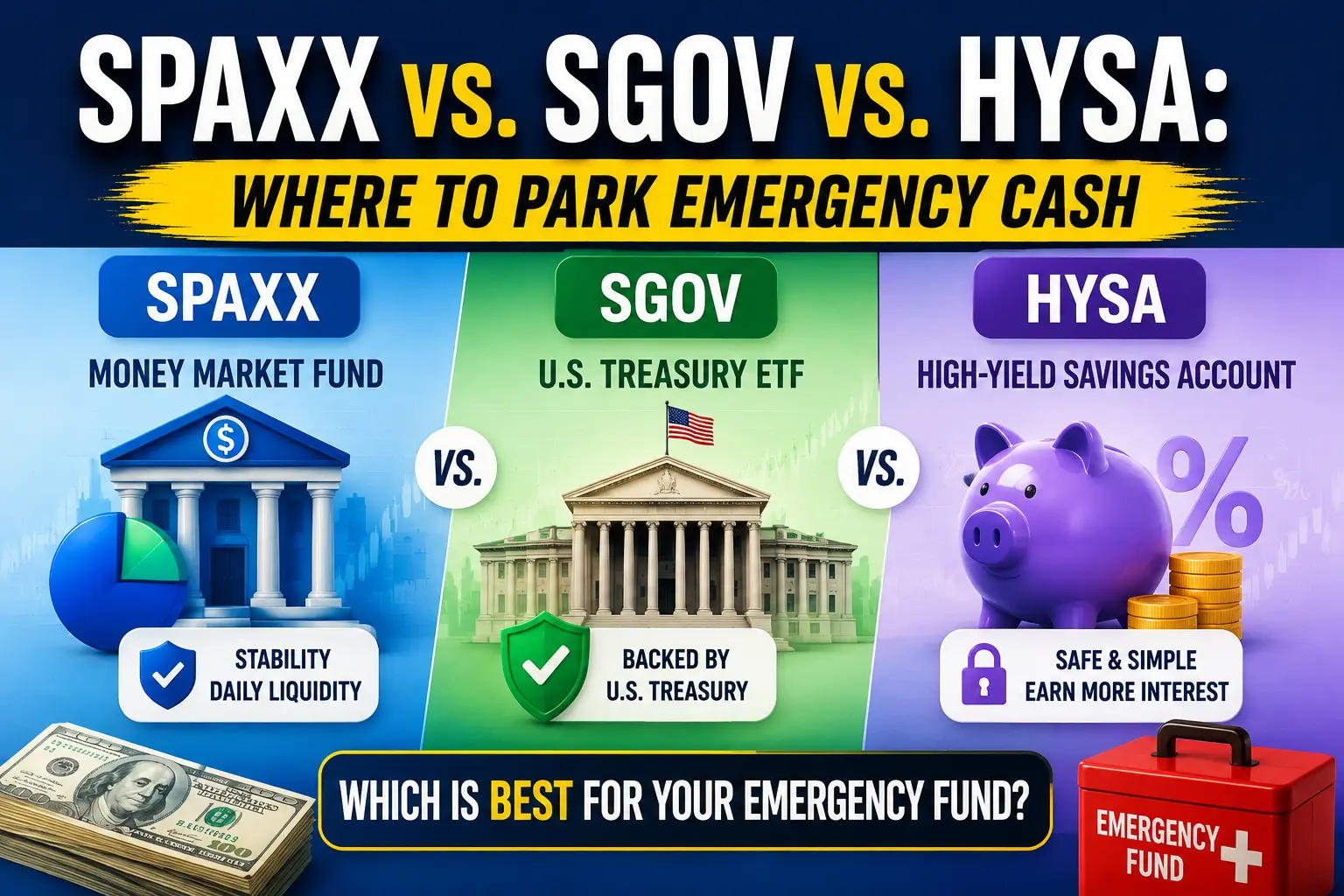
If you have $10,000 saved for emergencies, should you leave it in a high-yield savings account (HYSA), keep it in Fidelity Government Money Market Fund (SPAXX), or invest it in the iShares 0–3 Month Treasury Bond ETF (SGOV)?
All three options can generate income on your cash, but they are not interchangeable.
They differ in deposit insurance, access to money, investment risk, fees, and tax treatment.
The best choice depends on whether you need immediate access, how much emergency savings you have, and whether you are comfortable using a brokerage account.
Quick answer: An FDIC-insured high-yield savings account is generally the best starting point for an emergency fund because it combines deposit protection with straightforward access.
SPAXX may suit Fidelity users who want convenient brokerage cash management.
SGOV may suit investors who want short-term Treasury exposure and are comfortable selling ETF shares before withdrawing their money.
You can also combine these options. Keeping immediate emergency cash in a bank account and using a brokerage fund for additional reserves may help balance convenience and potential income.
SPAXX vs. SGOV vs. HYSA
Compare safety, access, taxes, and costs before choosing where to keep your cash.
| Feature | HYSA | SPAXX | SGOV |
|---|---|---|---|
| What it is | Bank savings deposit | Government money market mutual fund | Short-term Treasury ETF |
| FDIC insured? | Yes* | No | No |
| Principal fluctuation | No market-price fluctuation on deposits | Seeks a stable $1 NAV; not guaranteed | Share price can fluctuate |
| Access to money | Bank transfers; sometimes debit card or ATM | Eligible brokerage transactions and withdrawals | Sell shares, wait for settlement, then withdraw |
| Weekend access | Depends on available bank services | Depends on account and transaction rules | Exchange trades generally unavailable |
| Expense ratio | None for the depositor | 0.42% gross* | 0.09%* |
| Federal taxes | Interest generally taxable | Distributions generally taxable | Distributions generally federally taxable |
| State tax treatment | Generally taxable | Depends on qualifying government income | Qualifying Treasury income generally exempt |
| Best use | Immediate emergency cash | Convenient Fidelity cash management | Additional Treasury reserves |
*FDIC coverage is subject to applicable limits and eligibility rules. SPAXX and SGOV are not FDIC-insured. Expense ratios and fund details can change; verify the latest figures with the fund providers.
Fund expenses and yields can change. The published expense ratio is not an additional charge you should subtract from an already published fund yield. Verify current figures on the Fidelity SPAXX page and iShares SGOV page.
Is SPAXX better than a HYSA?
| Feature | SPAXX | High-Yield Savings Account (HYSA) |
|---|---|---|
| FDIC Insurance | ❌ No | ✅ Yes, up to $250,000 |
| Yield | Follows short-term rates; check the current 7-day yield. | Set by the bank and can change at any time. |
| State Income Tax | Part of the income may be exempt, depending on the fund’s holdings each year. | Interest is generally subject to state income tax. |
| Access | Instant inside Fidelity; typically 1–2 business days for an outside bank transfer. | Often same-day or next-day access to linked checking, depending on the bank. |
| Best For | Fidelity investors who want cash alongside their investments. | People who prioritize FDIC insurance and straightforward savings. |
Choose SPAXX if you already invest at Fidelity and want your cash ready to invest or move between accounts.
Choose a HYSA if FDIC insurance and simplicity matter most.
Also consider FDLXX: If you live in a high-tax state, compare Fidelity Treasury Only Money Market Fund (FDLXX). A larger portion of its income may qualify for state and local tax exemption than SPAXX, depending on each fund’s annual income composition and your state’s rules.
1. Why an Emergency Fund Needs More Than a Good Yield
An emergency fund serves a different purpose from an investment portfolio.
You might use it to pay for an unexpected medical bill, replace a broken appliance, repair your car, cover an insurance deductible, or pay essential expenses after losing your job.
These costs can arrive at inconvenient times. You may need money on a weekend, before payday, or while your regular income is temporarily unavailable.
That is why three questions matter more than the advertised interest rate:
- Can you access the money when you need it?
- Could the amount available be lower than your original balance?
- Is your money protected by deposit insurance or exposed to investment risk?
A product that earns slightly more but makes emergency withdrawals harder may not be the best choice for your immediate cash reserve.
A useful starting goal is three to six months of essential expenses. If your income is irregular, you are self-employed, or other people depend on your income, you may want a larger reserve.

2. HYSA: The Simplest Option for Immediate Emergency Cash
A high-yield savings account is a bank deposit that earns interest. It is often the easiest option for someone who wants emergency money separate from everyday spending.
The biggest advantage: FDIC insurance
Eligible deposits at an FDIC-insured bank are generally covered up to $250,000 per depositor, per insured bank, per ownership category. Your checking and savings balances in the same ownership category at the same bank generally count toward the same limit.
The FDIC explains these rules in its deposit insurance guide.
This protection is different from an investment’s market performance. An eligible savings deposit does not fluctuate with Treasury ETF prices.
Access is straightforward, but not always instant
Most savings accounts allow transfers to linked checking accounts. Some offer debit cards or ATM access, while others require you to transfer funds before spending.
Check the bank’s transfer cutoff times, withdrawal limits, and weekend processing policies. A transfer initiated on Saturday may not arrive in your checking account immediately.
For this reason, it can be useful to keep a smaller amount in checking for urgent expenses and the remainder of your emergency savings in an insured HYSA.
The trade-off
Savings rates can fall when market interest rates decline. Interest is generally subject to federal income tax and potentially state and local taxes.
Even so, the simplicity and deposit protection of an HYSA make it a strong default for money you cannot afford to have tied up or exposed to investment-price changes.
3. SPAXX: A Convenient Choice for Fidelity Users
SPAXX is Fidelity Government Money Market Fund. It invests in short-term government-related instruments and seeks to maintain a stable $1.00 net asset value.
Where available as a Fidelity account’s core position, it can automatically hold uninvested cash and generate income without requiring you to purchase and sell an ETF for every cash movement.
When SPAXX makes sense
SPAXX may be useful if you already keep money in Fidelity and want to manage investments and cash in one place.
Eligible account transactions can make access more convenient than manually selling an exchange-traded fund. However, the exact process depends on your account type, core position, and withdrawal method.
Understand the risk
SPAXX is not an FDIC-insured bank account. Although it seeks to maintain a $1.00 NAV and invests primarily in government-related instruments, the fund does not guarantee your principal.
Its yield also changes as short-term interest rates and portfolio income change.
Fidelity reported a 3.34% seven-day yield as of September 9, 2026, and a 0.42% gross expense ratio dated June 29, 2026, in the fund information available for this comparison. These are dated reference figures, not guaranteed future returns.
Another consideration is state taxation. SPAXX holds a mixture of government-related instruments, including Treasury securities, agency securities, and repurchase agreements. Not every dollar of its distribution necessarily qualifies for a state or local tax exemption.
Check Fidelity’s annual tax information and the rules for your state before assuming the entire distribution is tax-exempt.
4. SGOV: A Short-Term Treasury ETF for Additional Reserves
SGOV is an exchange-traded fund that invests in U.S. Treasury securities with very short remaining maturities, generally three months or less.
Unlike a savings account or money market mutual fund, SGOV trades on an exchange. Its share price can move during the trading day.
Why investors consider SGOV
SGOV offers exposure to short-term Treasury bills through a brokerage account. Its expense ratio is 0.09%, according to the fund’s official information.
Treasury income can also offer a tax advantage: qualifying interest from U.S. Treasury obligations is generally exempt from state and local income taxes, although federal income tax generally still applies.
iShares reported a 3.63% 30-day SEC yield as of September 9, 2026. That figure should not be treated as a promised return or directly compared with a bank APY without accounting for differences in yield calculations and taxes.
The important drawback: Selling is not the same as withdrawing
If you need $3,000 for a car repair, you must sell enough SGOV shares to generate the required cash.
You generally cannot execute that sale when the exchange is closed. ETF trades typically settle on the next business day under the standard T+1 settlement cycle, after which transferring the proceeds to a bank can take additional time.
The market price may also be slightly different when you sell. SGOV has relatively low interest-rate sensitivity, but its price is not guaranteed to remain constant.
For these reasons, SGOV is usually better considered for additional emergency reserves than for the only money you have available.
5. What Happens If You Need $5,000 This Weekend?
Imagine your car breaks down on Saturday, and the repair shop requires $5,000 before returning the vehicle.
With an HYSA: You may be able to use a debit card or transfer money to checking. If the bank’s transfer does not process over the weekend, access could still be delayed.
With SPAXX: If your money is in an eligible Fidelity account, the account may support convenient cash transactions. However, your ability to pay the repair shop immediately depends on the account’s withdrawal methods and available funds.
With SGOV: You generally cannot sell shares on Saturday. You may need to wait until the next trading session, then allow time for settlement and any bank transfer.
This example shows why emergency savings should be organized around access requirements rather than yield alone.
Before moving money into any brokerage fund, verify how you would actually pay an urgent bill from that account.
6. Which Option Gives You the Best After-Tax Return?
A higher quoted yield does not automatically mean more money in your pocket.
First, understand that the figures are measured differently. A savings account advertises an annual percentage yield (APY), SPAXX reports a seven-day yield, and SGOV reports a 30-day SEC yield. These figures use different methodologies and should not be treated as perfectly equivalent.
Second, consider taxes.
HYSA interest is generally taxable at the federal level and may be taxable at the state and local levels. SPAXX distributions are generally federally taxable, with state treatment depending on the qualifying portion of government income. Qualifying Treasury income from SGOV is generally exempt from state and local income taxes.
For example, suppose a taxpayer has a 24% federal marginal tax rate and a 5% state marginal tax rate. For illustration only, assume a savings account earns 4.00% APY and all its interest is taxed at both rates.
A simplified estimate of its after-tax return is:
4.00% × (1 − 0.24 − 0.05) = 2.84%
This is an approximation that assumes the rates apply to the entire interest amount and ignores other tax interactions.
If a Treasury fund earns a similar pretax yield, its state-tax exemption could improve its after-tax result. The actual benefit depends on the qualifying income percentage, applicable tax rules, and the fund’s yield.
Do not assume that SGOV always wins. If its yield is lower, if your state has no individual income tax, or if the difference is small, convenience may matter more than the tax benefit.
7. A Practical Way to Divide Your Emergency Savings
You do not need to put every dollar in the same product.
Consider a household with $18,000 in emergency savings and $4,000 in essential monthly expenses. That reserve covers 4.5 months of essential expenses.
A possible structure is:
- $2,000 in checking: For immediate bills and urgent payments.
- $10,000 in an FDIC-insured HYSA: For accessible, insured emergency savings.
- $6,000 in SPAXX or SGOV: Only if the household understands the risks and access requirements and has enough cash elsewhere.
This is an illustration, not a universal allocation. Someone with unstable income, limited savings, or no other source of emergency cash might reasonably keep the entire reserve in insured bank deposits.
If you choose SPAXX or SGOV, confirm how quickly you can turn the holding into spendable money before relying on it for an emergency.
8. SPAXX or HYSA: Which Should You Choose?
Choose an HYSA if you prioritize FDIC insurance, simple withdrawals, and predictable account balances.
Choose SPAXX if you already use Fidelity, value integrated cash management, and understand that a money market fund is not a bank deposit.
Consider SGOV if you have adequate immediately accessible savings, want short-term Treasury exposure, and are comfortable selling shares and waiting for settlement.
The decision is not necessarily HYSA versus SPAXX versus SGOV. It can be HYSA first, with SPAXX or SGOV used for a separate portion of your cash reserves.
Related Comparisons
Once you know how much of your emergency fund needs immediate access, these comparisons can help you evaluate other options:
- FDLXX vs. SPAXX: Compare Fidelity’s Treasury Only Money Market Fund with its Government Money Market Fund, including potential state-tax differences. (Add the link after publishing the FDLXX comparison.)
- SGOV vs. USFR: Compare a short-term Treasury bill ETF with a floating-rate Treasury ETF. (Add the link after publishing the USFR comparison.)
- SGOV vs. BIL: Compare two short-term Treasury ETFs by expenses, yield, liquidity, and tax treatment. (Add the link after publishing the BIL comparison.)
- SGOV vs. SPAXX: Which Is Better for an Emergency Fund?: Explore the differences between these two brokerage options in more detail.
Yield & Tax Comparison: High-Tax State vs. No-Tax State
A higher nominal APY does not always result in more money in your pocket. The state where you reside heavily influences the mathematical outcome.
Scenario: $30,000 Emergency Fund in California (9.3% State Tax Bracket)
Assume the following gross yields:
- HYSA: 4.10% gross yield
- SGOV: 3.55% gross yield (100% exempt from state tax)
HYSA Interest Earned:  $30,000 × 4.10% = $1,230 gross
State Tax Owed (9.3%): -$114
Net Return After State Tax: $1,116 (Effective Yield: 3.72%)

SGOV Dividends Earned: $30,000 × 3.55% = $1,065 gross
State Tax Owed: $0
Net Return After State Tax: $1,065 (Effective Yield: 3.55%)
Takeaway: In states with high income tax rates (CA, NY, NJ, HI, OR), SGOV’s state tax exemption significantly narrows the gap against higher-yielding bank accounts. When bank APYs drop closer to Treasury yields, SGOV often emerges as the clear winner after taxes.
Frequently Asked Questions
Is SPAXX safe for emergency savings?
SPAXX is a government money market mutual fund designed to preserve capital and provide liquidity. However, it is not FDIC insured, and its $1.00 NAV is not guaranteed. Consider keeping the money you may need immediately in an insured bank account.
Is SGOV better than a high-yield savings account?
Not for every investor. SGOV provides short-term Treasury exposure and may offer state-tax benefits, but its share price can fluctuate and you must sell shares to access the proceeds. An HYSA is generally simpler for immediate emergency cash.
Can I lose money in SGOV?
Yes. SGOV’s market price can fluctuate, and its value is not guaranteed. Its very short Treasury holdings help limit interest-rate sensitivity, but they do not eliminate all investment risks.
How much emergency money should I keep in a savings account?
A common starting point is three to six months of essential expenses. Keep enough in an immediately accessible account to cover urgent needs, then consider whether any additional reserve belongs in a brokerage fund.
Are SPAXX and SGOV tax-free?
No. Both can generate income that is generally subject to federal income tax. Qualifying government or Treasury income may receive state and local tax exemptions, but the amount depends on the fund’s holdings and applicable rules.
Is SPAXX a high-yield savings account?
No. SPAXX is the Fidelity Government Money Market Fund, a mutual fund, not a bank account. It is the default “core position” that holds uninvested cash in many Fidelity brokerage accounts. It invests in short-term U.S. government securities and repurchase agreements, and its yield is paid as monthly dividends rather than bank interest.
A high-yield savings account (HYSA) is a deposit account at a bank. It is FDIC-insured up to $250,000 per depositor, per bank, per ownership category. SPAXX is not FDIC-insured. Its yield can still be similar to a HYSA’s, which is why people often compare the two.
Is SPAXX safe for an emergency fund?
For most people, yes. SPAXX is one of the lower-risk places to keep cash. It holds short-term government securities and aims to keep a stable $1.00 share price. You can sell during market hours and use the money in your Fidelity account the same day.
Keep in mind:
No FDIC insurance. A money market fund can lose value, though government money funds have a strong track record of holding $1.00.
SIPC protection covers you if Fidelity as a broker fails. It does not cover investment losses.
Transfer time: moving money to an outside bank usually takes 1–2 business days.
To get cash instantly in a true emergency, many people keep a small amount in a checking account and the rest in SPAXX.
Final Verdict
For most households, an FDIC-insured high-yield savings account is the best starting point for an emergency fund because it offers deposit protection and straightforward access.
SPAXX can be convenient for Fidelity users who understand the risks of a money market mutual fund. SGOV can be worth considering for additional reserves when Treasury exposure and potential state-tax benefits matter more than immediate access.
Before deciding, check current yields, expense ratios, withdrawal rules, deposit insurance, and your tax situation. The purpose of an emergency fund is not to earn the maximum possible return. It is to make sure an unexpected expense does not become a financial crisis.
Disclaimer: This article is for educational purposes only and does not constitute individualized financial, investment, or tax advice. Yields, rates, and tax rules can change. Review official fund documents and consult a qualified professional when appropriate.
Latest Posts
- What Is FDLXX? Yield, Tax Perks & Who Should Use It
- ACA Open Enrollment 2027: Key Dates, Premium Increases, and What Lost Subsidies Mean for You
- Tax Brackets Married Filing Jointly: Rates & Calculator Guide
- How to Avoid State Taxes on Treasury Interest: A Guide for U.S. Investors
- Treasury Bills vs. CDs: Which Is Right for Short-Term Savings?