You’re sleeping in your car, crashing on a different couch every week, or counting the hours until the shelter doors open.
Every dollar that hits your palm seems to vanish into fast food, laundry, and bus fare. It feels like the math just doesn’t work.
But thousands of Californians crawl out of homelessness every year, not because they suddenly earned a six-figure salary, but because they treated housing like a puzzle—and then solved it piece by piece using free state resources.
This guide gives you the blueprint. No fluff. No false hope. Just a step-by-step financial survival map built on California-specific programs, hard data, and what actually gets people housed.
Why California’s Housing Math Is Brutal—and Why You Can Beat It
The median rent for a one-bedroom apartment in Los Angeles hovers around $2,200. In San Francisco, it’s even higher.
Even a single-family home rental in the Central Valley can run $1,500. If you’re unhoused, you already know these numbers mock you.
But here’s the shift: you don’t need to solve the whole problem at once. You need to replace your immediate survival costs with government and nonprofit benefits, then redirect your own cash into a dedicated housing fund.
The California Department of Social Services (CDSS) alone channels hundreds of millions of dollars into homelessness prevention and rapid rehousing each year. You just have to know which door to knock on.
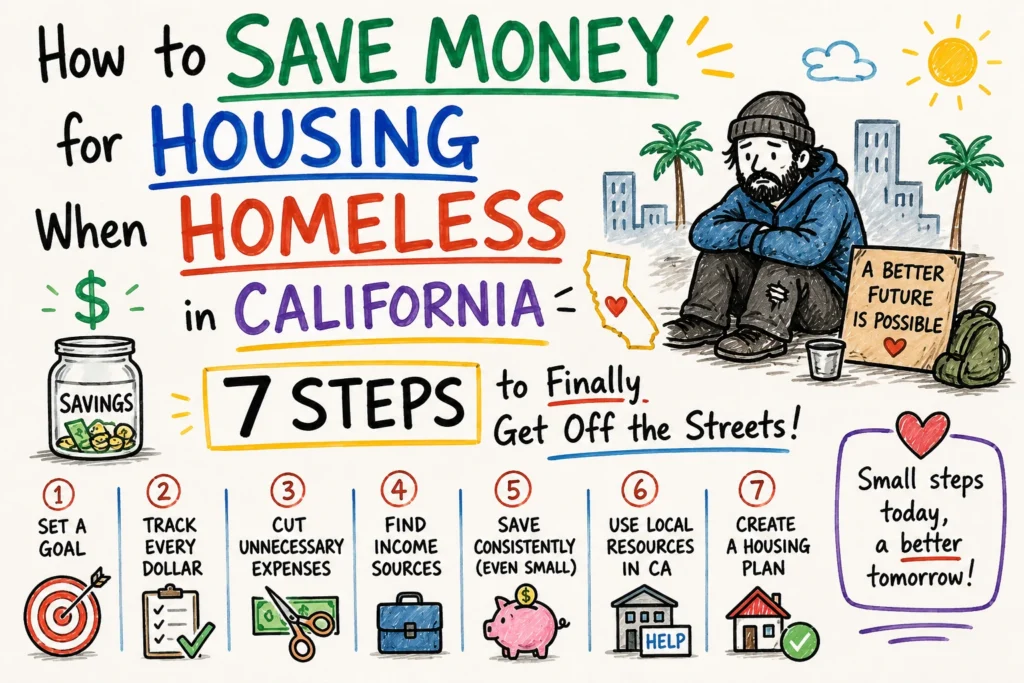
Step 1: Slash Daily Expenses by Claiming CalFresh and Medi-Cal Immediately
Food and medical bills eat the biggest holes in a tight budget. Plug those holes first. CalFresh (California’s SNAP program) gives you a monthly Electronic Benefit Transfer (EBT) card that covers groceries.
A single adult can receive up to $292 per month; a family of three gets up to $766. Medi-Cal provides free or low-cost health coverage, including mental health and substance use treatment, and it now pays for some housing services.
If you’re spending $10 a day on food, CalFresh alone frees up $300 a month. That’s your housing fund starter.
Apply online at your county’s social services portal.
Use a library computer or a free smartphone data lifeline. While searching “how to save money for housing when homeless in california online” might have brought you here, the real first click should be the “Apply for Benefits” button.
Once approved, your EBT card works at most grocery stores and even many farmers’ markets. Redirect what you would have spent on food into a separate, safe place—even a prepaid debit card from Walmart serves as a rudimentary “Move-in Fund” until you can open a real bank account.
Step 2: Tap Emergency Housing Help—Free Motel Vouchers and Temporary Shelter Cash
California counties offer immediate, short-term financial assistance to prevent street homelessness. The flagship program for families is CalWORKs Homeless Assistance (HA) . If you’re a parent with minor children and eligible for CalWORKs (cash aid), you can receive:
- Temporary HA: Up to 16 cumulative days of shelter, paid directly to a motel/hotel or shelter. As of 2023, the daily rate is $85 for a family of 1–4 members and $100 for families of 5 or more.
- Permanent HA: Security deposit, last month’s rent, and utility deposits to secure a new rental. You can tap this benefit once every 12 months, and it can provide a couple thousand dollars in upfront cash for a landlord.
If you’re an individual or couple without children, ask your county about General Relief (GR) housing subsidies . Many counties, including Los Angeles, offer limited motel vouchers or move-in assistance through GR or the local Coordinated Entry System.
You’ll often see searches for “free motel vouchers for homeless online.” The truth: you typically cannot print a voucher from a website.
You apply in person or by phone through your county’s Department of Social Services, but you can start the process online by submitting an application for CalWORKs or General Relief at your county’s equivalent portal. In LA County, use the Your Benefits Now (YBN) portal. The application itself becomes your ticket to an emergency shelter voucher interview.
Step 3: Get in Line for Permanent Housing Vouchers and Subsidized Rent
Short-term motel stays prevent crisis, but permanent housing requires a deeper pocket. The U.S. Department of Housing and Urban Development (HUD) funds Housing Choice Vouchers (Section 8) , and California adds state-level supplements. The catch: waitlists are long. The solution: get on every list you qualify for, today.
Key voucher programs you can apply for:
- Housing Choice Voucher (Section 8): You pay 30% of your income; the voucher covers the rest. Waitlists open sporadically, so sign up for alerts through your local housing authority.
- Veterans Affairs Supportive Housing (VASH): Combines a Section 8 voucher with VA case management. If you served, contact your local VA medical center.
- Continuum of Care (CoC) Permanent Supportive Housing: For chronically homeless individuals with a disability. The CoC coordinates rapid rehousing and long-term rental subsidies.
- CalWORKs Housing Support Program (HSP): Provides rental assistance and housing navigation for families receiving CalWORKs who are homeless or at imminent risk. This is separate from the short-term Homeless Assistance—HSP can cover months of rent.
The permanent housing voucher application rarely lives on a single website. Instead, the gateway is the Coordinated Entry System (CES) . Call 211 or visit your local CoC’s access point for a housing assessment.
In Los Angeles, call LA-HOP (213-225-6581) or use the LA-HOP online portal. Your CES assessment scores your vulnerability and matches you with the right long-term subsidy. The earlier you get assessed, the earlier you’re in line.
Step 4: Start a Mini Emergency Fund Using Micro-Savings You Won’t Miss
It’s maddening to hear “save money” when you have negative cash flow. But micro-savings work if you treat them as non-negotiable bill. Use any small windfall—a side gig, recycling money, plasma donation, or panhandling proceeds—to feed a housing fund first. Even $5 a day becomes $150 a month. In 12 months, that’s $1,800, enough for a security deposit in many California cities if paired with rental assistance.
Where to park your cash safely while homeless:
- Fee-free bank or credit union account: Many credit unions offer “second chance” checking. You don’t need a permanent address; you can use a shelter’s mailing address or a trusted friend’s address.
- Prepaid card with a savings bucket: Some prepaid cards, like the PayPal Prepaid Mastercard, offer a separate savings balance. It’s not FDIC-insured the same way but keeps cash out of sight.
- Apps that round up and save: If you have a bank account, apps like Chime’s Save When You Get Paid or Digit tuck small amounts automatically. When you’re homeless, automation is your best friend—you can’t spend what you don’t see.
A Reddit thread on saving for a house in the U.S. (r/personalfinance) surfaces a common tactic: set up an automatic transfer into a savings account you don’t touch.
The same psychology works on a smaller scale. If you receive CalWORKs cash aid or General Relief, ask your caseworker if direct deposit to a separate housing account is possible.
Step 5: Unlock Specific Programs for Families, Veterans, and Foster Youth
California carves out special pathways for groups that disproportionately experience homelessness. Lean into your category.
Families with children:
Beyond CalWORKs HA, the CalWORKs permanent housing assistance (HSP) pays up to 24 months of rental assistance plus case management. Apply through your county welfare department. Families can also access the Bringing Families Home program, which offers housing help for child-welfare-involved families.
Veterans:
The HUD-VASH program is the fastest track. Additionally, the California Department of Veterans Affairs (CalVet) runs the Veterans Housing and Homelessness Prevention Program (VHHP) , which provides rental assistance and supportive services. Contact your local CalVet office.
Former foster youth:
If you aged out of foster care, the Transitional Housing Program Plus (THP-Plus) provides up to 24 months of housing and case management for young adults ages 18–24. The Housing Choice Voucher for former foster youth (Family Unification Program) offers priority vouchers. Call your county’s Independent Living Program.
Los Angeles-specific housing programs:
The city of Los Angeles and LA County run multiple overlapping initiatives. The LA County Department of Mental Health offers Full Service Partnerships for individuals with serious mental illness. The Los Angeles Homeless Services Authority (LAHSA) coordinates Emergency Housing Vouchers (EHV) and rapid rehousing. If you’re in LA, bookmark LAHSA’s housing navigation portal. Other counties like Alameda and San Diego have similar centralized portals.
Step 6: Use Technology to Find and Apply for Aid Faster Than Ever
You no longer have to trudge from one office to another. The state has digitized many applications.
- Apply for homeless assistance online through custom portal. You can apply for CalFresh, Medi-Cal, and CalWORKs in one go.
- Use 211.org or dial 211 to get a live navigator who can search “free programs that help homeless get housing” on your behalf. 211 databases list local motel voucher programs, rental assistance, and day centers.
- Medi-Cal managed care plans now offer Community Supports, including housing deposits, rental assistance, and utilities. If you’re on Medi-Cal, call your plan (L.A. Care, Health Net, etc.) and ask for a “Housing Navigator.” This is part of the Housing and Homelessness Incentive Program (HHIP), which rewards plans for getting people housed. That means your insurance company actually has a financial incentive to pay for your deposit.
- Search the CDSS Housing Programs page (cdss.ca.gov) for a list of Housing Support Program providers in your county.
Step 7: Protect Your Savings and Avoid the Pitfalls That Keep People Trapped
Even a small stash of cash makes you a target. And good intentions without structure evaporate. Here’s how to shield your progress.
- Never carry your entire fund in cash. Use a bank account or, at minimum, keep money split between a locked backpack, a trusted family member, and a prepaid card.
- Get a free mailing address. Homeless day centers, shelter programs, and even some post offices offer general delivery. Having an address lets you receive EBT cards, bank statements, and job correspondence—critical for stability.
- Watch out for predatory landlord scams. If someone demands a “holding fee” in cash with no receipt, walk away. Legitimate housing programs use written agreements.
- Keep a simple expense log. A cheap notepad or a free app like Goodbudget can track every dollar saved toward move-in costs. Seeing the number grow is the strongest motivation you’ll ever have.
Key Takeaway: Saving for housing while homeless in California isn’t about white-knuckling deprivation. It’s about stacking the free resources the state already offers—CalFresh, Medi-Cal, CalWORKs Homeless Assistance, vouchers—so that your own income can be weaponized exclusively for housing. Treat the system like a financial lever, not a handout.
Actionable Next Steps (Do These Today)
- Open a benefits account. Go to BenefitsCal.com and submit one application for CalFresh, Medi-Cal, and CalWORKs. If you have kids, mark “homeless” on the form to trigger Homeless Assistance screening.
- Dial 211 and say, “I need a Coordinated Entry System assessment and emergency shelter assistance in my county.”
- Ask your Medi-Cal plan for a Housing Navigator. This one phone call can unlock rental deposits and utility payments worth several thousand dollars.
- Create a housing-only savings bucket. Even a prepaid debit card labeled “RENT” with a $20 starting deposit shifts your identity from “homeless” to “soon-to-be-housed.”
- Check HUD and VA portals. Visit hud.gov/states/california, and if you’re a veteran, contact the National Call Center for Homeless Veterans at 1-877-4AID-VET.
- Set a micro-savings goal. Commit to putting $5 aside every day. In 30 days, you’ll have a tangible $150 fund that, combined with a CalWORKs security deposit voucher, becomes keys in your hand.
The road from the street to a front door is paved with paperwork, patience, and small, stubborn acts of saving. You’ve already taken the first step by searching for a way out. Now go pull the levers California built for you.
Financial Disclaimer: This article is for informational and educational purposes only and does not constitute financial, legal, or tax advice. Eligibility for government programs depends on income, family composition, and other factors that change frequently. Always consult with a certified case manager, housing counselor, or legal aid professional before making financial decisions. The author and publisher assume no liability for actions taken based on this content.