

Choosing between a Traditional and Roth 401(k) is one of the most impactful financial decisions you’ll make.
With 2026 bringing new IRS limits and SECURE 2.0 Act changes, the stakes are higher than ever.
If you’re worried about paying too much in taxes or leaving money on the table, this guide breaks down exactly how to decide.
Quick Decision Guide
- Choose Traditional 401(k) if you expect to be in a lower tax bracket in retirement than you are now. You get a tax break today and pay taxes later.
- Choose Roth 401(k) if you expect to be in a higher or similar tax bracket in retirement. You pay taxes now and withdraw tax-free later.
- 2026 Limits: The employee contribution limit is $24,500 (shared between both types). Catch-up contributions for ages 50+ are $8,000, and ages 60–63 get a “super catch-up” of $11,250.q3adv+1
- New for 2026: High earners ($145,000+ in 2025 wages) must make catch-up contributions to Roth accounts.
Traditional vs. Roth 401(k)
Traditional 401(k): You contribute pretax dollars, potentially reducing your taxable income today. You pay ordinary income tax when you withdraw the money in retirement.
Roth 401(k): You contribute after-tax dollars. You receive no upfront federal income-tax deduction, but qualified withdrawals can be tax-free.
Which is better? Neither is universally better. A Roth 401(k) may make more sense if you expect your tax rate to be higher in retirement. A traditional 401(k) may be attractive if you are in a relatively high tax bracket now and expect a lower tax rate later.
You can also split contributions between the two if your employer’s plan permits both.
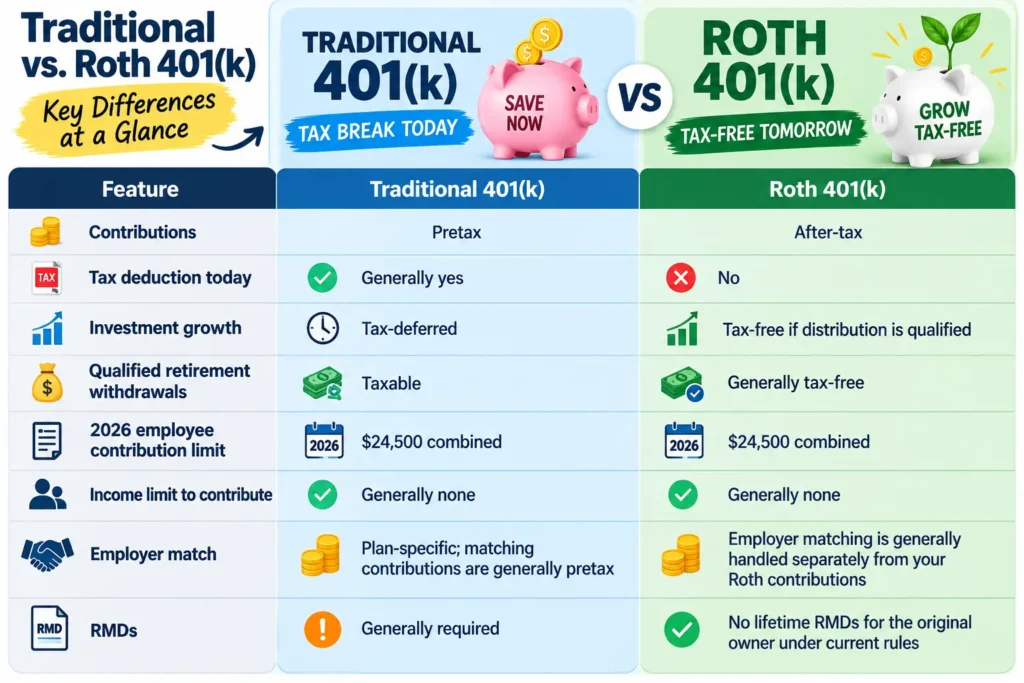
Traditional vs. Roth 401(k): What’s the Difference?
The central Roth 401(k) vs. traditional difference is when you pay income taxes.
| Feature | Traditional 401(k) | Roth 401(k) |
|---|---|---|
| Contributions | Pretax | After-tax |
| Tax deduction today | Generally yes | No |
| Investment growth | Tax-deferred | Tax-free if distribution is qualified |
| Qualified retirement withdrawals | Taxable | Generally tax-free |
| 2026 employee contribution limit | $24,500 combined | $24,500 combined |
| Income limit to contribute | Generally none | Generally none |
| Employer match | Plan-specific; matching contributions are generally pretax | Employer matching is generally handled separately from your Roth contributions |
| RMDs | Generally required | No lifetime RMDs for the original owner under current rules |
The important point is that Roth and traditional 401(k) contributions share the same employee contribution limit. You cannot contribute $24,500 to each. If you contribute to both, the combined employee deferrals generally cannot exceed the applicable annual limit.
Why This Decision Matters More in 2026
Tax planning has become increasingly important because retirement decisions can span several decades, while tax laws can change during your working life.
For 2026, the IRS increased the basic 401(k) employee contribution limit to $24,500. The regular catch-up contribution for people age 50 and older is $8,000, while individuals ages 60 through 63 may qualify for the higher $11,250 catch-up limit.
Federal tax brackets also remain important when deciding where to put your next retirement dollar. For 2026, the federal marginal rates range from 10% to 37%, with the 37% rate beginning above $640,600 of taxable income for single filers and $768,700 for married couples filing jointly.
Inflation is another consideration. The Bureau of Labor Statistics reported that consumer prices were still rising year over year in 2026, meaning future purchasing power and future retirement expenses remain important planning considerations.
In other words, your decision isn’t simply “pay taxes now or later.” It is a decision about managing your future tax exposure.
How a Traditional 401(k) Works
With a traditional 401(k), contributions are generally made from your paycheck before federal income taxes are calculated.
For example, suppose you earn $100,000 and contribute $10,000 to a traditional 401(k). Subject to your circumstances, that contribution can reduce the amount of income subject to current federal income tax.
Your investments can then grow tax-deferred. You generally don’t pay federal income tax on investment gains, dividends or interest inside the account each year.
The trade-off comes later.
When you withdraw money from the account in retirement, distributions are generally included in taxable income.
Benefits of a traditional 401(k)
A traditional 401(k) may be particularly useful if:
- You are currently in a high tax bracket.
- You expect your taxable income to fall after retirement.
- You want to reduce your current taxable income.
- You need the larger current paycheck that pretax contributions can provide.
- You want to maximize retirement savings while receiving an immediate tax benefit.
Example: If you’re currently earning peak-career income but expect substantially lower taxable income after retiring, taking the tax deduction now and paying tax later may be advantageous.
How a Roth 401(k) Works
A Roth 401(k) reverses the basic tax timing.
You contribute money after federal income taxes have already been applied. Therefore, Roth contributions generally don’t reduce your current taxable income.
However, qualified withdrawals can be excluded from gross income.
The IRS generally requires a Roth 401(k) distribution to satisfy the applicable five-taxable-year requirement and occur after age 59½, because of disability, or after the participant’s death to qualify for tax-free treatment.
Benefits of a Roth 401(k)
A Roth 401(k) may be attractive if:
- You’re relatively early in your career.
- Your current tax bracket is comparatively low.
- You expect your income to increase substantially.
- You believe your retirement tax rate could be higher.
- You value tax-free qualified retirement income.
- You want greater tax diversification in retirement.
One significant advantage is that a Roth 401(k) can provide a pool of retirement assets that isn’t generally subject to federal income tax when qualified withdrawals are made.
Is Roth 401(k) Better Than Traditional?
Not necessarily.
The better question is:
Is your current marginal tax rate likely to be higher or lower than the tax rate you will effectively pay on traditional 401(k) withdrawals in retirement?
Consider two workers.
Worker A: High income today
Someone earning a high salary during peak earning years may benefit from traditional contributions because the current tax deduction could be valuable.
If that person retires with significantly lower taxable income, traditional 401(k) withdrawals may be taxed at lower marginal rates.
Worker B: Early-career professional
Someone early in their career may be earning substantially less than they expect to earn later.
Choosing Roth contributions could mean paying taxes while their marginal tax rate is relatively low and potentially receiving tax-free qualified withdrawals decades later.
This is why there is no universal answer to “is Roth 401(k) better?”
Roth 401(k) vs. Traditional 401(k): Which Saves More?
Here’s where the comparison gets interesting.
Suppose you have $10,000 available before tax and you’re deciding between the two.
With a Roth 401(k), the entire $10,000 cannot necessarily go into the account if you’re comparing the same gross compensation amount because income taxes must be paid first.
With a traditional 401(k), the full contribution can generally go into the account before federal income tax.
But there’s an important catch: the traditional 401(k)’s tax savings need to be invested to make the comparison truly equivalent.
If you spend the tax savings instead of investing them, the Roth option can have a significant practical advantage because more of your retirement balance can ultimately be available tax-free.
This distinction is often overlooked in simple Roth-versus-traditional comparisons. NerdWallet similarly notes that comparing the after-tax value requires considering what happens to the tax savings generated by traditional contributions.
Roth vs. Traditional 401(k) Benefits: Can You Use Both?
Yes.
If your employer’s plan permits both traditional and Roth contributions, you can divide your employee contributions between them, subject to the combined annual limit.
For example, in 2026 you might contribute:
- $12,250 traditional
- $12,250 Roth
That would total $24,500.
This approach can create tax diversification.
Instead of betting entirely on what future tax rates will look like, you build both taxable and potentially tax-free retirement income sources.
Expert Insight
You don’t need to predict future tax rates perfectly. A balanced strategy can reduce your dependence on one tax outcome. Consider your current marginal tax rate, expected retirement income, Social Security, pensions, other investments and required distributions together.
What Are the 2026 Roth 401(k) Limits?
A common misconception is that Roth 401(k)s have a separate contribution limit.
They generally do not.
For 2026, the employee elective-deferral limit is $24,500 across traditional and Roth 401(k) contributions combined.
Additional limits include:
- Age 50+: up to $8,000 catch-up, if permitted by the plan.
- Age 60–63: up to $11,250 catch-up under the special SECURE 2.0 provision.
- Total defined-contribution plan limit: generally $72,000 in 2026, subject to applicable rules.
There is an important 2026 development for some higher-income workers: participants whose prior-year wages from the plan sponsor exceeded $150,000 generally must make applicable catch-up contributions on a Roth basis when the plan has a Roth feature.
People Also Ask: What’s the Difference Between a 401(k) and a Roth 401(k)?
A traditional 401(k) and Roth 401(k) are both workplace retirement-account options. The main difference is their tax treatment.
- Traditional 401(k): tax advantage now
- Roth 401(k): tax advantage later
Both can generally invest in the investment options offered by your employer’s retirement plan.
Also, “Roth 401(k)” does not mean Roth IRA. Roth IRAs have different eligibility and contribution rules.
People Also Ask: Can You Change From Traditional to Roth?
In many employer plans, you can change the type of future contributions you make.
Some plans may also permit an in-plan Roth rollover, although this is different from simply changing your future payroll election and can create a taxable event. The IRS notes that amounts converted through an in-plan Roth rollover may have to be included in gross income in the year of the conversion.
Check your plan documents before making a change.
People Also Ask: Which Is Better for High Earners?
High earners often have a stronger case for traditional contributions because the current tax deduction may be valuable at a higher marginal tax rate.
However, high income does not automatically make traditional contributions better.
A high earner expecting substantial retirement income, significant investment assets, a pension or continued high earnings could have reasons to build Roth assets as well.
Tax diversification may therefore be more valuable than choosing one account exclusively.
People Also Ask: Does a Roth 401(k) Have Required Minimum Distributions?
Under current federal rules, designated Roth 401(k) accounts are no longer subject to lifetime RMDs for the original owner, following changes effective beginning in 2024.
Traditional 401(k) accounts generally remain subject to required minimum distribution rules.
This distinction can matter for people who want greater control over taxable income later in life.
A Simple Decision Framework
Use these questions to narrow your choice:
Choose traditional if:
- You’re currently in a relatively high tax bracket.
- You expect your taxable income to fall substantially in retirement.
- You want an immediate tax deduction.
- Your current household budget benefits from reducing taxable income.
Consider Roth if:
- You’re currently in a relatively low tax bracket.
- You’re early in your career.
- You expect significant future income growth.
- You want tax-free qualified retirement withdrawals.
- You want to diversify your future tax exposure.
Consider both if:
You’re uncertain about future tax rates or expect your retirement income to come from multiple sources.

What Should You Do Next?
Before changing your 401(k) election, compare your current marginal federal tax bracket, expected retirement income, state income taxes, employer match, investment horizon and other retirement assets.
A practical starting point is to contribute enough to capture the full employer match if your plan offers one, then evaluate whether additional contributions should go traditional, Roth or a combination.
For authoritative information, use the IRS retirement-plan resources and your employer’s Summary Plan Description. You can also use retirement-planning resources from reputable financial institutions, but verify contribution limits and tax rules against the IRS because retirement regulations can change.
Bottom Line
The traditional vs. Roth 401(k) decision is ultimately a tax-timing decision.
A traditional 401(k) can be powerful when you value a tax deduction today and expect a lower tax rate later. A Roth 401(k) can be especially compelling when you can afford to pay taxes today and expect higher income or tax rates in retirement.
And you don’t necessarily have to choose only one.
For many investors, using both account types can provide valuable tax diversification and flexibility. Start by reviewing your current tax bracket and expected retirement income, then check your employer’s plan to see which options and investment choices are available.
Your next step: review your 2026 401(k) election, employer match and current tax bracket before deciding where your next retirement contribution should go.
Final Verdict: Which Should You Choose?
There’s no one-size-fits-all answer. Here’s a quick framework:
- Early-career (20s–30s): Lean Roth. You’re likely in a lower bracket now.
- Peak-earning (40s–50s): Lean Traditional. Maximize current tax deductions.
- Near-retirement (60+): Consider Roth conversions in low-income years.
- High earner ($145K+): Roth catch-up is mandatory—plan accordingly.due+1
Disclaimer
This article is for informational and educational purposes only and does not constitute financial, investment, tax, accounting or legal advice. Retirement-plan rules and tax laws can change, and individual circumstances can significantly affect the appropriate strategy. Consider consulting a qualified financial advisor or tax professional before making retirement or tax decisions.
More Related Reading
- How to Become a Quant: Skills, Degrees & Career Path
- Discounted Cash Flow Training: Build a DCF
- Traditional vs. Roth 401(k): Which Should You Choose?
- Splitero vs HELOC: Best Home Equity Options in 2027
- Best Household Budgeting Apps in 2026: Top Picks for Families, Couples & Shared Finances
- Backdoor Roth Pro Rata Rule Fix: Reverse Rollover Guide