
The Backdoor Roth Pro Rata Rule Fix
The most common solution to a Backdoor Roth IRA pro-rata problem is to move eligible pre-tax traditional IRA, SEP IRA, and SIMPLE IRA balances into an employer-sponsored 401(k) before completing the Roth conversion.
The IRS allows a traditional IRA to be rolled into a qualified employer retirement plan when the receiving plan accepts the rollover.
The pro-rata calculation generally looks at your traditional, SEP, and SIMPLE IRA balances as a group, rather than allowing you to choose only the after-tax dollars for conversion.
For 2026, the IRA contribution limit is $7,500, or $8,600 for individuals age 50 or older. The 401(k) employee deferral limit is $24,500, with higher catch-up limits for eligible older workers.
Why the Pro Rata Rule Matters?
A Backdoor Roth IRA is commonly used by higher-income taxpayers who cannot make a direct Roth IRA contribution because of the income limits.
The basic strategy is to make a nondeductible contribution to a traditional IRA and then convert that amount to a Roth IRA.
The problem begins when you already have pre-tax money in traditional, SEP, or SIMPLE IRAs.
In 2026, the standard IRA contribution limit increased to $7,500, but higher-income taxpayers can still encounter Roth IRA contribution restrictions.
The IRS also increased the 401(k) contribution limit to $24,500.
At the same time, inflation remains relevant to retirement planning.
The Bureau of Labor Statistics reported that the Consumer Price Index increased 3.4% over the 12 months ending July 2026.
That makes tax-efficient retirement strategies increasingly important, but a Backdoor Roth needs to be implemented correctly.
What Is the Backdoor Roth Pro Rata Rule?
The pro-rata rule prevents taxpayers from treating a traditional IRA conversion as though they converted only the nondeductible dollars.
Instead, the IRS generally considers your traditional, SEP, and SIMPLE IRA balances together when determining the taxable and nontaxable portions of a distribution or Roth conversion.
Form 8606 is used to report nondeductible contributions, IRA basis, and Roth conversions.
Example: How the Pro Rata Rule Creates a Tax Bill
Suppose you have:
| IRA component | Amount |
|---|---|
| Pre-tax traditional IRA | $45,000 |
| Nondeductible IRA contribution | $7,500 |
| Total IRA value | $52,500 |
| Roth conversion | $7,500 |
Your $7,500 conversion is not automatically 100% tax-free just because you originally contributed $7,500 after tax.
Conceptually, your after-tax basis represents:
$7,500 ÷ $52,500 = approximately 14.29%
Therefore, only approximately 14.29% of the conversion would represent basis, while the remainder would generally be taxable.
The actual Form 8606 calculation contains additional steps and should be completed using the applicable year’s IRS instructions.
What Is Form 8606 Line 6?
One of the most important figures in the calculation is the value reported on Form 8606, line 6.
Under the current IRS Form 8606 instructions, line 6 uses the total value of your traditional IRAs as of December 31, together with certain outstanding rollover amounts.
Traditional IRA balances for this purpose generally include traditional SEP and SIMPLE IRAs unless the instructions provide otherwise.
For example:
Traditional IRA A: $30,000
Traditional IRA B: $20,000
SEP IRA: $10,000
Form 8606 line 6 would generally reflect $60,000, subject to the specific instructions applicable to your tax year.
This is why looking at only the IRA where you made the nondeductible contribution can produce the wrong result.
Expert Insight
Your 401(k) balance is not included in the IRA balance used for the pro-rata calculation. That distinction is what makes a properly executed reverse rollover potentially useful.
Can You Fix the Pro Rata Rule With a Reverse Rollover?
Yes, potentially.
A reverse rollover generally means moving eligible pre-tax money from a traditional IRA into an employer-sponsored retirement plan such as a 401(k).
The IRS states that you may be able to roll a traditional IRA into a qualified employer plan, including a 401(k), provided the retirement plan accepts that type of rollover.
Plans are not universally required to accept every eligible rollover.
How the Strategy Works
Suppose you have:
- $40,000 of pre-tax IRA assets
- $7,500 of nondeductible IRA basis
- $7,500 you want to convert through a Backdoor Roth
One potential strategy is:
- Confirm your 401(k) accepts traditional IRA rollovers.
- Determine which IRA dollars are eligible for rollover.
- Move the eligible pre-tax IRA amount into the 401(k).
- Leave the nondeductible basis in the IRA.
- Convert the remaining $7,500 to your Roth IRA.
- Properly report the transactions on the applicable tax forms.
The IRS has special rules for IRA distributions rolled into employer plans when IRA basis exists. These rules can allow the rollover to consist of otherwise taxable amounts, subject to the statutory requirements.
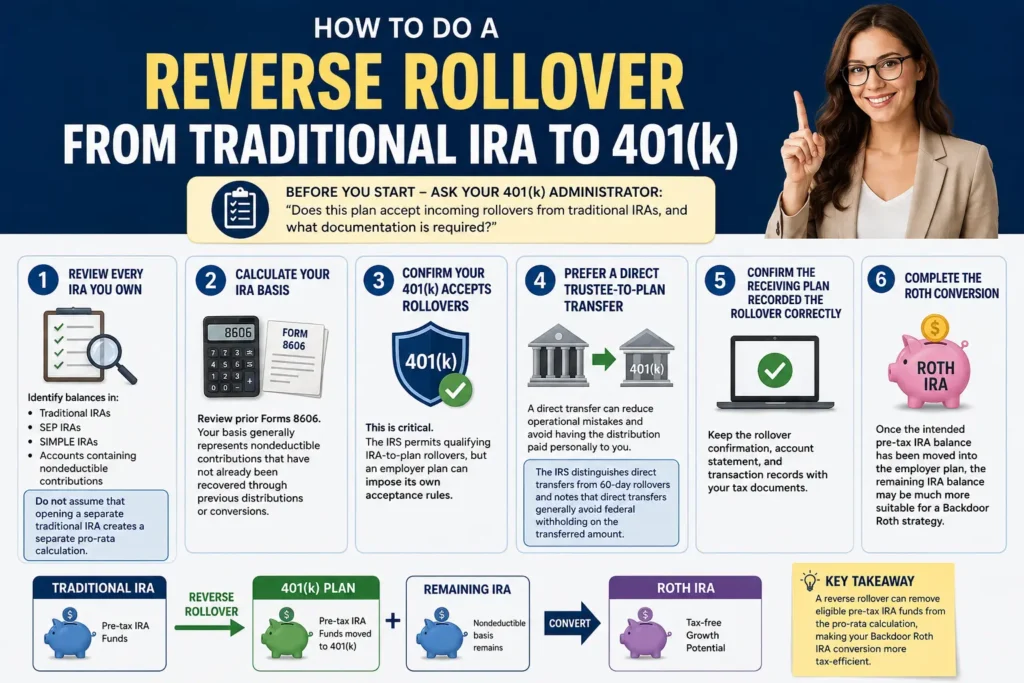
How to Do a Reverse Rollover From Traditional IRA to 401(k)
Before initiating the transaction, ask your 401(k) administrator:
“Does this plan accept incoming rollovers from traditional IRAs, and what documentation is required?”
Then follow these steps.
1. Review every IRA you own
Identify balances in:
- Traditional IRAs
- SEP IRAs
- SIMPLE IRAs
- Accounts containing nondeductible contributions
Do not assume that opening a separate traditional IRA creates a separate pro-rata calculation.
2. Calculate your IRA basis
Review prior Forms 8606. Your basis generally represents nondeductible contributions that have not already been recovered through previous distributions or conversions.
3. Confirm your 401(k) accepts rollovers
This is critical. The IRS permits qualifying IRA-to-plan rollovers, but an employer plan can impose its own acceptance rules.
4. Prefer a direct trustee-to-plan transfer
A direct transfer can reduce operational mistakes and avoid having the distribution paid personally to you.
The IRS distinguishes direct transfers from 60-day rollovers and notes that direct transfers generally avoid federal withholding on the transferred amount.
5. Confirm the receiving plan recorded the rollover correctly
Keep the rollover confirmation, account statement, and transaction records with your tax documents.
6. Complete the Roth conversion
Once the intended pre-tax IRA balance has been moved into the employer plan, the remaining IRA balance may be much more suitable for a Backdoor Roth strategy.
What If My 401(k) Does Not Accept IRA Rollovers?
You may have several alternatives, but they depend on your circumstances.
You could potentially leave the existing IRA alone and accept that part of the Roth conversion will be taxable. Another possibility is evaluating a different employer plan, if you have access to one that accepts rollovers.
Do not move an IRA into a 401(k) solely because of the pro-rata rule without reviewing investment expenses, available funds, plan fees, creditor protections, and other plan features.
A lower-cost IRA with better investment choices may be preferable in some situations.
Can I Convert Only My $7,500 Nondeductible Contribution?
Not necessarily.
This is one of the most common misunderstandings about the Backdoor Roth strategy.
If you have both pre-tax and after-tax IRA dollars, the tax rules generally do not allow you to simply identify the $7,500 as the after-tax portion and disregard the rest.
The IRS’s Form 8606 rules calculate taxable and nontaxable portions based on your IRA basis and applicable year-end values.
The reverse rollover strategy is designed to potentially remove eligible pre-tax IRA assets from the IRA pool before the conversion.
Does the Reverse Rollover Create Income Tax?
A properly completed rollover of eligible pre-tax IRA assets into a qualified employer plan can generally be tax-free.
However, the transaction must qualify under the applicable rollover rules, and the receiving plan must accept the assets. The IRS specifically notes that qualified plans may, but are not required to, accept rollovers from traditional IRAs.
Mistakes can become expensive, particularly if funds are distributed to you personally, withholding applies, or an amount that should have been rolled over is instead treated as a taxable distribution.
Backdoor Roth Pro Rata Rule Fix: Quick Comparison
| Strategy | Pro-Rata Problem | Potential Tax Result | Key Issue |
|---|---|---|---|
| Convert IRA while holding pre-tax IRA money | Usually remains | Part of conversion may be taxable | Simple but potentially costly |
| Reverse rollover to 401(k) | May reduce/remove pre-tax IRA balance | Can improve conversion tax treatment | 401(k) must accept rollover |
| Convert entire IRA to Roth | Eliminates traditional IRA balance | Potentially large taxable income | May create substantial tax |
| Leave IRA untouched | Problem remains for future conversions | No immediate conversion tax | Delays Backdoor Roth |
Does a 401(k) Count Toward the Pro Rata Rule?
Generally, no. The pro-rata calculation for IRA distributions and Roth conversions focuses on your applicable traditional IRA accounts, including traditional SEP and SIMPLE IRAs. A 401(k) is an employer retirement plan rather than an IRA.
That is why moving eligible pre-tax IRA money into a 401(k) can potentially change the IRA balance used in the calculation.
Does a Roth Conversion Count Toward the IRA Contribution Limit?
A Roth conversion is different from making a regular IRA contribution. For 2026, the combined annual contribution limit for traditional and Roth IRAs is $7,500, or $8,600 for those age 50 or older.
The conversion itself is not simply another $7,500 IRA contribution.
Common Backdoor Roth Mistakes to Avoid
The biggest errors are usually procedural rather than investment-related.
Avoid:
- Ignoring old traditional or SEP IRAs.
- Forgetting about SIMPLE IRA balances.
- Using the wrong year-end IRA value for Form 8606.
- Assuming separate IRA accounts are treated separately for the pro-rata calculation.
- Completing a rollover without confirming that the 401(k) accepts IRA assets.
- Taking the rollover distribution personally when a direct transfer would be more appropriate.
- Failing to file Form 8606 when required.
- Converting before understanding your existing IRA basis.
Bottom Line
The Backdoor Roth IRA can be an effective retirement-tax strategy, but the pro-rata rule can turn an apparently tax-free conversion into a partially taxable transaction.
For taxpayers carrying substantial pre-tax IRA balances, a reverse rollover from a traditional IRA to a 401(k) may be one of the most useful ways to address the problem—provided the employer plan accepts the rollover and the transaction is handled correctly.
Before completing the conversion, inventory every relevant IRA, review your previous Forms 8606, calculate your basis, confirm the 401(k)’s rollover rules, and document every transaction.
Your next step: ask your 401(k) administrator whether the plan accepts rollovers from traditional IRAs, then have your tax professional review the proposed transaction before you move the money.
Disclaimer
This article is for informational and educational purposes only and does not constitute tax, financial, investment, or legal advice. U.S. federal and state tax rules can change, and individual results depend on your income, filing status, IRA basis, retirement-plan provisions, and other circumstances. Consult a qualified tax professional, CPA, financial planner, or attorney before completing a Roth conversion or reverse rollover.
Important: This article explains federal tax rules for U.S. taxpayers. Individual circumstances can change the result, so consider consulting a qualified tax professional before completing a rollover or Roth conversion