If your credit report looks like a confusing list of numbers, codes, account names and dates, you are not alone.
Learning how to read a credit report can help you spot errors, recognize identity theft, understand your credit history and prepare before applying for a credit card, auto loan, mortgage or apartment.
The good news is that you do not need to understand every code immediately. Start at the top, review each section systematically and compare what you see with your own financial records.
How to Read a Credit Report: Quick Review
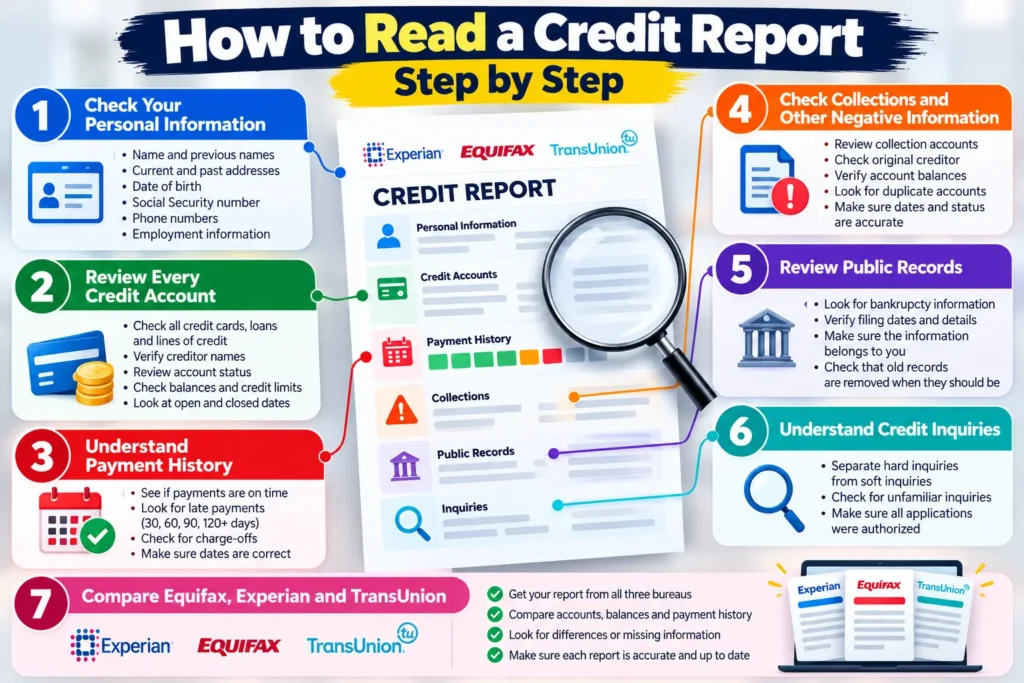
To read your credit report, review these sections in order:
- Personal information — Check your name, addresses and identifying information.
- Credit accounts — Verify every credit card, loan and account.
- Payment history — Look for accurate current and late-payment statuses.
- Collections and negative information — Check balances, dates and ownership.
- Public records — Review any bankruptcy information for accuracy.
- Credit inquiries — Separate hard inquiries from soft inquiries.
- Compare all three reports — Equifax, Experian and TransUnion may contain different information.
- Dispute errors — Contact the credit bureau and the company that supplied incorrect information.
You can get free weekly credit reports from all three nationwide credit reporting companies through AnnualCreditReport, the federally authorized source.
Why Learning How to Read a Credit Report Matters
Credit information can affect major financial decisions. Lenders may use your credit report and credit scores when evaluating applications for credit cards, mortgages, auto loans and other borrowing.
Your credit history can also matter in areas such as renting a home, certain insurance decisions and utility deposits, depending on the situation and applicable law.
There is another reason to pay attention in 2026: borrowing costs and household expenses remain important considerations for U.S. consumers.
The Bureau of Labor Statistics reported that the Consumer Price Index increased 3.4% over the 12 months ending August 2026.
When borrowing is expensive, even a relatively small difference in an interest rate can affect the total cost of a loan.
Reviewing your credit report before applying gives you an opportunity to identify inaccurate information and understand your credit history.
Expert Insight: Do not wait until you are applying for a mortgage or auto loan to check your credit report. An error can take time to investigate and correct.
What Is a Credit Report?
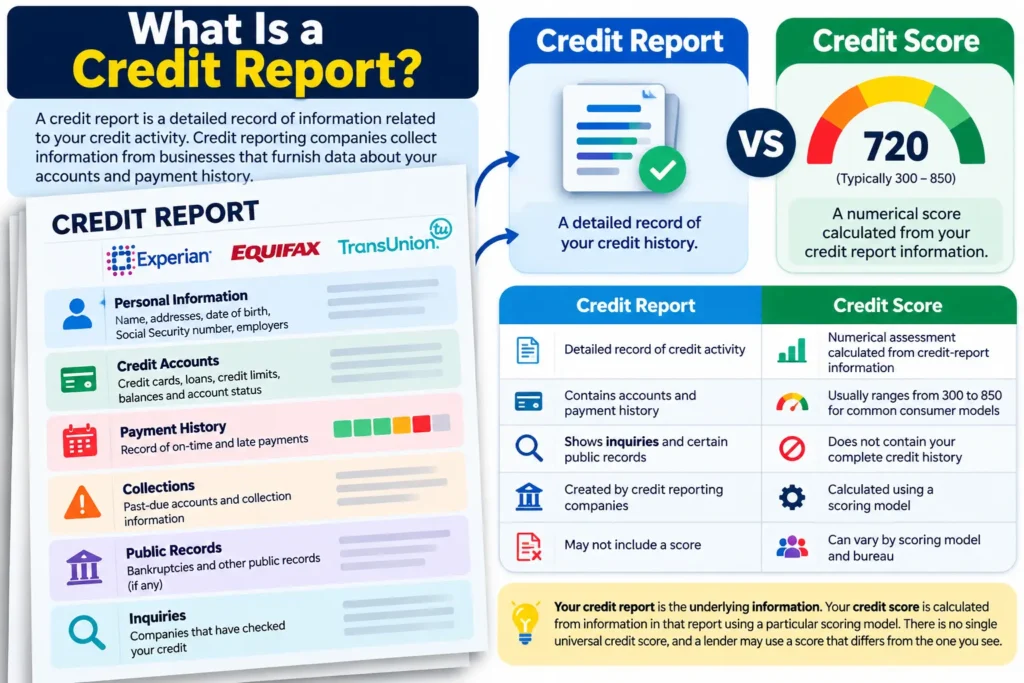
A credit report is a detailed record of information related to your credit activity. Credit reporting companies collect information from businesses that furnish data about your accounts and payment history.
The three nationwide credit reporting companies are:
- Equifax
- Experian
- TransUnion
Each company maintains its own file. Therefore, your Equifax, Experian and TransUnion reports may not look identical.
A creditor may report to one, two or all three bureaus, and reporting dates can differ.
Credit Report vs. Credit Score
One of the biggest mistakes people make when understanding their credit report is confusing the report with the score.
| Credit Report | Credit Score |
|---|---|
| Detailed record of credit activity | Numerical assessment calculated from credit-report information |
| Contains accounts and payment history | Usually ranges from 300 to 850 for common consumer models |
| Shows inquiries and certain public records | Does not contain your complete credit history |
| Created by credit reporting companies | Calculated using a scoring model |
| May not include a score | Can vary by scoring model and bureau |
Your credit report is essentially the underlying information. Your credit score is calculated from information in that report using a particular scoring model.
There is also no single universal credit score. Different scoring models can produce different numbers, and a lender may use a score that differs from the one you see through a consumer service.
So if you are searching for how to read a credit score, remember that the score alone does not explain everything. The report shows the underlying history that can help explain changes.
How Do I Get a Credit Report?
The safest starting point is AnnualCreditReport.com.
The site allows U.S. consumers to request reports from Equifax, Experian and TransUnion. Online reports are available weekly.
When requesting your report, you may need to provide information such as:
- Full name
- Date of birth
- Social Security number or ITIN
- Current address
- Previous address information
The official site uses identity verification before providing access.
Pro Tip
Save a PDF copy of each report and record the date you downloaded it. This makes it easier to compare changes later.
Also remember that a free credit report does not necessarily include your credit score. A credit report and credit score are separate products.
How to Read a Credit Report Step by Step
1. Check Your Personal Information
Start with the personal-information section.
Depending on the bureau, you may see:
- Full name
- Previous names
- Current address
- Previous addresses
- Date of birth
- Phone numbers
- Social Security number information
- Employer information
What Should You Look For?
Make sure the information belongs to you.
Pay particular attention to:
- An unfamiliar address
- A name you do not recognize
- Incorrect identifying information
- An unfamiliar employer
- Information that appears to belong to another person
An incorrect address does not automatically mean identity theft. However, unfamiliar personal information can be a warning sign that deserves further investigation.
The CFPB specifically recommends checking for mixed files, incorrect identity information and accounts that belong to someone else.
Important: Personal information generally does not directly determine your credit score, but inaccuracies can contribute to identification or file-matching problems.
2. Review Every Credit Account
This is usually the most important part of understanding my credit report.
Credit accounts are sometimes called tradelines. They can include:
- Credit cards
- Auto loans
- Mortgages
- Student loans
- Personal loans
- Lines of credit
For each account, check:
| Item | What to Check |
|---|---|
| Creditor | Do you recognize the company? |
| Account number | Does it match your records? |
| Account type | Credit card, mortgage, auto loan, etc. |
| Date opened | Does the date make sense? |
| Balance | Is the balance accurate? |
| Credit limit | Is the limit correct? |
| Payment status | Current, late, charged off, etc. |
| Last payment | Does it match your records? |
| Date updated | When was the information reported? |
| Account status | Open, closed or paid |
TransUnion notes that lenders commonly provide account updates periodically, so a report may not immediately reflect a very recent payment or balance change.
Example
Suppose your credit card has:
- Credit limit: $10,000
- Reported balance: $2,000
That means the reported balance represents 20% of the credit limit.
However, do not assume that the balance shown is your current real-time balance. Credit reports reflect information supplied by furnishers at particular times.
3. Understand Payment History
Payment history is one of the most important areas to review.
Your report may show whether an account was:
- Current
- 30 days late
- 60 days late
- 90 days late
- 120+ days late
- Charged off
- In collections
- Paid
- Closed
Some credit reports use numbers or letters rather than plain-language descriptions.
For example, TransUnion’s sample report uses codes such as 30, 60, 90 and 120 to represent different stages of delinquency. Other codes can represent collections, charge-offs, repossessions or voluntary surrender.
What If You See a Late Payment You Never Made?
Do not assume the report is correct.
Compare it with:
- Bank statements
- Credit card statements
- Payment confirmations
- Loan statements
- Cancelled checks
- Emails or receipts
If the information is inaccurate, you have the right to dispute it.
4. Check Collections and Other Negative Information
Collections generally involve debts that became seriously past due and were transferred or assigned to a collection company or otherwise reported as collection accounts.
When reviewing a collection, check:
- Original creditor
- Collection company
- Account balance
- Date of first delinquency
- Account ownership
- Payment status
- Whether the debt belongs to you
Also look for duplicate reporting.
For example, you might see an original creditor and a collection company reporting information related to the same debt. That does not automatically mean the information is wrong, but you should understand what each entry represents.
Most accurate negative information can remain on a credit report for up to seven years, while bankruptcy reporting periods can be longer depending on the type.
Expert Insight: Do not pay a company simply because it promises to remove accurate negative information. The CFPB warns that accurate negative information generally cannot simply be removed because someone requests it.
5. Review Public Records
Modern credit reports generally contain far fewer public-record categories than older reports.
Bankruptcy information may appear in the public-record section.
If you see a bankruptcy, verify:
- Chapter
- Filing date
- Court
- Case information
- Your identity
- Expected reporting period
TransUnion’s current sample report shows bankruptcy information as a separate public-record category.
If the bankruptcy information does not belong to you or contains incorrect information, gather supporting documentation and dispute it.
6. Understand Credit Inquiries
Inquiries show companies that accessed your credit information for particular purposes.
There are two major types.
Hard Inquiries
A hard inquiry generally occurs when you apply for new credit and a lender accesses your report as part of the application process.
Examples include:
- Credit card applications
- Auto loan applications
- Mortgage applications
- Some personal loan applications
Hard inquiries can affect credit scores, although their impact is generally smaller than major factors such as payment history.
Soft Inquiries
A soft inquiry can occur when:
- You check your own credit
- A company makes a prescreened offer
- An existing creditor reviews your account
- Certain other authorized reviews occur
Soft inquiries do not affect your credit score.
What If You Do Not Recognize a Hard Inquiry?
Contact the company listed on the report.
If you never authorized the application or credit activity, investigate it promptly because an unfamiliar inquiry can be an early sign of identity theft.
7. Compare Equifax, Experian and TransUnion
One of the most useful steps in understanding credit score reports is comparing all three credit reports.
Do not expect them to be identical.
Differences can happen because:
- A creditor reports to only one or two bureaus.
- Creditors update bureaus at different times.
- Account information changes between reporting dates.
- One bureau may have information another does not.
A Simple Three-Bureau Comparison
| Information | Equifax | Experian | TransUnion |
|---|---|---|---|
| Personal information | Check | Check | Check |
| Credit accounts | Check | Check | Check |
| Balances | Compare | Compare | Compare |
| Payment history | Compare | Compare | Compare |
| Collections | Compare | Compare | Compare |
| Public records | Compare | Compare | Compare |
| Hard inquiries | Compare | Compare | Compare |
The goal is not to make all three reports look exactly the same. The goal is to determine whether each report contains accurate information about you.
What Are the Biggest Credit Report Red Flags?
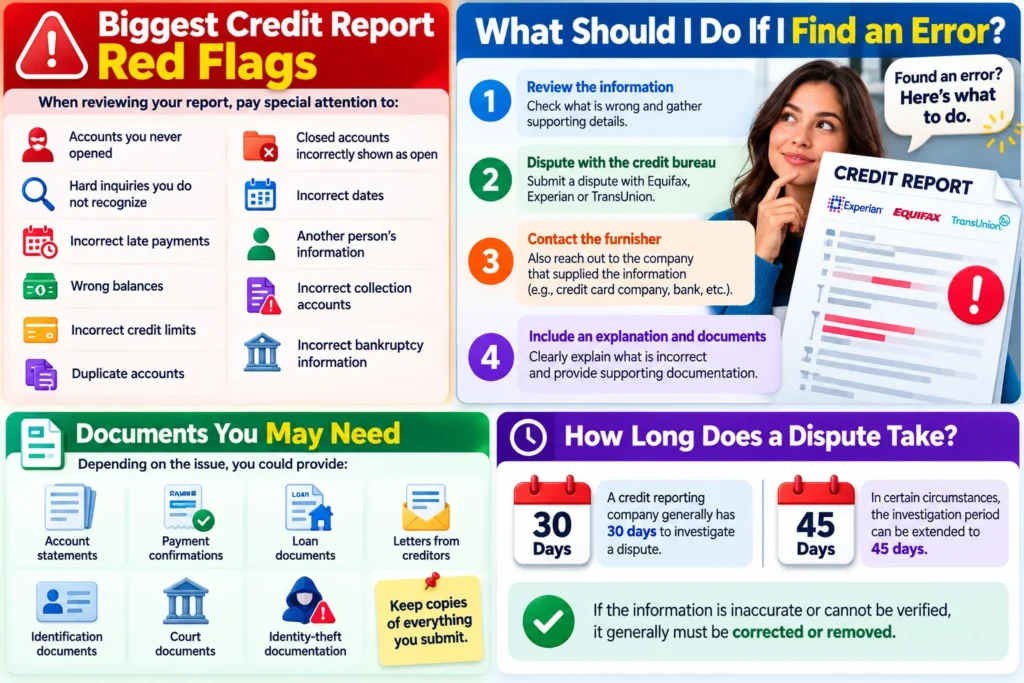
When reviewing your report, pay special attention to:
- Accounts you never opened
- Hard inquiries you do not recognize
- Incorrect late payments
- Wrong balances
- Incorrect credit limits
- Duplicate accounts
- Closed accounts incorrectly shown as open
- Incorrect dates
- Another person’s information
- Incorrect collection accounts
- Incorrect bankruptcy information
The CFPB identifies many of these as common credit-report errors.
A single unfamiliar address does not necessarily prove fraud. Look at the entire file. An unfamiliar address combined with an unknown credit card and unfamiliar hard inquiry is much more concerning.
What Should I Do If I Find an Error?
If you find inaccurate or incomplete information, dispute the information with the credit reporting company.
You should also consider contacting the company that supplied the information, known as the furnisher.
For example:
Credit bureau: TransUnion
Furnisher: Credit card company reporting the account
The CFPB recommends disputing the information with the credit reporting company and the company that provided the information. Include an explanation of what is wrong and supporting documentation.
Documents You May Need
Depending on the issue, you could provide:
- Account statements
- Payment confirmations
- Loan documents
- Letters from creditors
- Identification documents
- Court documents
- Identity-theft documentation
Keep copies of everything you submit.
How Long Does a Credit Report Dispute Take?
A credit reporting company generally has 30 days to investigate a dispute. Certain circumstances can extend the investigation period to 45 days.
If the information is inaccurate or cannot be verified, it generally must be corrected or removed.
What Is the Difference Between a Fraud Alert and a Credit Freeze?
If you discover possible identity theft, you may want to learn about fraud alerts and security freezes.
| Fraud Alert | Security Freeze |
|---|---|
| Tells creditors to take additional steps to verify identity | Restricts access to your credit file for most new-credit applications |
| Useful when identity theft is suspected | Stronger preventive measure for new-account fraud |
| Does not affect your credit score | Does not affect your credit score |
| Can be placed through a credit bureau | You generally place freezes separately with each nationwide bureau |
If you believe you are a victim of identity theft, the federal government directs consumers to IdentityTheft.gov for a recovery plan.
How Do I Read a TransUnion Credit Report?
A TransUnion credit report reading follows the same basic process as other credit reports.
Start with:
- Personal information
- Public records
- Account information
- Accounts with adverse information
- Collections
- Inquiries
- Consumer statements
- Summary of rights
TransUnion provides a sample credit report showing these categories and explains what each section means.
This makes a TransUnion credit report sample useful when you are looking at your first report.
Remember that the exact layout can change depending on the report and how the information is presented.
How Do I Read a Credit Score?
You do not read a credit score in the same way you read a credit report.
A score is a number generated by a scoring model. The report contains the underlying information used by scoring models.
When reviewing a score, consider:
- Which scoring model produced it?
- Which credit bureau supplied the underlying information?
- When was the score calculated?
- What factors are identified as influencing the score?
A score from one service may not match the score a lender uses because different scoring models and credit-reporting data can be involved.
That is why focusing only on the number can hide important information.
A 10-Minute Credit Report Review Checklist
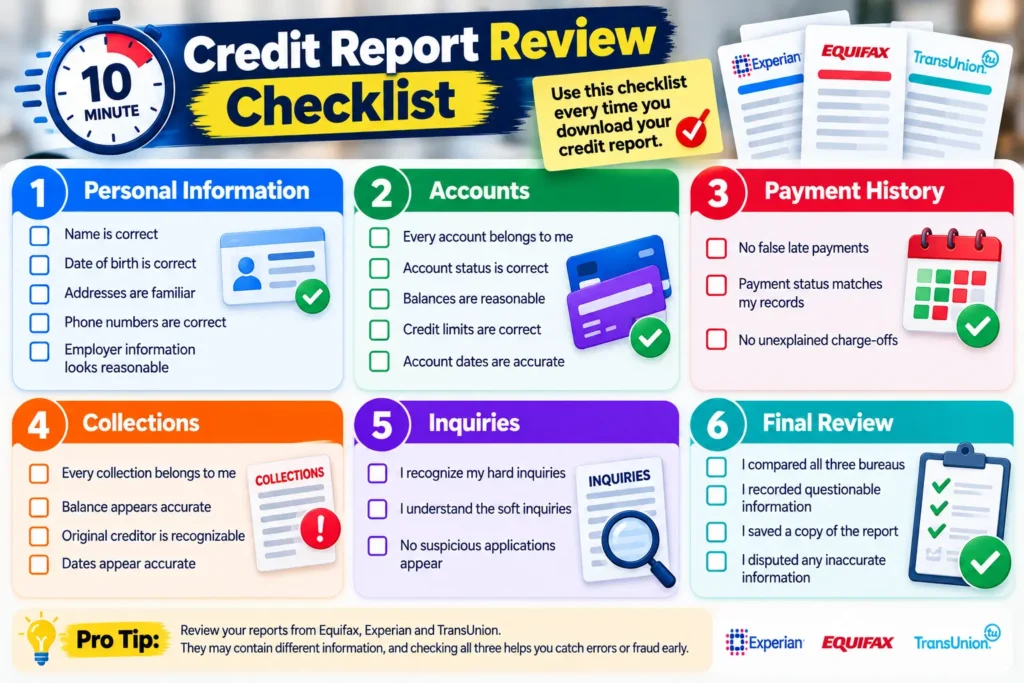
Use this checklist every time you download your report.
Personal Information
- Name is correct
- Date of birth is correct
- Addresses are familiar
- Phone numbers are correct
- Employer information looks reasonable
Accounts
- Every account belongs to me
- Account status is correct
- Balances are reasonable
- Credit limits are correct
- Account dates are accurate
Payment History
- No false late payments
- Payment status matches my records
- No unexplained charge-offs
Collections
- Every collection belongs to me
- Balance appears accurate
- Original creditor is recognizable
- Dates appear accurate
Inquiries
- I recognize my hard inquiries
- I understand the soft inquiries
- No suspicious applications appear
Final Review
- I compared all three bureaus
- I recorded questionable information
- I saved a copy of the report
- I disputed any inaccurate information
How Often Should You Read Your Credit Report?
There is no single schedule that works for everyone.
However, regular reviews can help you identify errors and potential identity theft earlier.
Checking your own report does not hurt your credit score.
You may want to review your reports:
- Before applying for a mortgage
- Before financing a car
- Before applying for major credit
- After paying off significant debt
- After discovering potential fraud
- After a major personal or financial change
- Periodically throughout the year
Because free weekly reports are available through AnnualCreditReport.com, you do not necessarily need to wait until the end of the year to check your files.
Final Takeaway: Read Your Credit Report Like an Auditor
Learning how to read a credit report becomes much easier when you stop trying to understand everything at once.
Start with your identity information. Then move through accounts, payment history, collections, public records and inquiries. Finally, compare your Equifax, Experian and TransUnion reports.
The most important question is simple:
Does every piece of information accurately describe me and my credit history?
If the answer is no, document the problem and dispute the inaccurate information with the appropriate credit reporting company and furnisher.
Your next step is straightforward: get your free reports from AnnualCreditReport.com, save copies, and use the checklist above to review each section.
Disclaimer
This article is for informational and educational purposes only. It is not financial, legal, credit-repair or tax advice. Credit-reporting rules, scoring models and reporting practices can change. For questions about your specific legal or financial situation, consider consulting a qualified financial professional or attorney.
Recommended External Sources
For YMYL credibility, prioritize primary or government sources:
- AnnualCreditReport.com — official free credit-report access
- Consumer Financial Protection Bureau (CFPB) — credit-report errors and dispute rights
- Federal Trade Commission (FTC) — identity theft and credit-report guidance
- TransUnion — sample report and bureau-specific terminology
- Equifax and Experian — bureau-specific dispute and report information
Recent Posts
- What Is FDLXX? Yield, Tax Perks & Who Should Use It
- ACA Open Enrollment 2027: Key Dates, Premium Increases, and What Lost Subsidies Mean for You
- Tax Brackets Married Filing Jointly: Rates & Calculator Guide
- How to Avoid State Taxes on Treasury Interest: A Guide for U.S. Investors
- Treasury Bills vs. CDs: Which Is Right for Short-Term Savings?