Your business needs capital, but a bank will not lend enough and selling equity would dilute too much ownership.
Mezzanine financing can fill that gap—yet its high cost, covenants, and equity upside mean it is not a decision to make quickly.
This guide explains exactly how it works in the U.S. market, when it makes sense, and the terms you should negotiate before signing.
Mezzanine financing is hybrid capital that sits between senior debt and common equity in a company’s capital structure.
It is usually structured as subordinated debt or preferred equity, often includes warrants or conversion rights, and typically costs more than a bank loan but less dilution than issuing common stock.
U.S. companies use it for acquisitions, leveraged buyouts, recapitalizations, growth capital, and commercial real estate deals where senior lenders will not fund the entire capital stack.
Investors accept more risk because they are repaid only after senior lenders, so they often seek total returns of roughly 12%–20% or higher through interest, payment-in-kind (PIK) interest, fees, and equity participation.
Why Mezzanine Financing Matters in 2026
Mezzanine capital has become more relevant because traditional financing remains selective and borrowing costs are still elevated.
The Federal Reserve raised its policy rate by 25 basis points in September 2026 and described inflation as elevated, reinforcing a higher-cost environment for leveraged transactions.
At the same time, Federal Reserve lending surveys show commercial real estate standards broadly easing for some property types in the second quarter of 2026, while construction and land development lending remained mixed.
That creates a continuing role for mezzanine debt and preferred equity where a first-mortgage lender will not advance enough proceeds.
For business owners, the key question is no longer simply “Can I borrow?” but “Which layer of capital gives me the money I need without surrendering too much control or cash flow?” Mezzanine financing can be the answer—but only when projected cash flow can support a higher-cost capital structure.
What Is Mezzanine Financing?
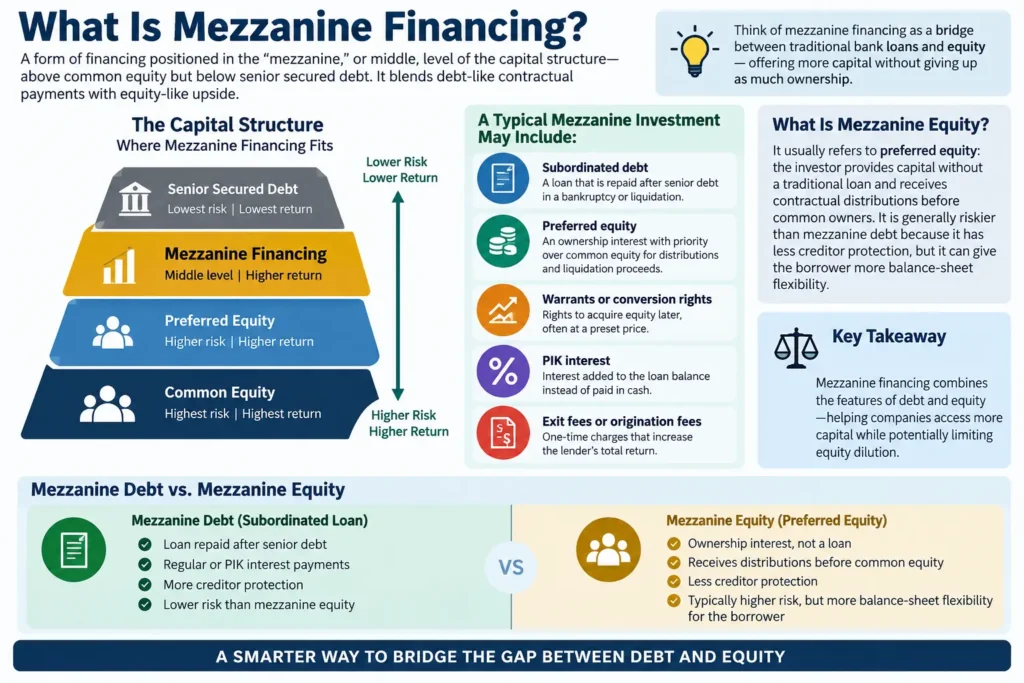
Mezzanine financing definition: A form of financing positioned in the “mezzanine,” or middle, level of the capital structure—above common equity but below senior secured debt. It blends debt-like contractual payments with equity-like upside.
A typical mezzanine investment may include:
- Subordinated debt: A loan that is repaid after senior debt in a bankruptcy or liquidation.
- Preferred equity: An ownership interest with priority over common equity for distributions and liquidation proceeds.
- Warrants or conversion rights: Rights to acquire equity later, often at a preset price.
- PIK interest: Interest added to the loan balance instead of paid in cash.
- Exit fees or origination fees: One-time charges that increase the lender’s total return.
What is mezzanine equity? It usually refers to preferred equity: the investor provides capital without a traditional loan and receives contractual distributions before common owners. It is generally riskier than mezzanine debt because it has less creditor protection, but it can give the borrower more balance-sheet flexibility.
How Does Mezzanine Financing Work?
Mezzanine financing is negotiated as part of a company’s full capital stack. A deal may look like this:
| Capital layer | Example provider | Repayment priority | Typical cost |
|---|---|---|---|
| Senior secured debt | Bank or senior lender | First | Lowest |
| Mezzanine debt | Private credit fund, BDC, insurance company | After senior debt | High |
| Preferred equity | Real estate or private equity investor | After mezzanine debt, before common equity | High |
| Common equity | Founder, sponsor, private equity firm | Last | Highest expected return |
In practice, a mezzanine lender advances capital against the borrower’s future cash flow, enterprise value, or real estate ownership structure. Because the loan is subordinated, the lender cannot rely on being first in line for repayment, so it charges a higher coupon and may require equity participation.
Common Deal Terms
- Loan amount: Often used to close a funding gap rather than finance an entire project.
- Coupon: Cash interest paid periodically.
- PIK interest: Non-cash interest capitalized into principal; useful when near-term cash flow is limited.
- Maturity: Commonly five years or longer, though terms vary by transaction.
- Covenants: Limits on additional borrowing, dividends, asset sales, refinancing, and management payouts.
- Equity kicker: Warrants, conversion rights, or profit participation that compensate the investor for subordinate risk.Expert insight: Focus on the all-in cost of capital, not just the stated interest rate. A 12% cash coupon plus 3% PIK interest, a 2% origination fee, warrants, and a 3% exit fee can produce an internal rate of return well above the headline rate.
Mezzanine Financing Example
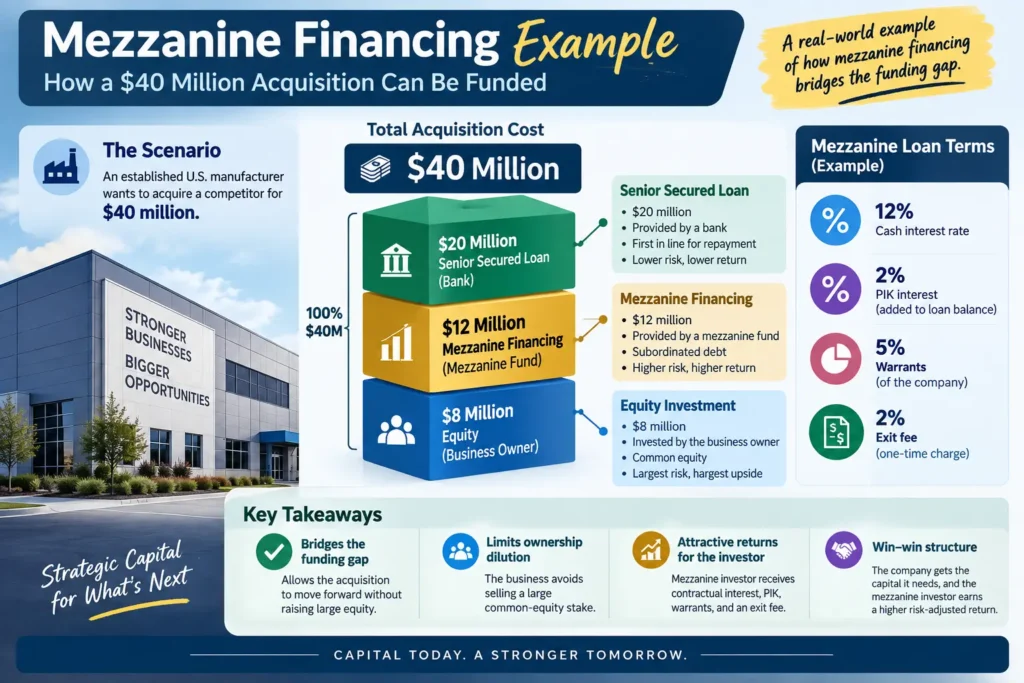
Imagine an established U.S. manufacturer wants to acquire a competitor for $40 million.
- A bank provides a $20 million senior secured loan.
- The owner can invest $8 million of equity.
- A mezzanine fund provides $12 million in subordinated debt.
The mezzanine loan might carry a 12% cash interest rate, plus 2% PIK interest, warrants for 5% of the company, and a 2% exit fee. The business avoids selling a large common-equity stake, while the mezzanine investor receives attractive contractual income and upside if the acquisition performs well. This mirrors the way mezzanine capital is commonly used for acquisitions, buyouts, and expansion.
Real estate mezzanine financing example
In mezzanine financing real estate, a developer may obtain a $60 million senior mortgage for a $100 million multifamily project. Rather than raising $40 million of common equity, the sponsor secures $15 million of mezzanine debt and contributes $25 million of equity.
In many U.S. real estate structures, the mezzanine lender does not hold a direct mortgage on the property. Instead, it may take a pledge of the ownership interests in the entity that owns the property. That structure can create powerful lender remedies, so sponsors should have real estate and bankruptcy counsel review collateral, default, and cure provisions carefully.
Why Companies Use Mezzanine Capital
Businesses choose mezzanine financing when they need capital but want to limit ownership dilution.
- Acquisitions and buyouts: It helps fund leveraged buyouts, management buyouts, and strategic acquisitions.
- Growth capital: Companies can finance expansion, facilities, working capital, or product development without a major equity sale.
- Recapitalization: Owners can take liquidity out of a business while retaining control.
- Refinancing: It can replace expensive or restrictive existing debt.
- Real estate projects: It fills the gap between senior mortgage proceeds and available sponsor equity.
Advantages and Disadvantages
| Factor | Borrower perspective | Investor perspective |
|---|---|---|
| Cost | More expensive than senior debt | Higher yield compensates for subordinate risk |
| Ownership | Less dilution than common equity | May receive warrants or conversion rights |
| Cash flow | PIK interest can preserve near-term cash | Deferred interest increases repayment risk |
| Control | Covenants may restrict decisions | May seek board rights or approval rights |
| Default risk | Senior debt is paid first | May lose all or part of investment in bankruptcy |
The main borrower benefit is that mezzanine capital can be “patient” capital: principal is often not amortized until maturity, and interest may be partly deferred through PIK terms. The main drawback is cost. Mezzanine returns are frequently estimated in the 12%–20% range, and complex transactions can take three to six months to negotiate and close.
Pro tip: Before pursuing mezzanine debt, build a downside case. Test whether the business can service all debt if revenue falls 15%–25%, margins compress, or refinancing markets tighten. Mezzanine lenders will scrutinize EBITDA, customer concentration, capital expenditures, and management’s operating history.
Is Mezzanine Interest Tax-Deductible?
Historically, one advantage of mezzanine debt is that interest may be deductible as a business expense, unlike dividends on equity. U.S. tax treatment depends on the structure and the borrower’s tax profile.
Under Internal Revenue Code Section 163(j), the deduction for business interest expense is generally limited to the sum of business interest income, 30% of adjusted taxable income, and certain floor-plan financing interest. Any excess is generally carried forward rather than permanently lost.
For tax years beginning after December 31, 2024, businesses may again add back depreciation, amortization, and depletion when calculating adjusted taxable income, which can increase the interest deduction capacity for some borrowers.
Still, mezzanine structures can include equity features, preferred returns, and participations that affect tax treatment, so obtain advice from a qualified CPA or tax attorney before closing.
Who Provides Mezzanine Financing?
Mezzanine capital is rarely offered by ordinary retail banks. Typical providers include:
- Private credit funds
- Business development companies (BDCs)
- Private equity firms with debt arms
- Insurance companies and institutional lenders
- Mezzanine funds and family offices
- Real estate private credit lenders
Because these are private investments, securities-law compliance matters. Many offerings occur through private placements to institutional or accredited investors; under SEC Regulation D Rule 506(c), general solicitation is permitted only when the issuer takes reasonable steps to verify that every purchaser is an accredited investor.

Mezzanine Financing vs. Other Funding Options
| Funding type | Repayment priority | Dilution | Typical best use |
|---|---|---|---|
| Senior bank loan | First | None | Lower-risk companies with strong collateral and cash flow |
| Mezzanine debt | After senior debt | Limited, via warrants | Acquisitions, buyouts, growth capital |
| Preferred equity | After debt, before common equity | Yes, but usually less than common equity | Real estate and cash-flow-sensitive deals |
| Common equity | Last | Highest | Startups or high-growth companies without debt capacity |
| Venture debt | Varies | Limited | Venture-backed companies with recurring revenue |
A mezzanine investment is not automatically better than equity. If a company is early-stage, unprofitable, or lacks predictable cash flow, equity may be more appropriate because it does not create mandatory repayment pressure. Conversely, a stable business with strong EBITDA and a clear path to refinancing may find mezzanine capital more efficient.
Risks to Understand Before Signing
Mezzanine financing can solve a capital gap, but it can also magnify problems in a downturn.
- High effective cost: Fees, PIK interest, and equity kickers can make the all-in return expensive.
- Subordination: Mezzanine investors are paid only after senior lenders, which is why they demand higher returns.
- Covenant restrictions: Borrowers may face limits on new debt, dividends, executive compensation, and asset sales.
- Loss of control: Equity rights, board observer seats, or approval rights can reduce owner flexibility.
- Refinancing risk: A borrower that cannot refinance at maturity may need to sell the company, raise equity, or accept less favorable terms.
- Default consequences: In real estate, remedies can include foreclosing on ownership interests, replacing the sponsor, or taking control of the property entity.
People Also Ask
What is a mezzanine investment?
A mezzanine investment is capital provided in the middle of the capital structure, usually as subordinated debt or preferred equity, with equity-like upside such as warrants or conversion rights.
Is mezzanine financing debt or equity?
It can be either. Mezzanine debt is a subordinated loan; mezzanine equity is usually preferred equity. Many deals combine both debt-like payments and equity participation.
What is the difference between mezzanine debt and preferred equity?
Mezzanine debt is a contractual loan with interest and maturity terms. Preferred equity is an ownership interest with preferred distributions, often without a fixed maturity, and is generally subordinate to debt.
Is mezzanine financing secured?
Corporate mezzanine debt is often unsecured or secured only by a subordinate interest in the business. In real estate, it may be indirectly secured through a pledge of ownership interests in the property-owning entity.
When should a company avoid mezzanine financing?
Avoid it when cash flow is unpredictable, debt service coverage is thin, the company already has restrictive covenants, or the owner is unwilling to give equity participation or accept loss of operational flexibility.
Sources:
- IRS for Section 163(j) and interest-deduction rules.
- Federal Reserve for FOMC decisions and Senior Loan Officer Opinion Survey data.
- SEC for Regulation D, accredited-investor rules, and private-offering guidance.
Conclusion
Mezzanine financing is powerful bridge capital for U.S. companies that need more money than senior lenders will provide but do not want to sell substantial common-equity ownership. It works best for profitable businesses, acquisitions, buyouts, recapitalizations, and real estate projects with predictable cash flow and a credible exit or refinancing plan.
Before pursuing a deal, model the full cost of capital, stress-test debt service, review every covenant and default remedy, and have both financing counsel and a tax professional review the structure. If those pieces support the transaction, request term sheets from several experienced mezzanine lenders and compare not only the coupon but also fees, PIK terms, warrants, covenants, prepayment flexibility, and control rights.
Disclaimer
This article is for general informational purposes only and does not constitute financial, investment, legal, accounting, or tax advice. Mezzanine financing involves significant risk and complex contractual and securities-law issues. Consult a qualified U.S. financial advisor, attorney, CPA, and lender before making any financing or investment decision.
Latest Posts:
- What Is FDLXX? Yield, Tax Perks & Who Should Use It
- ACA Open Enrollment 2027: Key Dates, Premium Increases, and What Lost Subsidies Mean for You
- Tax Brackets Married Filing Jointly: Rates & Calculator Guide
- How to Avoid State Taxes on Treasury Interest: A Guide for U.S. Investors
- Treasury Bills vs. CDs: Which Is Right for Short-Term Savings?
- How Much Emergency Fund Should You Have in 2027?
- Fidelity Treasury Bill Ladder: Earn Interest Every Month