A financial derivative is a contract whose value comes from another asset, rate, index, or event.
That underlying item might be a stock, commodity, interest rate, currency, or market index.
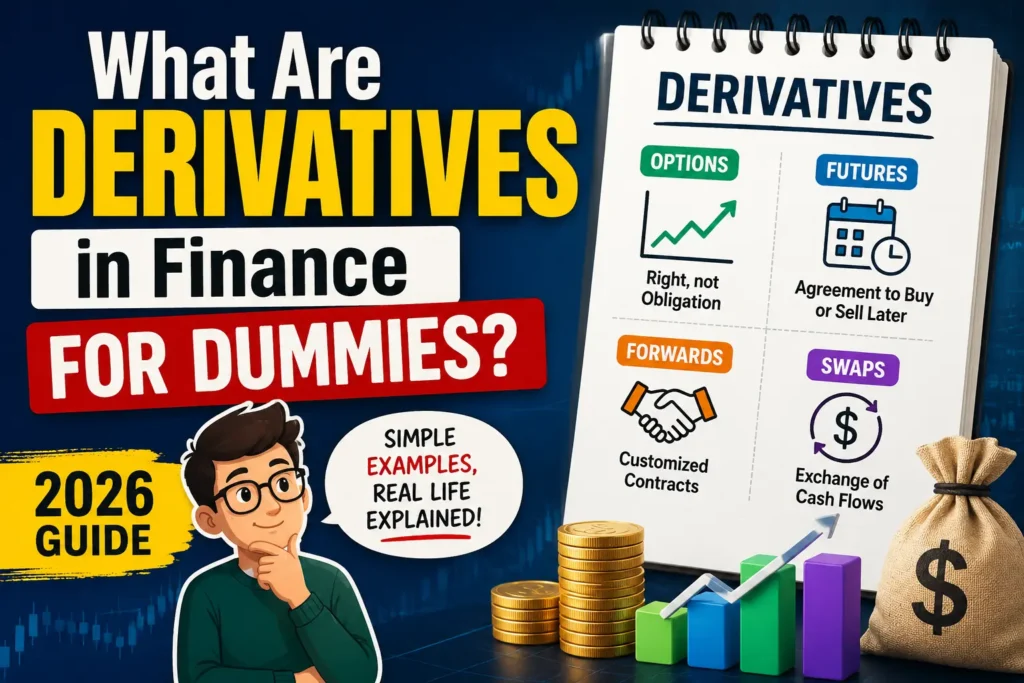
The four common types are:
- Options: Give the buyer a right, but not an obligation, to buy or sell.
- Futures: Require parties to buy or sell something at an agreed price and future date.
- Forwards: Customized contracts to exchange an asset later at an agreed price.
- Swaps: Contracts where parties exchange cash flows, such as fixed and floating interest payments.
Businesses often use derivatives to hedge risk. Investors may also use them to speculate on price movements.
The key issue is leverage: a relatively small amount of money can control a much larger position, increasing both potential gains and losses.
What Are Derivatives in Finance?
The simplest definition of derivatives in finance is this:
A derivative is a financial contract whose value is derived from an underlying asset, security, index, rate, or other measurable variable.
The CFTC defines derivatives as instruments whose prices depend directly on underlying securities, debt instruments, commodities, indexes, or other pricing arrangements. Futures, options, and swaps are common examples.
Think of a derivative as a financial agreement based on something else.
For example, suppose Company A needs 1 million gallons of fuel six months from now. If fuel prices rise sharply, its costs could increase. The company could use a derivative to lock in a price today.
That contract does not necessarily mean Company A owns the fuel today. Instead, the derivative changes how the company is exposed to future price movements.
What Is a Derivative and How Does It Work?
A derivative generally has three important components:
- Underlying asset: What determines the derivative’s value.
- Contract terms: The agreed price, date, quantity, or payment formula.
- Counterparties: The parties taking opposite sides of the contract.
Imagine a stock is trading at $100.
You purchase an option allowing you to buy the stock at $105 before expiration. If the stock rises to $125, that right could become valuable. If the stock stays below $105, the option may expire worthless.
This is why derivatives can provide exposure to an asset without simply purchasing the asset itself.
The SEC explains that options derive their value from underlying assets such as stocks, indexes, ETFs, and fixed-income products.
Derivatives in Finance With Examples
| Derivative | How It Works | Simple Example |
|---|---|---|
| Option | Right to buy or sell | Pay $200 for the right to buy shares at $100 |
| Future | Obligation to transact later | Lock in a commodity price for future delivery |
| Forward | Customized future agreement | Business agrees today on a future currency exchange |
| Swap | Exchanges cash flows | Company swaps floating-rate payments for fixed-rate payments |
Example 1: Stock Option
Suppose XYZ stock trades at $50. You buy a call option with a $55 strike price.
If XYZ rises to $70, the option may have significant value.
If XYZ remains below $55 through expiration, you could lose the premium paid for the option.
The premium is simply the price paid for the option contract.
The SEC warns that option buyers can lose their entire premium, while certain option-writing strategies can create substantially greater losses.
Example 2: Commodity Futures
A farmer worries that wheat prices could fall before harvest.
The farmer can sell wheat futures to establish a price for future delivery. If wheat prices decline, gains on the futures position can help offset lower selling prices.
This is called hedging.
The CFTC specifically describes futures as a tool producers and consumers can use to reduce commodity price risk.
Example 3: Interest Rate Swap
Imagine a company has debt with a floating interest rate.
If interest rates rise, its borrowing costs could increase. The company might enter an interest-rate swap to exchange floating-rate payments for fixed-rate payments.
The goal is not necessarily to make money. It is to create more predictable cash flows.
Why Do Companies and Investors Use Derivatives?
Derivatives generally serve three major purposes.
1. Hedging
Hedging means reducing exposure to an unwanted price movement.
Common examples include:
- Airlines hedging fuel prices
- Importers hedging currency risk
- Farmers hedging crop prices
- Companies managing interest-rate exposure
2. Speculation
Traders can use derivatives to bet that an asset’s price, interest rate, or index will rise or fall.
Unlike hedging, speculation intentionally accepts market risk in pursuit of profit.
3. Managing Exposure
Institutional investors can use derivatives to change portfolio exposure without buying or selling every underlying security.
This can make portfolio management more flexible, but it can also make risk harder to understand.
Why Derivatives Matter in 2026
Derivatives matter because Americans and U.S. businesses continue to face changing inflation, interest-rate, currency, and commodity conditions.
The latest available BLS data show that U.S. CPI increased 3.5% over the 12 months ending June 2026.
Meanwhile, the Federal Reserve’s June 2026 projections placed median 2026 PCE inflation at 3.6% and the median year-end federal funds rate at 3.8%.
These conditions can affect borrowing costs, commodity prices, currencies, and investment markets.
That is one reason derivatives remain important to banks, corporations, institutional investors, and sophisticated traders.
Are Derivatives Risky?
Yes. Derivatives are not automatically dangerous, but their structure can magnify risk.
Important risks include:
- Leverage: Small amounts of capital can control larger positions.
- Market risk: The underlying asset can move against you.
- Expiration risk: Some contracts lose value as expiration approaches.
- Counterparty risk: One party may fail to meet its obligations.
- Liquidity risk: Some contracts can be difficult to exit.
- Complexity: Certain strategies can be difficult to understand.
The CFTC cautions that futures and commodity options can be highly volatile and that traders can lose all of their money or, in some circumstances, more than they initially invested.
Expert Insight: Never judge derivative risk solely by the amount you pay upfront. Look at the total economic exposure, maximum possible loss, margin requirements, expiration date, and what happens if the market moves sharply against you.
Are Derivatives the Same as Stocks?
No.
When you buy a stock, you generally own an equity interest in a company.
A derivative is a contract whose value is linked to something else.
For example, owning 100 shares of a company is different from owning a call option on those shares.
The stock can potentially be held indefinitely, while an option has specific contractual terms and an expiration date.
Who Regulates Derivatives in the U.S.?
U.S. derivatives regulation depends on the product.
The Commodity Futures Trading Commission (CFTC) has primary authority over futures and most swaps.
The Securities and Exchange Commission (SEC) regulates security-based swaps and securities-related derivatives within its jurisdiction. The Dodd-Frank Act established a comprehensive framework for the U.S. swaps market.
Individual investors should also understand that brokerage approval may be required before trading options. Brokers evaluate factors such as investing experience and ability to tolerate risk.
What Are the Main Types of Derivatives?
The main types are options, futures, forwards, and swaps.
Options provide rights without the same obligation for the buyer. Futures create standardized contractual obligations. Forwards are generally customized agreements. Swaps exchange specified cash flows.
Can Beginners Trade Derivatives?
Some derivatives are available to individual investors, including listed stock options and certain futures products.
Availability does not mean suitability.
Beginners should understand the contract, maximum loss, margin requirements, expiration rules, and tax implications before trading.
Bottom Line
So, what are derivatives in finance for dummies? They are contracts that get their value from an underlying asset, rate, index, or other measurable factor.
They can help businesses manage risk and allow investors to gain targeted market exposure. But leverage, expiration, margin, and contract complexity can make losses much larger than expected.
If you’re new to derivatives, start by learning options, futures, forwards, and swaps separately rather than treating all derivatives as one investment product.
Next step: Before trading any derivative, read the contract terms and understand your maximum potential loss. For options, review the SEC’s investor education materials and your broker’s required risk disclosures.
Disclaimer: This article is for educational and informational purposes only. It is not professional financial, investment, tax, or legal advice. Derivatives involve substantial risk, and individual circumstances can vary. Consider consulting a qualified financial professional before making investment decisions.