If your income is too high for a direct Roth IRA contribution, you may feel like you’ve lost one of the best retirement-saving tools available.
You haven’t.
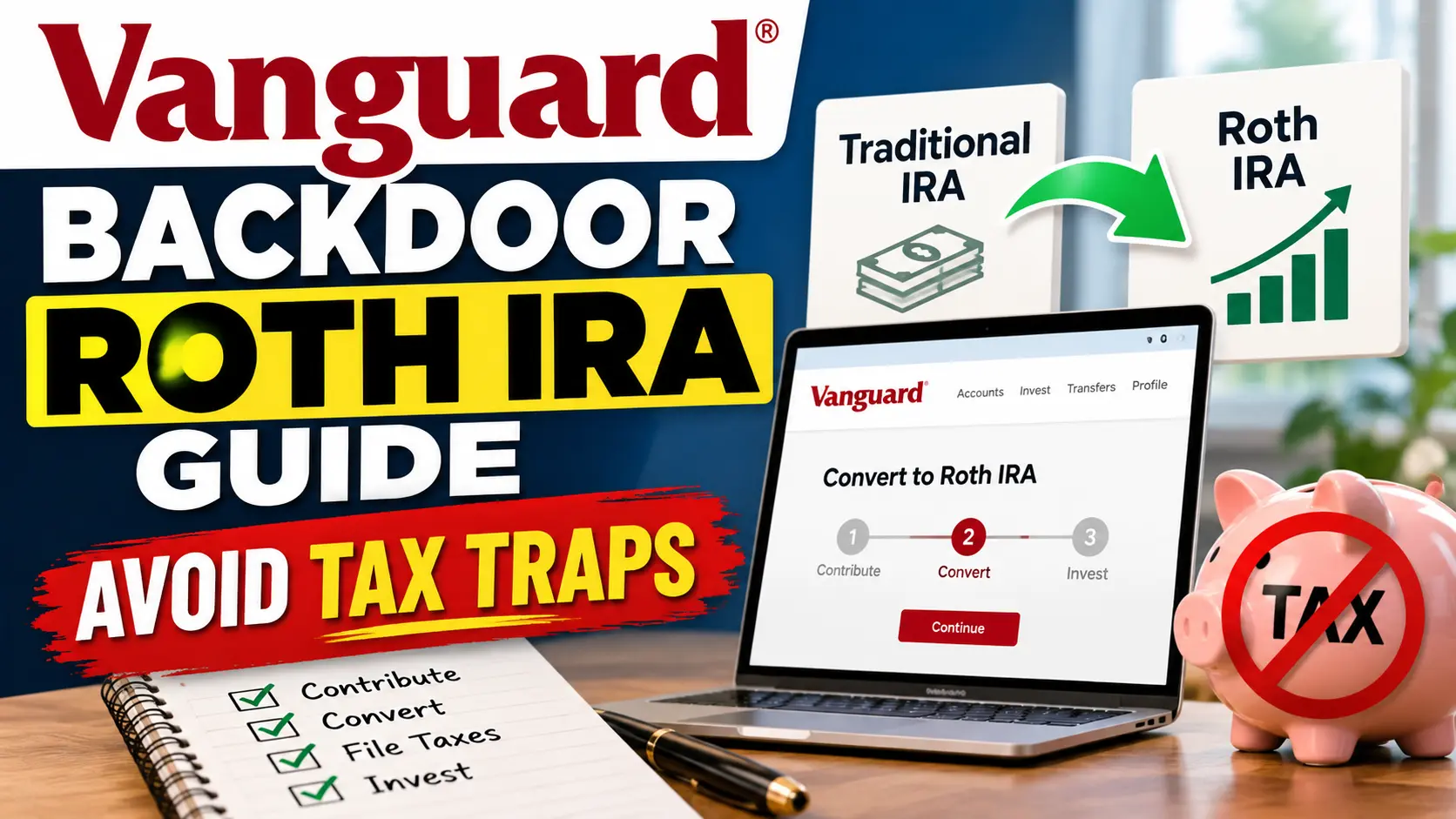
A Vanguard backdoor Roth IRA can let eligible U.S. taxpayers contribute after-tax money to a Traditional IRA and then convert it to a Roth IRA.
The process is straightforward, but the pro-rata rule, tax reporting, and timing can create expensive mistakes.
This 2026 guide walks through the Vanguard process step by step and explains exactly what to check before you begin.
Important: This article is educational. A backdoor Roth can have significant tax consequences, especially if you have existing Traditional, SEP, or SIMPLE IRA balances. Consider consulting a qualified tax professional before completing a conversion.
How the Vanguard Backdoor Roth Works
A backdoor Roth IRA is generally a two-step strategy:
- Contribute after-tax money to a Traditional IRA.
- Convert that money to a Roth IRA.
For 2026, the combined contribution limit across your Traditional and Roth IRAs is $7,500, or $8,600 if you’re age 50 or older, subject to the compensation rules. IRS
The key issue isn’t simply whether your income is high. Your existing IRA balances matter.
Before doing a Vanguard backdoor Roth, check whether you have money in:
- Traditional IRAs
- Rollover IRAs
- SEP-IRAs
- SIMPLE IRAs
The IRS generally applies the pro-rata rules across these IRA balances when determining how much of a conversion is taxable.
If you have no problematic pre-tax IRA balance, the process can be relatively simple:
Contribute → let the contribution settle → convert to Roth → file Form 8606 → invest the Roth funds.
What Is a Backdoor Roth IRA?
A backdoor Roth IRA isn’t a special type of IRA. It’s a strategy using two existing account types.
Normally, someone contributes directly to a Roth IRA. But Roth IRA contributions have income limits.
For 2026, the Roth IRA contribution phaseout is:
| Filing status | 2026 MAGI range | Direct Roth contribution |
|---|---|---|
| Single/Head of Household | Under $153,000 | Full contribution |
| Single/Head of Household | $153,000–$168,000 | Reduced |
| Single/Head of Household | $168,000+ | Not permitted |
| Married Filing Jointly | Under $242,000 | Full contribution |
| Married Filing Jointly | $242,000–$252,000 | Reduced |
| Married Filing Jointly | $252,000+ | Not permitted |
| Married Filing Separately* | $0–$10,000 | Reduced |
| Married Filing Separately* | $10,000+ | Not permitted |
*Special rules apply if you lived with your spouse during the year.
These are 2026 figures published by the IRS and reflected in Vanguard’s current guidance.
The backdoor strategy works differently.
You make a nondeductible Traditional IRA contribution and then convert the Traditional IRA balance to a Roth IRA.
The contribution itself is subject to the normal IRA contribution limit. The Roth conversion is a separate transaction.
Why the Backdoor Roth Matters in 2026
The strategy remains particularly relevant for high-income U.S. households because direct Roth contributions can phase out at relatively modest income levels compared with professional and dual-income households.
At the same time, the IRS increased the IRA contribution limit for 2026 from $7,000 to $7,500, with an $8,600 catch-up limit for people age 50 or older.
That means a qualifying taxpayer can potentially move another $7,500 of after-tax money into Roth space for 2026.
The larger retirement-planning point is important:
Roth IRA assets can provide tax-free qualified withdrawals in retirement, while Traditional IRA assets generally create taxable income when withdrawn.
So the backdoor Roth can be useful as part of a broader retirement-tax strategy—not simply as a way to get around an income limit.
Vanguard Backdoor Roth IRA: Step-by-Step
Step 1: Check Your Existing IRA Balances First
Do this before contributing any money.
Log in to Vanguard and identify whether you have:
- Traditional IRA
- Rollover IRA
- SEP-IRA
- SIMPLE IRA
Do not assume an old Rollover IRA is irrelevant.
For example, suppose you have:
- $63,000 in pre-tax Traditional IRA assets
- $7,000 in new nondeductible IRA contributions
Your total IRA balance is $70,000.
Only 10% of the combined balance represents after-tax basis.
If you convert $7,000, the pro-rata rules can make approximately $6,300 taxable, rather than allowing you to designate the entire $7,000 as after-tax money.
Pro Tip
Don’t ask only:
“Do I have a Traditional IRA?”
Ask:
“What is the total year-end balance of all my Traditional, SEP, and SIMPLE IRAs?”
That is the number that can materially affect the tax calculation.
Step 2: Open a Vanguard Traditional IRA
If you don’t already have one, open a Traditional IRA at Vanguard.
You’ll also need a Roth IRA to receive the conversion.
The Traditional IRA is where the nondeductible contribution initially goes.
The Roth IRA is where you ultimately want the money.
The two accounts can be maintained at Vanguard, making the conversion a same-provider transaction. The IRS recognizes same-trustee transfers as one way to convert a Traditional IRA to a Roth IRA.
Vanguard Backdoor Roth IRA Guide
Step 3: Make a Nondeductible Traditional IRA Contribution
For 2026, the general IRA contribution limit is:
- $7,500 if under age 50
- $8,600 if age 50 or older
The combined limit applies across your Traditional and Roth IRA contributions.
When making a backdoor Roth contribution, the important distinction is that you’re generally making the Traditional IRA contribution without taking a tax deduction.
Example
You earn too much to make a direct Roth contribution.
You contribute:
$7,500 → Traditional IRA
You don’t claim that $7,500 as a deductible Traditional IRA contribution.
You then convert the balance to your Roth IRA.
That creates the basic backdoor Roth strategy.
Don’t accidentally exceed your IRA limit
If you’ve already contributed $3,000 directly to a Roth IRA for 2026, you generally cannot simply add another $7,500 to the Traditional IRA.
The combined regular contribution limit matters.
Step 4: Keep the Contribution in Cash While It Settles
For a straightforward backdoor Roth, many investors choose to leave the newly contributed money in the settlement fund rather than investing it before conversion.
Why?
Because investment gains between the contribution and conversion can create additional taxable income.
For example:
- Traditional IRA contribution: $7,500
- Value before conversion: $7,530
- Amount converted: $7,530
The $30 gain may be taxable.
Vanguard specifically notes that earnings from market performance before conversion can create tax consequences. It also notes that there may be a waiting period before the conversion can be completed. Vanguard
Expert Insight
The objective isn’t to “time the market.”
The objective is to avoid unnecessarily creating a taxable gain between the nondeductible contribution and Roth conversion.
Step 5: Convert Your Traditional IRA to a Roth IRA
Once the contribution has settled, initiate the Traditional IRA-to-Roth IRA conversion through Vanguard.
The exact website interface can change, so don’t rely on an old screenshot alone.
Look for Vanguard’s transaction option for converting to a Roth IRA.
You’ll generally identify:
- The Traditional IRA as the source
- Your Roth IRA as the destination
- The amount you want to convert
For a typical backdoor Roth, you generally want to convert the entire available balance, including any small amount of earnings.
The IRS allows Traditional-to-Roth conversions through several mechanisms, including a same-trustee transfer when both accounts are held at the same institution.
Should You Convert the Entire Traditional IRA Balance?
Usually, if you’ve just made the nondeductible contribution specifically for a backdoor Roth, converting the full balance is the cleanest approach.
Suppose you contribute $7,500 and it becomes $7,510.
You could convert the $7,510.
The $7,500 after-tax basis generally isn’t taxed again, while the $10 gain may be taxable.
Leaving the $10 behind doesn’t necessarily solve the underlying tax issue. It can create additional IRA activity that you must account for later.
The White Coat Investor similarly emphasizes converting the full amount rather than attempting to leave gains behind. White Coat Investor
Step 6: File IRS Form 8606
This is one of the most important steps.
Don’t skip Form 8606.
The IRS says Form 8606 is used to report:
- Nondeductible Traditional IRA contributions
- Traditional IRA distributions when basis exists
- Traditional IRA-to-Roth IRA conversions
- Certain Roth IRA distributions
The form establishes and tracks your basis.
What is IRA basis?
Your basis is essentially the amount of your IRA money that has already been taxed.
For a basic backdoor Roth, your nondeductible contribution creates after-tax basis.
Form 8606 helps document that basis so the same dollars aren’t improperly taxed again.
You’ll also generally receive tax documents from Vanguard relating to the transactions, such as Form 1099-R.
Important
A Form 1099-R showing a Roth conversion does not automatically mean the entire conversion is taxable income.
Your tax return needs to account for the nondeductible contribution and basis.
The Pro-Rata Rule: The Biggest Backdoor Roth Trap
This is where many otherwise simple backdoor Roth strategies become complicated.
The IRS doesn’t generally allow you to say:
“I’m converting only my after-tax Traditional IRA dollars.”
Instead, the tax treatment looks at your IRA balances under the applicable pro-rata rules.
Vanguard explicitly warns that the rule considers Traditional IRA accounts collectively, including pre-tax and after-tax amounts. Vanguard
Example
Imagine you have:
- $90,000 pre-tax IRA
- $10,000 nondeductible basis
- $100,000 total IRA assets
Your after-tax percentage is 10%.
If you convert $10,000 to Roth, only roughly 10% of that conversion represents after-tax basis under this simplified example.
Approximately:
- $1,000 = nontaxable basis
- $9,000 = potentially taxable
That’s very different from the simple “contribute $7,500 and convert $7,500 tax-free” scenario.
What About a Rollover IRA?
A Rollover IRA is particularly important if you’re considering a backdoor Roth.
Suppose you previously left a job and rolled your 401(k) into a Traditional Rollover IRA.
That account may contain pre-tax money.
If you then make a nondeductible Traditional IRA contribution and attempt a backdoor Roth, that Rollover IRA can affect the pro-rata calculation.
One possible solution
If your current employer’s 401(k) accepts incoming rollovers, you may be able to move eligible pre-tax IRA assets into the employer plan.
That can potentially simplify the backdoor Roth calculation.
But don’t assume every 401(k) accepts rollovers.
Check your plan documents or ask the plan administrator first.
A rollover into a 401(k) is not the same thing as a Roth conversion. The tax consequences and rules are different.
Vanguard Traditional IRA to Roth: Conversion vs. Rollover
These terms are often mixed together.
| Transaction | What happens? | Potential tax |
|---|---|---|
| Traditional IRA → Roth IRA | Roth conversion | Untaxed amounts generally taxable |
| Traditional IRA → Traditional IRA | Trustee transfer | Generally not taxable |
| 401(k) → Traditional IRA | Rollover | Generally not taxable if properly completed |
| Traditional IRA → 401(k) | Rollover if plan accepts it | Generally not taxable |
| Roth IRA → Roth IRA | Roth transfer | Generally not taxable |
The IRS specifically states that a Traditional IRA can be converted through a rollover, trustee-to-trustee transfer, or same-trustee transfer.
What If You Already Have a Traditional IRA?
Don’t automatically proceed.
First determine:
- How much is pre-tax?
- How much is after-tax basis?
- Is it a Traditional IRA, Rollover IRA, SEP-IRA, or SIMPLE IRA?
- Does your 401(k) accept rollovers?
- What will your IRA balances be at year-end?
This is one situation where professional tax advice can be worth the cost.
Questions/Awnsers
A. Can High Earners Still Do a Backdoor Roth in 2026?
Generally, yes.
The backdoor strategy is designed to address the income restriction on direct Roth contributions.
The IRS limits direct Roth IRA contributions based on MAGI, but the conversion process has different rules.
However, your eligibility for the Traditional IRA contribution and the tax treatment of the conversion are separate questions.
B. Is a Backdoor Roth Legal?
Yes.
A backdoor Roth is a tax-planning strategy involving a nondeductible Traditional IRA contribution followed by a Roth conversion.
The important issue is proper reporting and tax treatment, particularly Form 8606 and the pro-rata rule.
The IRS specifically provides instructions for reporting nondeductible contributions and Traditional-to-Roth conversions.
C. When Should I Do a Backdoor Roth?
There isn’t one universal date.
For many investors, doing the contribution and conversion relatively close together can minimize the chance of creating taxable investment gains.
But the contribution deadline and conversion timing are different concepts.
Don’t confuse:
IRA contribution deadline
with
Roth conversion date.
For example, a contribution for a particular tax year may have a later contribution deadline, while the conversion belongs to the tax year in which the conversion actually occurs.
D. Can I Do a Backdoor Roth Every Year?
Potentially, yes.
The strategy can be repeated for future tax years as long as you remain eligible to make IRA contributions and follow the applicable contribution limits and tax rules.
For 2026, the regular IRA limit is $7,500, or $8,600 for eligible taxpayers age 50 or older.
Remember that the limit is per person, not per IRA account.
A married couple may therefore have separate IRA contribution opportunities, assuming each spouse meets the applicable requirements.
Common Vanguard Backdoor Roth Mistakes
Avoid these mistakes:
1. Forgetting an old Rollover IRA
This is probably the most important mistake to check before starting.
2. Claiming the Traditional IRA contribution as deductible
A backdoor Roth generally relies on a nondeductible Traditional IRA contribution.
3. Investing before converting
A gain can create additional taxable income.
4. Converting only the original contribution
Leaving gains behind doesn’t necessarily eliminate the tax issue.
5. Forgetting Form 8606
The IRS uses Form 8606 to track nondeductible IRA contributions and conversions. IRS
6. Assuming a 1099-R tells the entire tax story
The form reports the distribution/conversion. Your complete tax return determines the applicable taxable amount.
7. Confusing a Roth conversion with a Roth contribution
A Roth contribution and Roth conversion are different transactions with different rules.
8. Ignoring your 401(k)
If you have a pre-tax IRA, your employer plan could potentially provide a rollover option that changes the pro-rata situation.
Vanguard vs. Fidelity for a Backdoor Roth
The basic tax rules don’t change because you use Vanguard or Fidelity.
| Feature | Vanguard | Fidelity |
|---|---|---|
| Traditional IRA | Yes | Yes |
| Roth IRA | Yes | Yes |
| Roth conversions | Yes | Yes |
| Form 8606 required | Yes | Yes |
| Pro-rata rule | Applies | Applies |
| Investment choices | Broad | Broad |
| Main difference | User interface/process | User interface/process |
The important point is this:
Don’t choose a brokerage based on the belief that Fidelity or Vanguard changes the IRS rules.
The tax rules follow the taxpayer and transaction—not the brokerage.
What Should You Invest in After the Conversion?
Once the money reaches your Roth IRA, the conversion is not the end of the process.
You still need to invest the cash according to your retirement strategy.
Possible Vanguard investments include diversified stock and bond funds or ETFs.
The appropriate investment depends on factors such as:
- Time until retirement
- Risk tolerance
- Existing 401(k) allocation
- Taxable brokerage assets
- Desired asset allocation
- Need for diversification
Don’t choose an investment merely because it is popular.
A Roth IRA is an account type, not an investment itself.
Checklist For You
A Simple Vanguard Backdoor Roth Checklist
Before you click “Convert”, check each step below.
Resources :
Vanguard’s own guide currently confirms the 2026 income thresholds, $7,500/$8,600 contribution limits, pro-rata warning, and Form 8606 requirement. Vanguard
IRS IRA Contribution Limits
IRS Form 8606 Information
Vanguard Backdoor Roth IRA Guide
Final Takeaway
A Vanguard backdoor Roth IRA can be a powerful retirement strategy for a U.S. taxpayer whose income prevents a direct Roth IRA contribution.
The process is conceptually simple:
Nondeductible Traditional IRA contribution → Roth conversion → Form 8606 → invest the Roth assets.
But the pro-rata rule is the critical checkpoint.
If you have no significant pre-tax Traditional, Rollover, SEP, or SIMPLE IRA balance, the strategy can be relatively straightforward. If you do have those balances, stop and understand the tax consequences before converting.
For 2026, the IRA contribution limit is $7,500, or $8,600 for eligible taxpayers age 50 or older.
Your next step: Before contributing anything to Vanguard, list every IRA you own and determine whether it contains pre-tax money. That single step can tell you whether your backdoor Roth is likely to be straightforward—or whether you need to address the pro-rata rule first.
Disclaimer: This article is for informational and educational purposes only and does not constitute financial, investment, tax, or legal advice. Tax rules can change, and individual circumstances can materially affect the tax treatment of an IRA contribution or Roth conversion. Consult a qualified tax professional, CPA, or fiduciary financial adviser before making a retirement-account decision.
Recent Posts:
- What Is FDLXX? Yield, Tax Perks & Who Should Use It
- ACA Open Enrollment 2027: Key Dates, Premium Increases, and What Lost Subsidies Mean for You
- Tax Brackets Married Filing Jointly: Rates & Calculator Guide
- How to Avoid State Taxes on Treasury Interest: A Guide for U.S. Investors
- Treasury Bills vs. CDs: Which Is Right for Short-Term Savings?