A single account can slash your healthcare costs, cut your taxable income, and double as a stealth retirement fund.
That account is a Health Savings Account, and if you’re not tracking the new numbers, you’re probably leaving tax-free money on the table—or worse, setting yourself up for a penalty.
The 2026 HSA contribution limits just landed, and they bring modest increases that matter more than you think.
This guide unpacks every dollar, every rule, and every opportunity so you can fund your HSA with confidence and precision.
2026 HSA Contribution Limits at a Glance
Before we dig into strategies, here is exactly what the IRS allows you to contribute for the 2026 tax year. All numbers apply to combined employee and employer contributions.
- Self-only HDHP coverage: $4,400 (up from $4,300 in 2025)
- Family HDHP coverage: $8,750 (up from $8,550 in 2025)
- Catch-up contribution (age 55 or older): $1,000 (unchanged—it’s not inflation-adjusted)
If you’re 55 or older, add that extra $1,000 to the base limit you’re eligible for.
The IRS also sets the floor for your health plan.
To qualify for an HSA, your High-Deductible Health Plan must have a minimum deductible of **$1,700 (self-only) or $3,400 (family)** in 2026. Out-of-pocket maximums are capped at **$8,350 (self-only) and $16,700 (family)**.
Both figures ticked up from 2025, a sign that healthcare inflation is alive and well.
These numbers come straight from IRS Revenue Procedure 2025-26, which establishes the 2026 inflation-adjusted amounts for HSAs and HDHPs. Major custodians like Fidelity and HSA Bank have confirmed them on their guidance pages, and you’ll see the same digits across every compliant plan document.
HSA Contribution Limits 2026 vs 2025: What’s Actually Changing?
If you memorized last year’s limits, you only need a small update—but the delta matters for your payroll deductions. Here’s a side-by-side look.
| Coverage Type | 2025 Limit | 2026 Limit | Change |
|---|---|---|---|
| Self-only | $4,300 | $4,400 | +$100 |
| Family | $8,550 | $8,750 | +$200 |
| Catch-up (55+) | $1,000 | $1,000 | $0 |
| Min deductible (self) | $1,650 | $1,700 | +$50 |
| Min deductible (family) | $3,300 | $3,400 | +$100 |
| Out-of-pocket max (self) | $8,300 | $8,350 | +$50 |
| Out-of-pocket max (family) | $16,600 | $16,700 | +$100 |
What do you do with that extra $100 or $200? Adjust your per-paycheck contribution immediately.
If you front-load your HSA in January, make sure the total doesn’t accidentally exceed the new ceiling.
Even a dollar over triggers a 6% excise tax on the excess until you correct it, so updating your contribution election now is a quiet money saver.
HSA Contribution Limits 2026 for Those 55 and Older
The $1,000 catch-up contribution is one of the most misunderstood perks in the tax code.
First, the crisp rule: If you turn 55 at any point during 2026 (even on December 31), you can contribute the full extra $1,000 on top of your applicable base limit. There’s no proration. The IRS considers you “age 55” for the entire year.
Here’s where it gets personal. The catch-up is per individual, not per household. If you and your spouse are both 55+ and both have self-only HDHP coverage through separate employers, each of you can stuff $5,400 into your own HSA ($4,400 + $1,000). That’s $10,800 total.
When only one spouse has family coverage, the math shifts. The family limit of $8,750 belongs to that covered individual. The catch-up contribution also belongs only to the HSA account holder who is 55+.
If the HSA is in your name and you’re 57 but your spouse is 48, you can put in $9,750 ($8,750 + $1,000). Your spouse’s age doesn’t unlock an extra catch-up inside your account.
But—and this is a favorite planning move—if your spouse turns 55 during the year and is also an eligible individual, they can open their own HSA solely to receive their $1,000 catch-up contribution, even if all the medical bills flow through your family plan.
Key Takeaway: A married couple both 55+ with family HDHP coverage can legally shelter **$10,750** in 2026—$8,750 in one spouse’s HSA plus a $1,000 catch-up in each spouse’s HSA. That’s pure tax-free money if used for qualified medical expenses, and it grows tax-deferred if invested.
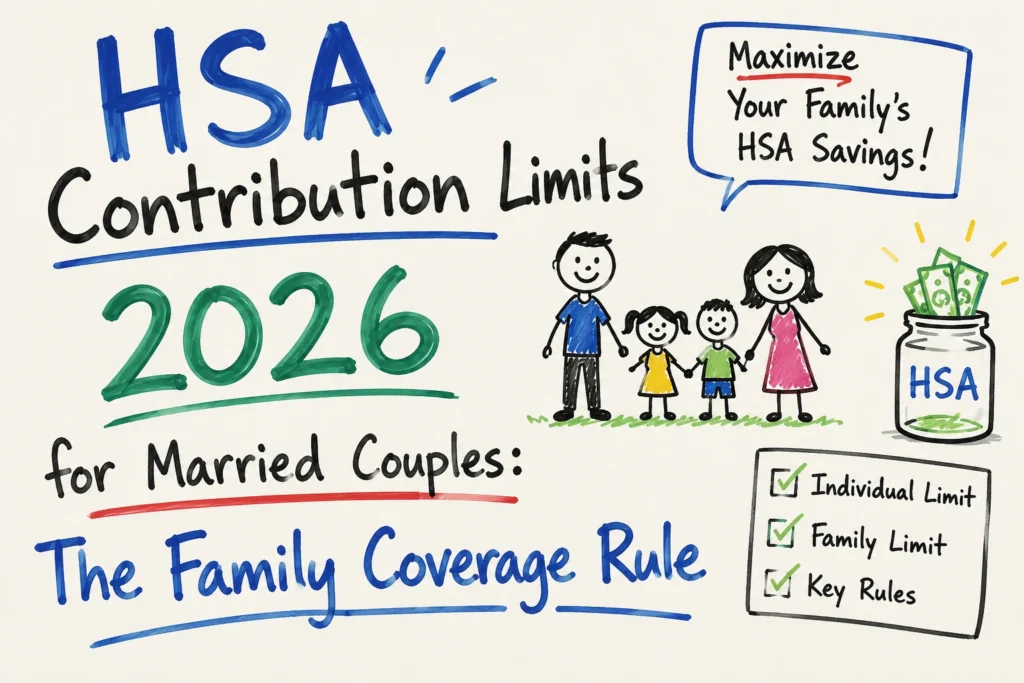
HSA Contribution Limits 2026 for Married Couples: The Family Coverage Rule
Family HSA contribution limit 2026 is straightforward at first glance: $8,750.
But marriage adds nuance.
HSAs are individually owned.
You cannot have a joint HSA. If both of you are covered by a family-qualifying HDHP, the **total combined contributions to both HSAs cannot exceed the $8,750 family limit**.
You and your spouse may divide that amount however you agree—50/50, 100/0, or any split—as long as neither account goes over the statutory limit when viewed individually.
Watch out for the “overlapping coverage” trap. If one spouse has self-only HDHP and the other has family HDHP, the family limit generally applies to the spouse with family coverage.
The spouse with self-only coverage cannot contribute to their own HSA unless they are also covered by a qualifying HDHP and no other disqualifying coverage exists.
The IRS rules become unforgiving when a spouse is enrolled in a general-purpose medical FSA, which disqualifies both spouses from HSA eligibility.
If you’re married, a single health FSA that reimburses all medical expenses can torpedo the entire household’s HSA eligibility, even if only one person carries the FSA. Check your spouse’s workplace benefits before you fund a dime.
The good news? The $1,000 catch-up contributions are **individual entitlements** and don’t count against the family cap. So that couple both 55+ can still hit $10,750. If only one spouse is 55+, the total drops to $9,750. Write these numbers down. They’re the absolute ceiling.
HSA Contribution Limits 2026 Include Employer Match: Yes, Every Dollar Counts
Many people search “HSA contribution limits 2026 include employer match,” and the answer is an unambiguous yes.
The IRS caps total contributions from all sources—you, your employer, and anyone else (except rollovers).
If your company seeds your HSA with $1,500 for family coverage, your personal contribution limit shrinks to $7,250. Contribute a penny more, and you’re looking at the 6% excess contribution penalty every year until it’s removed.
Employer contributions often show up as a line item on your pay stub or in your HSA portal. Some employers call it a “match,” but it’s typically a flat contribution deposited periodically. Track it. If you change jobs mid-year, the limit still applies in aggregate. Your new employer doesn’t know what your old employer already kicked in, so you must do the reconciliation.
A tax-savvy move: If you realize in December that you’ve overshot the cap because of an employer contribution you forgot about, contact your HSA administrator immediately and request a return of excess contributions before you file your tax return. Complete IRS Form 8889 the right way, and you avoid the excise tax. Wait too long, and the cost compounds.
HSA Contribution Rules You Need to Know
Qualifying for an HSA isn’t just about having a high-deductible plan. The rules form a tight fence, and if even one slat is loose, your contributions become non-deductible and may be subject to penalties. Here are the gatekeeping rules:
- You must be covered by a qualifying HDHP on the first day of the month. No other health coverage that isn’t an HDHP (with limited exceptions like dental, vision, or a limited-purpose FSA).
- You cannot be enrolled in Medicare. The moment Part A or Part B kicks in, your HSA eligibility ends. If you apply for Social Security after age 65, Medicare Part A may be retroactive for up to six months. You are responsible for stopping contributions in the month that retroactive coverage begins.
- You cannot be claimed as a dependent on someone else’s tax return.
- The “last-month rule” offers flexibility: If you are HSA-eligible on December 1, 2026, you can contribute the full annual limit as if you were eligible all year. The catch? You must remain eligible for the entire following 12-month testing period. If you lose HDHP coverage before that period ends, you’ll owe income tax plus a 10% penalty on the portion of contributions attributable to the months you weren’t covered.
- Excess contributions must be withdrawn (plus earnings) by the tax filing deadline, including extensions, to avoid the 6% excise tax. Complete Form 8889 each year.
The rules are exacting because the tax benefits are extraordinary. An HSA is the only account type that offers triple tax advantages: pre-tax contributions (or tax-deductible if you contribute directly), tax-free growth, and tax-free withdrawals for qualified medical expenses. No 401(k), no IRA, no Roth can match that trifecta.
HSA Contribution Limits by Year: A Historical View
Noticing the long-term trend helps you plan future contributions and convince a skeptical spouse that HSAs deserve priority funding. Below is a snapshot of recent limits, including the brand-new 2026 numbers and a placeholder for 2027.
| Year | Self-Only Limit | Family Limit | Catch-Up (55+) |
|---|---|---|---|
| 2020 | $3,550 | $7,100 | $1,000 |
| 2021 | $3,600 | $7,200 | $1,000 |
| 2022 | $3,650 | $7,300 | $1,000 |
| 2023 | $3,850 | $7,750 | $1,000 |
| 2024 | $4,150 | $8,300 | $1,000 |
| 2025 | $4,300 | $8,550 | $1,000 |
| 2026 | $4,400 | $8,750 | $1,000 |
| 2027 | TBD | TBD | $1,000 (likely) |
The IRS adjusts HSA limits annually based on the Chained Consumer Price Index for All Urban Consumers (C-CPI-U). We won’t see official HSA contribution limits 2027 until the IRS releases its revenue procedure, typically in May 2026. Based on recent inflation patterns, however, financial planners expect a similar modest bump—potentially another $100–$200, assuming no legislative change. Those projections aren’t guarantees, so never fund for 2027 ahead of the official announcement.
Strategic Moves to Max Out Your HSA in 2026
Knowing the numbers is one thing. Acting on them is where the wealth builds. Commonly, investors see an HSA as a spending account, but the most tax-efficient play is to treat it like a retirement account on steroids.
1. Pay current medical costs out of pocket. If your budget allows, cover doctor visits and prescriptions with after-tax dollars and leave your HSA dollars invested. Scan your receipts, but don’t reimburse yourself yet. There is no time limit on reimbursing qualified expenses, so you can let the account compound for decades and withdraw tax-free later.
2. Dump your year-end bonus into the HSA. A lot of folks front-load their 401(k) but neglect the HSA. For 2026, if you’re in the 24% federal tax bracket, maxing out a $4,400 HSA contribution saves you $1,056 in federal income tax alone. Add state income tax savings where applicable, and the effective “discount” on your contribution gets compelling.
3. Use the 55+ catch-up aggressively. If you’ve ever felt behind on retirement savings, the HSA catch-up is an immediate boost with zero income phase-out. You don’t need earned income to contribute (unlike an IRA). Just be eligible and under 65 once Medicare kicks in.
4. Watch for stealth disqualifiers. A working spouse’s general-purpose FSA, a telehealth benefit that waives costs before the deductible, or an employer’s on-site clinic can all disqualify you unless the plan is carefully designed. Ask your benefits department for the plan’s HSA-compatibility letter.
Pro Tip: If you’re approaching Medicare, stop HSA contributions at least six months before your Part A start date to avoid penalties from retroactive Medicare coverage. Medicare-eligible individuals can still spend HSA funds tax-free on qualified medical expenses and even use them for Medicare premiums (Parts B and D, but not Medigap).
Actionable Next Steps
Don’t let the 2026 limits sit in an article tab. Turn them into dollars today.
- Check your 2026 HDHP: Confirm your plan meets the $1,700/$3,400 minimum deductible and falls under the out-of-pocket maximums. Ask HR for a confirmation letter if unsure.
- Revisit your payroll elections: Log in and adjust your per-paycheck HSA deduction to hit the $4,400 or $8,750 target after accounting for any employer seed money.
- Track employer contributions: Tally what your company plans to deposit in 2026 and subtract that from the cap. Set a calendar reminder in October to verify you’re still on track.
- Split contributions for married couples: If both spouses are eligible, decide on an allocation. Consider weighting contributions toward the older spouse to maximize catch-up eligibility if applicable.
- Invest idle cash: If your HSA administrator offers an investment platform, sweep any balance above your annual deductible into low-cost index funds. The triple tax benefit is wasted on a cash-only balance yielding 0.1%.
- Build a digital folder for medical receipts: Scan and store them. You’ll thank yourself in 20 years when you withdraw tax-free against those expenses.
- Stay alert for 2027: When the IRS publishes next year’s limits, likely in May 2026, compare to your plan and adjust again.
Financial Disclaimer: This article is for general informational and educational purposes only and does not constitute financial, tax, or legal advice. Health savings account rules, contribution limits, and tax treatments are governed by IRS regulations that can change. Individual circumstances vary widely. Before making any HSA contribution, withdrawal, or investment decision, consult a qualified tax professional or financial advisor who understands your complete financial picture and can apply the latest IRS guidance to your situation.